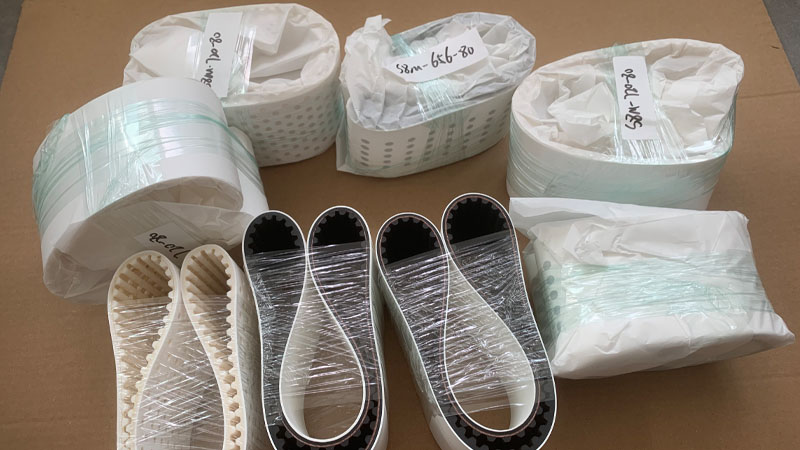
A silicone timing belt is usually a polyurethane or rubber synchronous belt with a silicone cover bonded to its conveying side. The toothed base belt provides positive, slip-free indexing, while the silicone surface adds grip, release behavior, heat resistance, cushioning, or food-contact capability for selected applications.
The phrase does not normally mean that the complete load-bearing belt is made from silicone. Steel, aramid, fiberglass, or polyester tensile cords carry tension inside the base belt. The silicone layer interacts with film, packages, food, labels, glass, or other conveyed products.
In 2026, successful selection requires two separate checks. First, size the timing belt for pitch, width, tensile load, speed, pulley teeth, and duty cycle. Second, specify the silicone hardness, thickness, texture, machining, temperature, adhesion, and compliance. A strong cover cannot correct an under-sized base belt.
Key Takeaways
- Most silicone timing belts use a PU or rubber synchronous base with a silicone cover.
- Silicone adds grip, cushioning, release, and useful temperature resistance.
- Cover thickness increases the required minimum pulley diameter.
- Continuous and peak temperatures are different ratings.
- Food-contact suitability must be verified for the complete construction and intended use.
What Is a Silicone Timing Belt?
In 2026, Habasit lists silicone timing-belt covers from 1 to 3 mm thick in 40, 50, and 60 Shore A options. Fenner describes silicone-coated PU timing belts as combining positive drive and wear resistance with a high coefficient of friction for accurate media feeding (Habasit, HabaSYNC Silicone Timing Belt Covers Product Data Sheet, 2024).
The base belt contains the teeth, tensile member, and structural body. Its job is to mesh with a matching pulley and hold pitch under load. The silicone cover sits on the belt’s back, which becomes the conveying or gripping surface.
This division of labor explains why the product is useful. A bare timing belt already provides synchronized movement. Adding silicone lets it grip slippery packaging film, compress gently against a product, tolerate selected hot surfaces, or release sticky material more effectively than the base polyurethane or rubber.
Some suppliers mold the silicone seamlessly around the belt. Others bond a sheet or cast coating to the back. VFFS belts may also be ground, grooved, perforated, or machined for vacuum pulling. Construction method affects adhesion, thickness tolerance, pulley bending, and service life.
How Is a Silicone-Coated Timing Belt Constructed?
Bervina describes VFFS timing belts as three layers: an endless toothed base belt, adhesive, and a seamless cover. Its standard coating example is 6 mm thick and 35 to 45 Shore A, showing that packaging belts can use much thicker, softer covers than Habasit’s general 1 to 3 mm HabaSYNC range (Bervina, VFFS Timing Belts).
| Belt Layer | Typical Materials | Function |
|---|---|---|
| Silicone cover | Molded or bonded silicone in selected hardness and color | Grip, release, cushioning, heat and moisture behavior |
| Bonding layer | Product-specific adhesive or molded interface | Keeps cover attached under flexing, heat, and load |
| Belt body | Thermoplastic PU, thermoset PU, neoprene, or other elastomer | Supports teeth and protects tensile cords |
| Tensile member | Steel, aramid, fiberglass, or polyester | Controls elongation and carries belt tension |
| Tooth-side facing | Bare body material or wear-reducing fabric | Controls pulley friction, noise, and tooth wear |
Thermoplastic polyurethane base belts are common because they offer precise tooth geometry, abrasion resistance, and fabrication options. Truly endless molded polyurethane or rubber belts can avoid a joined tensile member. Open-ended belts may be joined for conveying, but their allowable tensile load can differ from a truly endless product.
The bond between silicone and the base belt is a critical design element. Repeated bending creates peel and shear stress at the interface. Heat, oil, moisture, cleaning chemicals, small pulleys, and thick covers increase the risk of delamination.
Specify whether the cover is molded, cast, sheet-laminated, or mechanically patterned. Ask how the supplier prepares the base surface and controls adhesion. For critical equipment, request peel-strength criteria or a sample belt for endurance testing.
How Does a Silicone Timing Belt Work?
A timing belt transmits motion through tooth engagement rather than friction. The silicone-covered back then transfers force to the product through surface friction or controlled compression. These two interfaces let the belt synchronize machine motion while gripping media independently of the tooth drive.
This is useful in a vertical form-fill-seal machine. Opposing belts grip packaging film and pull it by a precise distance. The pulley teeth control belt position. Silicone friction limits film slip. Vacuum holes or slots can add holding force when friction alone is insufficient.
The silicone layer compresses as it passes between a product and pulley or between paired belts. Softer silicone creates more contact area and cushioning but can deform, generate heat, or wear faster. Harder silicone holds geometry better but may provide less conformity on uneven products.
Cover thickness affects bending. The outside layer travels through a larger bending radius than the tensile member. A thicker cover experiences more strain on a small pulley. That is why coating data sheets include a thickness factor or minimum-diameter rule.
What Are the Main Benefits?
Habasit’s general silicone-cover data lists a continuous operating range from -30°C to 150°C. Megadyne’s Megapower Silcoat lists a peak surface temperature from -40°C to 220°C. The difference demonstrates why every temperature claim must identify the product, duration, and whether the value is continuous or peak (Megadyne, Megapower Silcoat VFFS Belt).
High grip with synchronized motion
Silicone commonly provides a higher coefficient of friction than bare polyurethane. The teeth prevent normal belt slip on the pulley, while the cover improves product grip. This combination supports accurate feeding of films, labels, bags, cartons, and sheets.
Cushioning and product protection
Soft silicone can conform to irregular surfaces and distribute pressure. It can reduce marking on fragile packages, glass, coated products, or food. The appropriate hardness depends on compression, speed, load, and desired positioning accuracy.
Heat resistance
Selected silicone covers tolerate temperatures beyond many standard polyurethane covers. This helps near sealing jaws, hot films, bakery processes, laminating, and thermal equipment. The complete belt remains limited by its base body, tensile cords, bond, splice, and flexing conditions.
Release behavior
Silicone can release sticky, tacky, or adhesive products better than some rubber covers. Release is formulation- and surface-dependent. A smooth silicone finish may behave differently from a sanded or patterned finish.
Moisture and chemical resilience
Megadyne describes Silcoat as resilient in wet and humid production environments. However, compatibility with oils, solvents, cleaners, plasticizers, and process chemicals must be confirmed for the exact compound and bonding system.
Fabrication flexibility
Silicone-covered timing belts can be ground to thickness, grooved, slotted, perforated, or machined for vacuum. These features make one base belt adaptable to specialized handling tasks.
Where Are Silicone Timing Belts Used?
VFFS belts often use a 6 mm silicone cover, according to Bervina’s packaging range. That thickness provides enough material for grooves, vacuum holes, and controlled compression. General conveying or indexing belts may use thinner 1 to 3 mm covers where pulley diameter, speed, or positioning stiffness matters more.
Common applications include:
- Vertical form-fill-seal film pulling
- Horizontal packaging and bag handling
- Labeling and printing feeds
- Paper, foil, and plastic-film transport
- Food and pharmaceutical conveying with documented materials
- Bakery, confectionery, and sticky-product release
- Glass, ceramic, and fragile-product transfer
- Electronics and solar-panel production
- Medical-product and clean manufacturing equipment
- Paired-belt feeders and vacuum-assisted transport
In packaging, the belt may run as a matched pair. Both belts need equal pitch length, thickness, machining, hardness, and effective circumference. A small difference in coating thickness can make one belt travel faster at the product surface, causing skew or film tracking problems.
In vacuum applications, holes in the silicone must align with channels or ports in the base belt and pulley system. Hole edges must resist tearing. Dust, product debris, and adhesive residue can block vacuum paths, so cleanability should be designed into the groove pattern.
For direct food contact, the belt must also fit the food, time, and temperature conditions. The guide to food-safe conveyor belt selection explains why a compliant material declaration does not automatically make the complete conveyor hygienic.
Silicone Timing Belt vs Standard PU Timing Belt
A bare PU timing belt is usually thinner, easier to bend, and more dimensionally direct at the conveying surface. A silicone-covered belt adds grip, compliance, and temperature capability but increases diameter, bending stress, cost, and fabrication complexity.
| Selection Factor | Silicone-Coated Timing Belt | Standard PU Timing Belt |
|---|---|---|
| Product grip | High in suitable silicone formulation | Moderate and surface-dependent |
| Positive pulley drive | Yes | Yes |
| Cushioning | Adjustable through hardness and thickness | Limited |
| Release | Often useful for tacky products | Product-dependent |
| Temperature | Cover may tolerate higher values | Limited by PU formulation |
| Minimum pulley diameter | Larger as cover thickness increases | Usually smaller for same base profile |
| Fabrication | Grooves, vacuum holes, grinding, patterns | Cleats, holes, machining, fabric facing |
| Thickness tolerance | Cover and grinding process add variables | Simpler section control |
| Delamination risk | Bonded interface must be controlled | No separate cover interface |
| Cost | Higher | Lower |
Choose bare PU when the product already feeds reliably and the machine needs the smallest pulleys or highest positioning stiffness. Choose silicone when documented tests show that grip, release, heat, or cushioning solves a real process problem.
Do not use a high-friction cover to compensate for poor tension, misalignment, worn pulleys, or incorrect acceleration. Excess grip can increase product stress, tooth load, heat, and tracking sensitivity.
How Do You Select the Tooth Profile, Pitch, Width, and Length?
The silicone cover does not change the pulley tooth pitch. The base belt and pulley must still share the same tooth profile. Common families include T, AT, HTD, RPP, STD, XL, L, and H, but names alone are insufficient because dimensions and tooth forms differ.
Start with:
- Required pitch and pulley profile
- Truly endless, welded endless, or open-ended construction
- Pitch length and number of teeth
- Belt width
- Driver and driven pulley tooth counts
- Transmitted torque and effective pull
- Speed and acceleration
- Start-stop frequency and reversing duty
- Arc of contact and engaged teeth
- Shaft alignment and available tensioning
For motion-control duties, calculate tooth shear, tensile-cord load, fatigue, and permissible pretension. Packaging feed belts may carry modest torque but experience high cycling and repeated compression. A cover can increase rotational inertia and flexing heat.
Select width from the corrected design load, not the available mounting space alone. Wider belts can distribute force and provide more product-contact area, but they demand better pulley alignment. Very wide matched belts may require tight lateral thickness tolerances to avoid uneven tracking.
When replacing an existing VFFS belt, record the machine manufacturer, model, OEM part number, belt profile, teeth, width, base thickness, total thickness, silicone color, hardness, grooves, hole pattern, and running direction. A photograph cannot capture all these dimensions.
How Do You Choose Silicone Thickness and Hardness?
Habasit offers 1, 2, and 3 mm silicone covers in several 40, 50, and 60 Shore A variants. Bervina’s VFFS example uses a 6 mm cover at 35 to 45 Shore A. These ranges show that thickness and hardness must be chosen together for the application.
Thin covers
One to two millimeters can add grip while preserving a relatively small pulley requirement and firm positioning. Thin covers suit light media, labeling, paper, and compact drives where cushioning is secondary.
Medium covers
Three millimeters provides more compliance, allows shallow grooves, and can absorb product variation. It also increases minimum pulley diameter and interface stress.
Thick covers
Around six millimeters is common in specialized VFFS pull belts because the cover can be ground, grooved, and perforated. Thick soft silicone improves film contact but requires larger pulleys and careful matched-pair control.
Soft silicone
Approximately 35 to 40 Shore A silicone conforms well and creates broad contact. It may compress, heat, and wear more under high load. Soft covers can also change effective circumference more with tension and product pressure.
Hard silicone
Around 50 to 60 Shore A holds its shape better and may support accurate feeding under pressure. It offers less cushioning and may not grip irregular products as effectively.
Request a sample or prototype when coefficient of friction is critical. Test with the real film, dust, humidity, temperature, pressure, speed, and cleaning residue. Static friction, dynamic friction, release, and wear can change over time.
How Does Cover Thickness Affect Pulley Diameter?
Habasit’s silicone data uses a thickness factor of 25 for 40 Shore A covers and 30 for 50 or 60 Shore A covers. Its guidance calculates the cover’s recommended minimum pulley diameter by multiplying cover thickness by that factor, then using the larger requirement from either the cover or base belt.
Examples from that method:
| Silicone Cover | Thickness Factor | Cover-Based Minimum Diameter |
|---|---|---|
| 1 mm, 40 Shore A | 25 | 25 mm |
| 2 mm, 40 Shore A | 25 | 50 mm |
| 3 mm, 40 Shore A | 25 | 75 mm |
| 1 mm, 50 or 60 Shore A | 30 | 30 mm |
| 2 mm, 50 or 60 Shore A | 30 | 60 mm |
| 3 mm, 50 or 60 Shore A | 30 | 90 mm |
These are cover-based values for the cited Habasit products, not universal pulley limits. The base timing belt may require a larger pulley. Profiles, cleats, grooves, hole patterns, reverse bending, idlers, speed, and temperature can increase the requirement further.
Small pulleys force the outer silicone layer to stretch and the bond line to cycle sharply. This promotes cracking, edge lifting, heat, and delamination. Backside idlers create reverse bending and should be included in the supplier’s review.
For paired VFFS belts, confirm pulley tooth count as well as pitch diameter. The cover’s outside running radius affects surface speed, compression, and film pull. Both belts need matched total thickness after grinding.
What Fabrication Options Are Available?
Bervina lists belt lengths from 330 to 980 mm for its coated VFFS range and offers tooth removal, grinding, grooves, slots, vacuum holes, and custom shapes. Those features solve specific machine functions but also create stress concentrations and cleaning requirements.
Grinding
Precision grinding controls total thickness, flatness, and matched-pair circumference. Specify tolerance, surface roughness, and whether thickness is measured under compression.
Longitudinal or transverse grooves
Grooves increase compliance, channel air, or improve vacuum distribution. Their depth, pitch, and corner radius affect tearing and cleanability.
Vacuum holes and slots
Perforations let the belt pull packaging film or porous products against its surface. Hole position must match pulley or vacuum-box geometry. Reinforcement should not be damaged during drilling.
Tooth removal and pockets
Removing selected teeth can clear machine components or synchronize fixtures. It reduces local tooth engagement, so load capacity must be reviewed.
Tooth-side fabric
A polyamide fabric facing can reduce friction, noise, and tooth wear. It changes tooth thickness and pulley behavior, so it should be included in the part specification.
Cleats and profiles
Profiles can locate products, but their bond must withstand cyclic bending. They may also require larger pulleys and create hygiene zones. For precise indexing, specify profile position relative to a defined timing tooth.
What Temperature Rating Should You Use?
Habasit’s silicone cover is rated from -30°C to 150°C for continuous operation. Megadyne states that Silcoat’s blue silicone cover can withstand -40°C to 220°C as a peak surface temperature. These ratings describe different products and duty definitions, so they cannot be substituted for each other.
The complete belt rating is the lowest acceptable limit among:
- Silicone cover
- Adhesive or molded interface
- PU or rubber base body
- Tensile cord
- Tooth-side fabric
- Splice or endless construction
- Cleats and machined features
- Continuous flexing temperature
- Ambient and product temperature
A hot product can touch the cover briefly while the belt body remains cooler. That may justify a peak surface rating. Continuous operation near a heater can raise the entire belt, pulley, and tensile member temperature, requiring a lower limit.
Measure temperature at the belt surface and body during realistic production. Include startup, stalled product, cleaning, sealing-jaw proximity, and shutdown heat soak. Do not use oven-air temperature alone.
High temperature can soften the base belt, weaken the bond, change silicone friction, and increase tensile-cord fatigue. Ask the manufacturer for a written duty recommendation when operation approaches any published limit.
Is a Silicone Timing Belt Food Safe?
Habasit’s 2025 Declaration of Compliance for its black HabaSYNC silicone cover permits direct contact with dry, aqueous, alcoholic, and acidic foods for up to 60 minutes at temperatures up to 121°C, but excludes fatty and oily foods. This example proves that “silicone” does not mean universal food-contact suitability (Habasit, HabaSYNC Silicone Black Declaration of Compliance, 2025).
Check the complete construction:
- Silicone color and compound
- Base belt material
- Adhesive or bonding system
- Tensile member exposure risk
- Tooth fabric
- Machined holes and grooves
- Cleats, profiles, and repair materials
- Food type, time, and temperature
- Cleaning chemicals and sanitation temperature
- Intended U.S., EU, and other markets
Habasit’s product sheet marks selected black, transparent, and blue silicone variants as having food-grade declarations, while its light-gray 50 Shore A examples do not carry the same mark. Product code matters.
For EU use, ask for a current Declaration of Compliance and supporting intended-use details. For U.S. use, request the exact FDA regulatory basis and conditions. Do not accept a generic supplier statement covering silicone raw material when the finished belt includes adhesive and a separate base belt.
Food compliance also does not guarantee cleanability. Grooves, vacuum holes, edges, exposed cords, adhesive lines, and pulley interfaces can trap soil. Review the complete conveyor under the plant’s HACCP and sanitation program.
Common Selection Mistakes
Habasit’s own 3 mm silicone examples produce cover-based minimum pulley diameters from 75 to 90 mm, depending on hardness. Ignoring the coating can therefore turn an acceptable base-belt pulley into an aggressive flexing condition.
Avoid these mistakes:
- Treating the entire belt as solid silicone
- Using cover temperature as the complete belt rating
- Confusing peak surface temperature with continuous duty
- Choosing silicone by color instead of product code
- Ignoring minimum pulley diameter after coating
- Selecting hardness without compression and friction testing
- Ordering total thickness without a tolerance
- Failing to match paired VFFS belts after grinding
- Drilling vacuum holes through tensile cords
- Adding grooves with sharp corners that initiate tears
- Assuming every silicone compound is food-contact compliant
- Ignoring fatty-food exclusions in a declaration
- Using high grip to mask poor tracking or worn pulleys
- Forgetting backside idlers and reverse bending
- Replacing an OEM belt from photographs alone
Another mistake is specifying maximum grip. Excess friction can stretch film, wrinkle labels, overload teeth, increase heat, or prevent clean product release. The goal is controlled traction at the lowest pressure that maintains accurate feeding.
Buyer’s Specification Checklist
In 2026, a complete silicone timing-belt specification needs at least four dimensional groups: base timing geometry, silicone cover, fabrication pattern, and machine duty. Missing one group can produce a belt that fits the pulley but fails to feed the product.
- Record machine manufacturer, model, and OEM part number.
- Identify tooth profile, pitch, length, tooth count, and width.
- Specify truly endless, joined endless, or open-ended construction.
- Provide pulley tooth counts and minimum diameters.
- State torque, effective pull, speed, acceleration, and cycle rate.
- Select silicone color, compound, hardness, and thickness.
- Define total-thickness and matched-pair tolerances.
- Provide groove, hole, slot, tooth-removal, and profile drawings.
- State product material, temperature, humidity, dust, oil, and chemicals.
- Separate continuous, peak, and cleaning temperatures.
- Define food-contact markets and intended food conditions.
- Request compliance, adhesion, tolerance, and inspection documents.
- Test prototype grip, release, tracking, heat, and wear.
- Approve a golden sample before production quantities.
Measure the worn belt carefully, but do not reproduce wear as a design dimension. When possible, obtain the original drawing or inspect an unused spare. Total thickness should be measured at several positions because an old silicone surface may be polished, compressed, or unevenly ground.
Frequently Asked Questions
Is a silicone timing belt made entirely from silicone?
Usually not. Most products use a polyurethane or rubber toothed base with tensile cords and a silicone back cover. The base provides synchronized drive and load capacity. The silicone controls product grip, cushioning, release, and surface temperature behavior.
What is the temperature limit of a silicone timing belt?
It depends on the complete product. Habasit lists -30°C to 150°C continuous for its cited silicone cover. Megadyne Silcoat lists -40°C to 220°C peak surface temperature. The base belt, bond, cords, splice, and duty cycle may impose lower limits.
What silicone hardness is best?
Soft 35 to 40 Shore A covers provide conformity and cushioning. Harder 50 to 60 Shore A covers retain geometry and resist compression better. The best value depends on film, pressure, speed, temperature, texture, and positioning accuracy. Prototype testing is recommended.
Can silicone timing belts contact food directly?
Only when the exact product code and complete construction are documented for the intended food, contact time, temperature, and market. Some Habasit silicone covers have food declarations with specific limitations; one black-cover declaration excludes fatty and oily foods.
Why does a silicone cover require a larger pulley?
The cover sits outside the tensile member and stretches more during bending. Thicker or harder silicone increases flex stress and interface strain. Habasit’s method multiplies cover thickness by a factor of 25 or 30, then uses the larger requirement from the cover or base belt.
Final Selection Advice
A silicone timing belt is the right choice when synchronized feeding also needs controlled grip, release, cushioning, heat tolerance, or a specialized vacuum surface. It is not simply a standard timing belt with a generic rubber layer.
Size the base belt first. Then select silicone thickness, hardness, color, texture, fabrication, temperature, pulley diameter, and compliance as one integrated system. Treat peak and continuous temperatures separately, and test the real product under production pressure, speed, humidity, and cleaning conditions.
TranBelt can review your machine drawing, tooth profile, pulley geometry, product, temperature, and machining pattern to specify a suitable silicone-coated timing belt. For related synchronous-belt fundamentals, see the RPP timing belt guide and the overview of mechanical power-transmission belt types.
Sources
- Habasit, HabaSYNC Silicone Timing Belt Covers Product Data Sheet, 2024, retrieved 2026-07-13.
- Habasit, HabaSYNC Silicone Black Declaration of Compliance, 2025, retrieved 2026-07-13.
- Fenner, Polyurethane Timing Belts and Silicone Coatings, retrieved 2026-07-13.
- Megadyne, Megapower Silcoat VFFS Belt, retrieved 2026-07-13.
- Megadyne, Megapower FC Food-Contact Polyurethane Timing Belts, retrieved 2026-07-13.
- Bervina, VFFS Timing Belts, retrieved 2026-07-13.