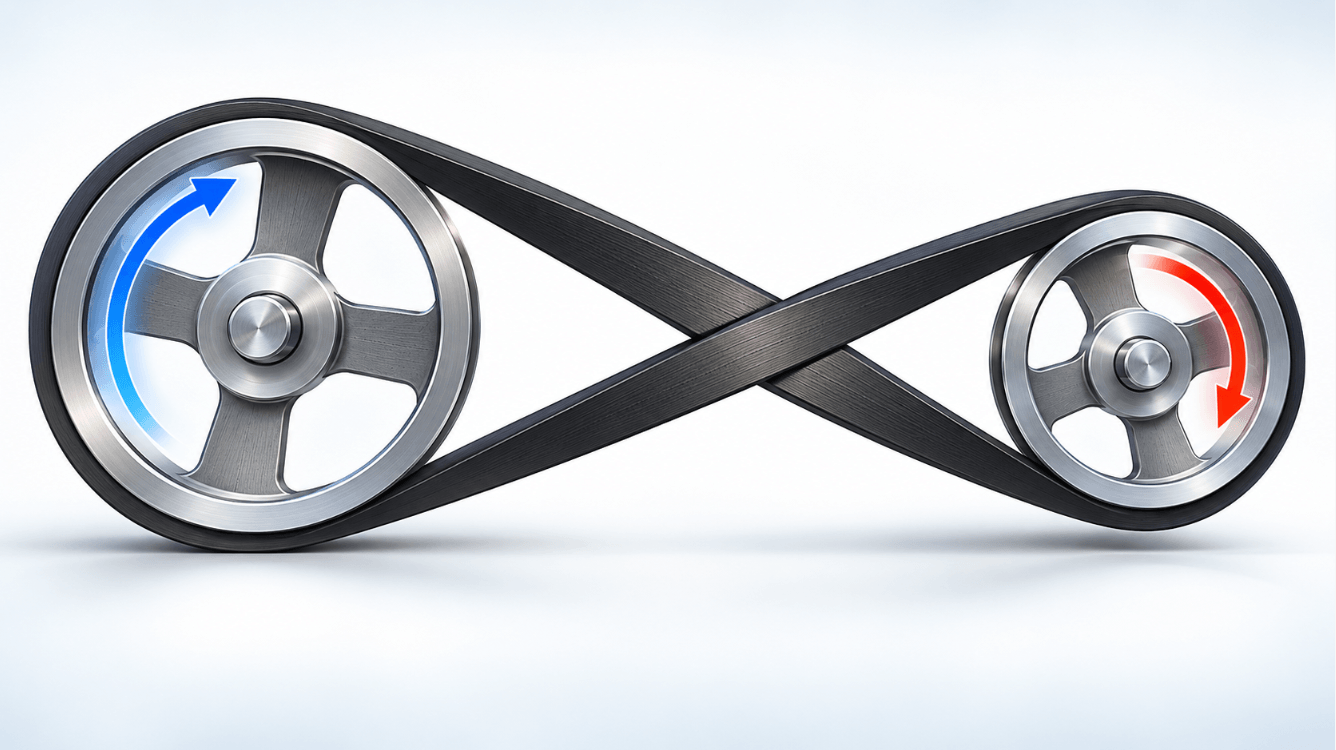
Yes. In a standard two-pulley crossed belt drive with parallel shafts, the driven pulley rotates in the opposite direction to the driving pulley. If the same belt is arranged as an open drive, both pulleys rotate in the same direction.
Crossing the belt changes the side of the driven pulley that the moving span approaches. That reverses the tangential force applied at the driven pulley. It does not, by itself, change the theoretical speed ratio, which still depends primarily on the effective pulley diameters when slip is neglected.
Key Takeaways
- An open belt drive makes parallel pulleys rotate in the same direction.
- A crossed belt drive makes parallel pulleys rotate in opposite directions.
- Crossed drives usually provide more wrap but also add belt twist and crossover wear.
- Flat belts are generally better suited to crossed layouts than conventional V-belts.
- A jockey pulley can increase wrap, but it cannot correct the wrong belt, poor alignment, worn pulleys, or insufficient design capacity.
1. The Core Rule: Open Belt Same Direction, Crossed Belt Opposite Direction
The direction rule is straightforward for two pulleys on parallel shafts. In an open drive, the belt’s upper and lower spans remain uncrossed. The surface velocity imposed by the belt makes the driven pulley turn in the same direction as the driver. In a crossed drive, one span travels from the top of one pulley toward the bottom of the other. The driven pulley therefore turns in the opposite direction.
| Belt Arrangement | Driving Pulley | Driven Pulley |
|---|---|---|
| Open belt drive | Clockwise | Clockwise |
| Crossed belt drive | Clockwise | Counterclockwise |
| Open belt drive | Counterclockwise | Counterclockwise |
| Crossed belt drive | Counterclockwise | Clockwise |
This rule assumes a conventional two-pulley arrangement with parallel shafts and the belt following the intended path. Additional idlers, compound shafts, reversing pulleys, or quarter-turn layouts can change the motion relationship. Always trace the actual belt path when more than two pulleys are involved.
MathWorks’ Belt Drive model describes the same kinematic result: open-belt pulleys tend to rotate in the same direction, while crossed-belt pulleys tend to rotate in opposite directions (MathWorks, Belt Drive). TranBelt’s guide to common belt-drive arrangements also distinguishes open and crossed layouts from the belt cross-section used in the drive.
A crossed arrangement does not automatically change the ideal speed ratio. If a small driver turns a larger driven pulley, the driven pulley still turns more slowly. The crossing reverses its direction. Pulley pitch diameters and belt slip determine the actual speed relationship.
2. Why Does the Driven Pulley Rotate in the Opposite Direction?
The driven pulley reverses because the belt approaches and leaves it on opposite sides compared with an open drive. Follow one moving point on the belt. In an open arrangement, the upper span contacts the upper side of both pulleys, so their surface velocities correspond to the same rotational sense. After the belt is crossed, that moving span reaches the opposite side of the driven pulley. The tangential force at the contact surface therefore produces rotation in the opposite sense.
NPTEL’s IIT Kharagpur belt-drive module identifies open drives as same-direction systems and crossed drives as opposite-direction systems (NPTEL, Module 13: Belt Drives). The same source shows that crossed geometry increases the wrap angle around both pulleys. That extra wrap can improve frictional grip, but the direction reversal comes from the crossed path itself, not from higher tension, pulley size, or a separate reversing mechanism.
3. Can You Use V-Belts in a Crossed Drive? Friction and Wear
A conventional V-belt can be used in some engineered crossed or twist drives, but it is usually not the first choice. A V-belt transmits load through contact between its angled sidewalls and the sheave grooves. Crossing the span twists the belt between pulleys, making clean entry into both grooves more difficult and adding lateral bending that a flat belt handles more naturally.
The crossover also creates a risk that the two moving spans will touch. Belt-to-belt rubbing produces heat, abrasion, dust, and rapid wear. Even when the spans do not touch, the belt changes orientation between the pulleys. Short center distances create a steeper twist and increase the entry angle. High speed magnifies heat and tracking problems.
Conventional V-belts have high transverse stiffness and are not automatically suitable for crossed or twisted paths. Use only a belt and geometry explicitly approved by the manufacturer.
Do not assume that all ribbed or V-shaped products behave alike. Some manufacturers publish crossed-drive limits for specific multi-rib products, but that approval cannot be transferred to an ordinary wrapped V-belt, raw-edge V-belt, or timing belt. Use the design data for the exact belt family.
For a new design, prefer an open V-belt drive plus a separate reversing stage when space and cost allow. If a crossed V-belt path is unavoidable, ask the belt manufacturer to validate the belt profile, center distance, pulley diameter, speed, entry angle, allowable twist, tension, and expected life. Use guards so a failed or derailed belt cannot reach personnel.
4. How to Prevent Belt Slip: Do You Need a Jockey Pulley?
A jockey pulley, also called an idler or snub pulley, can reduce slip when it increases wrap on the limiting pulley or controls the slack span. It should be added only after confirming that belt selection, pulley condition, alignment, and basic tension are correct. An idler introduces another bearing, another bending cycle, and another alignment requirement.
Step 1: Check the Initial Belt Tension
Insufficient initial tension reduces the available friction between the belt and pulley. Under load, the tight-side tension rises while the slack side loses tension. If the difference exceeds the grip available over the contact arc, the belt slips, heats, polishes the pulley surface, and wears faster.
Use the belt manufacturer’s tension method rather than judging by feel. Gates notes that many problems described as belt stretch, instability, vibration, or short life can be traced to drive layout and weak idler bracketry (Gates, Heavy Duty V-Belt Drive Design Manual, 2020). Excessive tension is also harmful because it raises shaft and bearing loads without correcting poor wrap or contamination.
Step 2: Increase the Pulley Wrap Angle
More wrap gives the belt a longer contact path over which friction can transmit force. The smaller pulley is usually the limiting member in an open drive because it often has the lower arc of contact. Moving the shafts farther apart can improve the geometry in some layouts. A correctly positioned snub pulley can increase wrap where the machine footprint prevents that change.
Penn State’s Mechanics Map explains that the maximum tension relationship before slip depends on initial tension, coefficient of friction, and contact angle (Penn State, Belt Friction). More wrap helps, but it cannot compensate indefinitely for an undersized belt or a pulley surface contaminated with oil.
Step 3: Use a Jockey Pulley When Necessary
Use a jockey pulley when the drive needs more wrap, controlled take-up, reduced span vibration, or a defined belt path. It is commonly placed against the slack span so it does not carry the highest belt load. The exact inside or backside position depends on belt construction and manufacturer guidance.
The idler must have an adequate diameter and compatible surface. A small idler sharply bends the belt and increases internal stress. Gates applies an idler correction factor because additional bending reduces the usable power rating. The bracket must also resist deflection; otherwise, the idler can move under load and create the instability it was intended to solve.
A jockey pulley is not mandatory when the original two-pulley geometry already provides enough wrap and an approved tensioning method. Adding one without calculation can shorten belt life.
Step 4: Check Pulley Alignment and Surface Condition
Parallel shafts and correctly aligned pulley grooves help the belt enter and leave without side loading. Check angular and offset misalignment with suitable alignment tools. In a crossed drive, the intentional twist still needs enough center distance and span separation to prevent rubbing.
Inspect the pulleys for worn grooves, rough edges, corrosion, embedded debris, and polishing caused by slip. Keep friction belts free from oil and grease. Replace damaged pulleys rather than increasing tension to force a worn drive to grip. Confirm that belt section and pulley groove standard match, and replace multiple belts as a compatible set.
5. Open vs. Crossed Belt Drive: A Quick Comparison
| Factor | Open Belt Drive | Crossed Belt Drive |
|---|---|---|
| Driven-pulley direction | Same as driver | Opposite to driver |
| Belt arrangement | Spans remain uncrossed | Spans cross between pulleys |
| Typical shaft relationship | Parallel | Parallel |
| Wrap angle | Often lower on the smaller pulley | Usually greater and equal on both pulleys |
| Grip potential | Depends on wrap, tension, and friction | Extra wrap can increase grip |
| Belt rubbing risk | Low in a correct layout | Higher if crossover spans touch |
| Belt twist | Minimal | Required between pulleys |
| Wear and heat | Usually lower | Usually higher |
| Belt suitability | Flat belts and V-belts | Flat belts preferred; V-belts require validation |
| Typical purpose | Same-direction rotation | Opposite-direction rotation |
Choose an open belt drive when the shafts must rotate in the same direction and standard belt life, easy alignment, and straightforward maintenance are priorities. It is the normal arrangement for most two-pulley V-belt drives.
Choose a crossed belt drive when opposite shaft rotation is required and the belt, spacing, speed, and guarding can support the layout. The increased wrap can improve grip, but the crossover adds twist and potential wear. A reversing gearbox, idler-based reversing path, or multi-stage drive may be better for high-speed, compact, or long-life machinery.
The correct decision therefore involves more than rotation direction. Verify power, speed ratio, pulley diameters, center distance, contact angle, belt speed, tension, bearing load, environment, and maintenance access. If you need help matching a drive arrangement to the correct belt, TranBelt supplies industrial transmission belts and can review the available application data.
The final answer is simple: a crossed belt reverses the driven pulley in a standard two-pulley parallel-shaft drive. Use that arrangement only when the selected belt and geometry are designed to tolerate the additional twist and wear.
Sources
- NPTEL, Module 13: Belt Drives, retrieved 2026-09-22.
- MathWorks, Belt Drive, retrieved 2026-09-22.
- Penn State, Belt Friction, retrieved 2026-09-22.
- Gates, Heavy Duty V-Belt Drive Design Manual, published 2020, retrieved 2026-09-22.