1. Key Takeaways
- RPP timing belts use a clever M-shaped tooth with a notch that cuts noise way down and bends tighter than older designs compared to HTD and STD profiles.
- You cannot swap RPP belts onto HTD or STD pulleys — each profile requires its own pulley geometry.
- Common sizes include RPP2M, RPP3M, RPP5M, RPP8M, and RPP14M, covering pitches from 2 mm to 14 mm.
- Best for high-speed, high-precision work — servo drives, CNC machines, robotics, that kind of thing.
- The parabolic tooth design reduces contact surface between belt and pulley, improving stress distribution and enabling tighter bend radii.
2. What Is an RPP Timing Belt?
An RPP timing belt (short for Reinforced Polyurethane Parabolic or just Parabolic Profile) is a synchronous drive belt with a curved M-shaped tooth and a small notch at the tip. Think of it as the third generation of curvilinear timing belt tech — it came after HTD (High Torque Drive) and STD (Super Torque Drive) profiles, and it improves on both.
Unlike traditional trapezoidal-toothed belts, RPP belts mesh with pulley grooves through smooth rolling action rather than wedging, which reduces noise and stress concentration. The notch at the top of each tooth allows the belt to flex more easily around smaller pulleys while maintaining tooth engagement.
RPP timing belts are typically manufactured from chloroprene rubber (for general industrial use) or polyurethane (for oil-resistant or washdown environments), reinforced with fiberglass or steel tension members, and often feature a nylon fabric tooth facing (such as PAZ/NFT green cloth) for reduced friction and wear.
3. RPP Timing Belt Tooth Profile Design
The defining feature of an RPP timing belt is its parabolic tooth shape, often described as an “M” profile with a notch. This design is a major engineering refinement over earlier curvilinear profiles.
How the RPP Tooth Profile Works
The parabolic curve spreads stress evenly across the tooth base when the belt engages, which means less risk of the tooth shearing off under high torque. The notch at the top of each tooth does two useful things:
1. Cuts down the contact surface between the tooth and pulley groove — less friction, less noise
2. Lets the belt bend easier, so you can wrap it around smaller pulleys without stressing it out
The end result? A tooth profile that keeps the load capacity of curvilinear designs but adds the flexibility and quiet operation you need at high speeds.
Tooth Geometry Comparison
| value | RPP5M | RPP8M | RPP14M |
|---|---|---|---|
| Pitch (mm) | 5 | 8 | 14 |
| Tooth Height (mm) | 1.95 | 3.2 | 6 |
| Belt Thickness (mm) | 3.5 | 5.5 | 10 |
| Common Widths (mm) | 9, 15, 25 | 20, 30, 50 | 40, 60, 80 |
4. RPP vs HTD vs STD: What’s the Difference?
So which one should you pick — HTD, STD, or RPP? Here’s how they stack up:
Tooth Profile Comparison
| Feature | HTD (Full Arc) | STD (Semi-Arc) | RPP (Parabolic with Notch) |
|---|---|---|---|
| Tooth Shape | Full circular arc | Flat-top semi-arc | M-shaped with notch |
| Stress Distribution | Good | Better | Best |
| Noise Level | Moderate | Low | Extremely Low |
| Flexibility | Standard | Improved | Highest |
| Turning Radius | Standard | Smaller | Smallest |
| Pulley Compatibility | HTD pulley only | STD pulley only | RPP pulley only |
Performance and Application
| Aspect | HTD | STD | RPP |
|---|---|---|---|
| Transmission Efficiency | High | Extreme High | High |
| Torque Capacity | High | Very High | High |
| Speed Suitability | Medium-High | Medium | High |
| Precision | Standard | High | Highest |
| Typical Applications | General industrial machinery | Medical instruments, CNC | Servo motors, precision robots, high-speed printers |
Key Takeaway on Compatibility
RPP belts can’t be used with HTD or STD pulleys. Despite all three being curvilinear profiles, the tooth geometries are fundamentally different. Mixing profiles causes accelerated wear, noise, and premature failure. Always match the belt profile to its corresponding pulley.
5. RPP Timing Belt Specifications and Sizing
Standard Size Range
RPP timing belts are available in five standard pitch sizes:
| Type | Pitch (mm) | Typical Power Range | Max Speed |
|---|---|---|---|
| RPP2M | 2 | Low power, miniature drives | Up to 50 m/s |
| RPP3M | 3 | Light-duty precision | Up to 45 m/s |
| RPP5M | 5 | Medium power (up to ~12 kW) | Up to 45 m/s |
| RPP8M | 8 | High power | Up to 40 m/s |
| RPP14M | 14 | Very high power | Up to 35 m/s |
How to Read an RPP Belt Part Number
RPP belt part numbers follow a standard convention:
Example: 600-RPP8M-20
- 600: Belt length in mm (pitch length)
- RPP8M: Profile (RPP) and pitch (8 mm)
- 20: Belt width in mm
Other examples:
- RPP5M-09: RPP profile, 5 mm pitch, 9 mm width (belt length specified separately)
- 1000-RPP14M-40: 1000 mm length, RPP14M profile, 40 mm width
6. Applications: Where RPP Timing Belts Excel
RPP timing belts are the preferred choice in applications that demand low noise, high precision, and high speed.
Precision Automation
- Servo motor drives — The parabolic tooth profile minimizes cogging and position error in closed-loop systems
- CNC machine tools — High positioning accuracy for axis and spindle drives
- Industrial robots — Smooth, backlash-free motion for joint actuation and end-effector positioning
Low-Noise Environments
- Automatic doors and windows — Quiet operation is critical in commercial and residential settings
- Elevator hoists — Reduced mechanical noise improves passenger comfort
- Stage curtain systems — Silent movement during performances
- High-end printers and copiers — Precision paper handling with minimal acoustic footprint
Precision Conveying
- Medical instruments — Clean, accurate positioning for diagnostic and laboratory equipment
- Packaging machinery — High-speed indexing with registration accuracy
- Textile equipment — Smooth, vibration-free power transmission
7. How to Select the Right RPP Timing Belt
Here’s how to pick the right RPP belt for your setup:
1) Determine Power Requirements
Calculate the design power by multiplying the motor power by a service factor (typically 1.5–2.0 for industrial applications). This ensures the belt can handle peak loads and starting torque.
2) Choose the Pitch
- RPP2M / RPP3M: Light loads, miniature drives, precision instruments
- RPP5M: General-purpose, moderate loads up to approximately 12 kW
- RPP8M: Heavy loads, higher torque applications
- RPP14M: Very high torque, large industrial drives
3) Select Belt Width
Wider belts distribute load across more tooth surface. Standard widths vary by pitch — for example, RPP5M is available in 9 mm, 15 mm, and 25 mm widths.
4. Verify Pulley Compatibility
Ensure the pulleys are specifically designed for the RPP profile. Using RPP belts on HTD or STD pulleys will cause rapid wear and potential drive failure.
5) Consider Environmental Factors
- Oil or chemical exposure: Choose polyurethane RPP belts over rubber
- High temperatures: Verify the belt material temperature rating (chloroprene rubber is typically rated from -30°C to +100°C)
- Washdown environments: Stainless steel or non-metallic tension members may be required
Selection Checklist
- Design power calculated with appropriate service factor
- Pitch selected based on power and speed requirements
- Width sufficient for load distribution
- Pulleys are RPP-profile (not HTD or STD)
- Center distance and belt length within adjustment range
- Environmental factors (temperature, chemicals, moisture) addressed
- 15–20 % safety margin applied for peak loads
8. Advantages and Limitations
Advantages
- Extremely low noise operation — The M-shaped notch design reduces air displacement and friction during meshing, making RPP belts among the quietest synchronous drive options available. At equivalent power ratings, RPP belts can be 3–5 dB quieter than HTD belts.
- Superior flexibility — Smaller pulley diameters are possible compared to HTD or STD profiles, enabling more compact drive designs.
- Excellent stress distribution — The parabolic tooth root profile minimizes stress concentration, reducing the risk of tooth shear under shock loads.
- High-speed capability — RPP belts maintain stable engagement at circumferential speeds up to 45–50 m/s depending on the pitch.
- Backward compatibility consideration — RPP is the latest evolution of curvilinear timing belt technology, incorporating improvements from both HTD and STD designs.
Limitations
- Higher cost — RPP belts and pulleys typically cost 10–20 % more than equivalent HTD components
- Pulley availability — RPP pulleys may be less readily available than HTD pulleys from local distributors
- Not compatible with existing HTD/STD pulleys — Full pulley replacement is required when upgrading to RPP
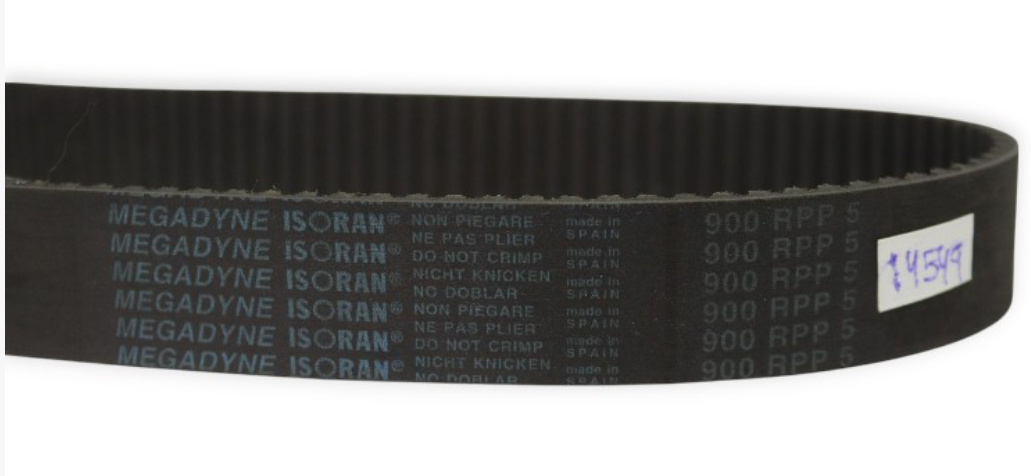
- Limited standardization — RPP is a Megadyne/ISORAN profile; some manufacturers use proprietary variations
9. Frequently Asked Questions
1) What does RPP stand for in timing belts?
RPP stands for Reinforced Polyurethane Parabolic or Parabolic Profile, referring to the belt’s parabolic (M-shaped) tooth design. It is also associated with Megadyne’s ISORAN RPP product line.
2) Can I use an RPP belt on an HTD pulley?
No. RPP belts aren’t compatible with HTD or STD pulleys. The tooth profiles are fundamentally different — RPP uses a parabolic M-shaped tooth with a notch, while HTD uses a full circular arc. Using mismatched profiles causes accelerated wear, noise, and premature failure.
3) What is the difference between RPP5M and RPP8M?
RPP5M has a 5 mm tooth pitch and is suitable for moderate loads up to approximately 12 kW. RPP8M has an 8 mm pitch and handles higher torque requirements. RPP8M belts are also thicker (5.5 mm vs 3.5 mm) with taller teeth (3.2 mm vs 1.95 mm).
4) Are RPP and HTD belts interchangeable?
No, they aren’t interchangeable. RPP and HTD belts require their own specific pulley profiles. However, if you’re designing a new system, you can choose either profile — RPP offers lower noise and better flexibility, while HTD offers broader availability and lower component cost.
5) Which is better for high-speed applications — RPP or STD?
RPP timing belts are generally better for high-speed applications. The parabolic tooth notch improves flexibility and reduces the contact surface area, allowing RPP belts to maintain stable engagement at higher speeds with less noise than STD belts.
6) Where can I buy RPP timing belts?
RPP timing belts are available from Megadyne Group (the original ISORAN RPP manufacturer), Timken Belts (Dual RPP synchronous belts), and industrial power transmission distributors globally. For custom sizes, suppliers such as Puteken and Yonghang offer made-to-order RPP belts.
10. Conclusion
RPP timing belts are basically the most refined version of curvilinear belt tech you can get right now. That M-shaped tooth with the notch gives you real, measurable wins in noise, flexibility, and stress distribution over older HTD and STD designs.
If you’re designing a new precision drive system — especially with servo motors, robotics, or noise restrictions — RPP belts are a solid pick. Yes, they cost a bit more upfront. But the quieter operation, longer life, and tighter pulley arrangements usually make up for it.
Next step: When you’re spec’ing an RPP belt, calculate your design power with a 15–20% safety margin, double-check pulley compatibility, and look up manufacturer catalogs for belt length and width options. Megadyne, Timken, or your local distributor can help with sizing and pricing.
Sources:
- Megadyne Group — MEGASYNC™ RPP and RPP DD technical documentation. Accessed July 2026.
- Puteken — Differences Between HTD, STD and RPP Toothed Drive Belt (April 2025).
- Yonghang — What Are Differences Between STD Timing Belt and RPP Timing Belt? (October 2025).
- ConCar Industrietechnik GmbH — RPP Timing Belt product specifications. Accessed July 2026.
- Timken Belts — Dual RPP Synchronous Belt product data. Accessed July 2026.