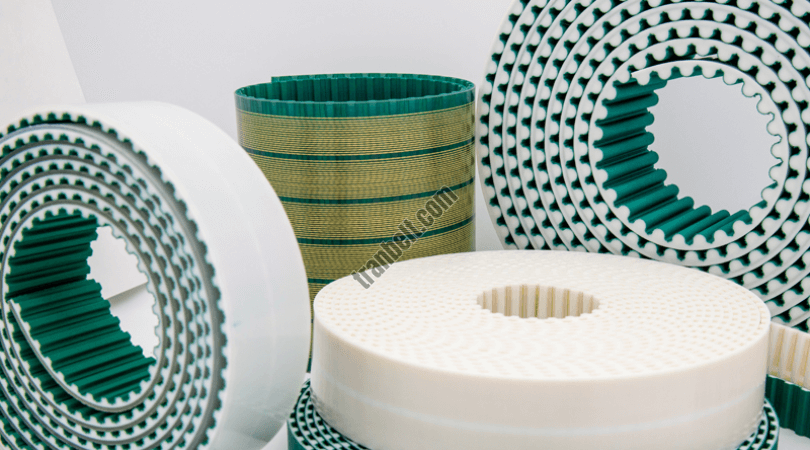
Mechanical belts transfer power, motion, or material between rotating shafts and pulleys. For industrial buyers, the right belt type affects machine uptime, energy use, replacement frequency, and motion accuracy. A belt that works well on a fan may fail quickly on an indexing machine, even if the width looks similar.
In 2026, most industrial belt selection still starts with a simple question: do you need friction-driven power transmission, synchronized motion, or material handling? This guide explains the main types of belts in mechanical systems, where each one fits, and what to check before choosing a replacement.
Key Takeaways
- The main mechanical belt types are flat belts, V-belts, timing belts, ribbed belts, round belts, link belts, and conveyor belts.
- V-belts are the usual general-purpose choice; timing belts are better when synchronized, no-slip motion matters.
- Belt choice depends on power, speed, pulley geometry, environment, precision, and maintenance access.
What Are Mechanical Belts?
In 2026, mechanical belts are still one of the simplest ways to connect rotating shafts because they can transmit power without requiring the shafts to touch. Wikipedia’s “Belt (mechanical)” overview defines a belt as a loop of flexible material used to link two or more rotating shafts mechanically (Wikipedia, Belt (mechanical), 2026-07-08).
Mechanical belts are flexible power transmission components that connect pulleys and shafts. Friction belts depend on contact force, while timing belts use teeth for synchronized motion. This difference is why a V-belt can suit pumps and fans, while a timing belt better suits indexing, positioning, and automation equipment.
A belt drive normally includes a driving pulley, a driven pulley, and a belt wrapped around both. Changing pulley diameters changes the speed ratio. Changing belt type changes grip, accuracy, noise, load capacity, and maintenance behavior.
The most important distinction is between friction belts and positive-drive belts. Friction belts, such as flat belts and V-belts, transmit torque through contact and tension. Positive-drive belts, such as timing belts, use teeth that mesh with matching pulleys.
For purchasing teams, belt type should not be treated as a commodity label. Two belts with the same outside length can behave very differently if one relies on friction and the other relies on tooth engagement.
What Are the Main Types of Belts in Mechanical Power Transmission?
In 2026, the seven belt categories most industrial buyers compare are flat belts, V-belts, timing belts, ribbed belts, round belts, link belts, and conveyor belts. The same Wikipedia overview lists flat, V, ribbed, round, timing, and specialty belt forms, showing how broad the mechanical belt family has become (Wikipedia, Belt (mechanical), 2026-07-08).
| Belt Type | Best For | Main Advantage | Main Limitation |
|---|---|---|---|
| Flat belt | High-speed, light-to-medium power transmission | Simple and efficient | Can slip under load |
| V-belt | General industrial drives | Strong grip from wedge action | Needs correct tension |
| Timing belt | Synchronized motion | No intentional slip | Requires matching toothed pulleys |
| Ribbed belt | Compact multi-pulley layouts | Flexible and smooth | Not always ideal for shock loads |
| Round belt | Light-duty drives and rollers | Easy routing | Low torque capacity |
| Link belt | Fast replacement and adjustable length | Easy installation | Usually costs more |
| Conveyor belt | Material handling | Moves products or bulk material | Not mainly for shaft synchronization |
This table gives a practical starting point, but it is not a substitute for application data. Belt speed, pulley diameter, wrap angle, tension method, temperature, oil exposure, dust, and shock load all affect service life.
When Should You Use a Flat Belt?
In 2026, flat belts are most useful when the drive needs high speed, smooth running, and relatively light-to-medium load capacity. The “Belt (mechanical)” reference notes that flat belts were widely used in line shafting and can deliver high power at high speed when pulleys and belt width are large enough (Wikipedia, Belt (mechanical), 2026-07-08).
Flat belts are simple friction belts used for smooth, high-speed power transmission. They can work well over longer center distances, but they rely on pulley contact and tension. Buyers should avoid flat belts when the machine requires exact synchronization or high torque in a compact drive.
Flat belts have a rectangular cross-section and run on flat or slightly crowned pulleys. The crown helps the belt self-center. They can be efficient and quiet, especially on longer center distances where a simple pulley layout is possible.
Their weakness is slip. If load increases suddenly, the belt can lose grip before a V-belt or timing belt would. That makes flat belts less attractive for compact, high-torque modern machinery unless the drive is designed carefully.
Use flat belts for clean, high-speed, lower-shock applications. Avoid them when you need exact timing, compact torque transfer, or strong grip in a short-center drive.
Why Are V-Belts So Common in Industrial Machines?
In 2026, V-belts remain common because their trapezoidal profile wedges into pulley grooves and improves grip as load increases. The “Belt (mechanical)” reference describes V-belts as a basic power transmission belt that offers a strong combination of traction, speed, bearing load, and service life (Wikipedia, Belt (mechanical), 2026-07-08).
That wedge action is the reason V-belts replaced many flat belts in short-distance industrial drives. A V-belt can transmit more torque with less width because the pulley groove increases effective contact.
Common applications include fans, pumps, compressors, blowers, agricultural machinery, woodworking equipment, and many general factory drives. Multiple V-belts can also run side by side on multi-groove pulleys when one belt is not enough.
The tradeoff is maintenance discipline. V-belts need correct tension and alignment. Too little tension causes slip and heat. Too much tension can overload bearings and shorten belt life.
When maintenance teams ask why a new V-belt failed early, the cause is often not the belt itself. Misaligned pulleys, worn sheaves, or over-tensioned installation are just as common as a poor belt match.
When Do Timing Belts Make More Sense Than V-Belts?
In 2026, timing belts make more sense when the driven shaft must stay synchronized with the driving shaft. Wikipedia’s “Toothed belt” page explains that toothed belts run over matching toothed pulleys and are non-slipping when correctly tensioned (Wikipedia, Toothed belt, 2026-07-08).
Timing belts are also called toothed belts, cogged belts, or synchronous belts. Their teeth mesh with pulley grooves, so the belt does not depend only on friction. That makes them useful for indexing, packaging equipment, robotics, printing machines, textile equipment, engine timing, and motion-control systems.
The buyer question is simple: would slip damage the product, timing, or process? If yes, a timing belt deserves serious consideration. A V-belt can be cheaper and more forgiving, but it cannot guarantee shaft position under every load condition.
Timing belts do require matching pulleys. They also need proper tooth profile, pitch, width, and tension. Replacing only the belt without checking pulley wear can create noise, tooth wear, or tracking issues.
What Are Ribbed Belts and Serpentine Belts?
In 2026, ribbed belts are used when a compact drive needs flexibility, smooth operation, and contact across multiple ribs. The “Belt (mechanical)” reference describes ribbed belts as belts with lengthwise grooves that contact matching pulley grooves and distribute tension across the pulley width (Wikipedia, Belt (mechanical), 2026-07-08).
A ribbed belt is thinner than a comparable group of V-belts. That flexibility helps it bend around smaller pulleys and follow more complex paths. In automotive layouts, a serpentine belt can drive several accessories with one continuous belt path.
In industrial use, ribbed belts can suit compact equipment, appliances, light machinery, fitness equipment, and drives where noise and smooth running matter. They are also useful when back-side idlers or serpentine routing are part of the design.
The limitation is load and abuse tolerance. Ribbed belts are not automatically better than V-belts for harsh shock loads. The right choice depends on pulley wrap, belt width, groove profile, and operating environment.
Where Do Round Belts and O-Ring Belts Fit?
In 2026, round belts are mainly light-duty belts for low-torque motion transfer. The “Belt (mechanical)” reference describes round belts as circular-section belts designed for grooved pulleys and low-torque uses (Wikipedia, Belt (mechanical), 2026-07-08).
Round belts are common on small machines, light conveyors, roller drives, packaging lines, and office or hobby equipment. They are often made from polyurethane or rubber-like materials. Some can be cut to length and joined by welding, gluing, or mechanical connectors.
Their advantage is routing flexibility. A round belt can work across small pulleys and simple roller systems where heavy torque is not required. It can also be easier to replace in a light-duty layout.
The limitation is obvious: torque capacity. If the drive has high shock load, heavy start-stop cycles, or important speed accuracy requirements, a round belt is usually not the first choice.
Are Link Belts Worth Considering?
In 2026, link belts are worth considering when fast installation, adjustable length, or difficult access matters more than the lowest belt price. Link V-belts use individual segments that can be assembled into a belt without always removing shafts, guards, or adjacent components.
That makes them useful for emergency repairs and machines where downtime is expensive. A link belt can also help maintenance teams fine-tune length on older machinery where the exact replacement size is hard to source.
The practical tradeoff is cost. Link belts usually cost more than standard endless V-belts. They may also behave differently in high-speed or high-load drives, so buyers should check manufacturer ratings instead of assuming one-to-one substitution.
For a plant manager, link belts are less about buying the cheapest belt and more about buying time. If a segmented belt gets a critical machine running while the exact endless belt is on order, the value can be easy to justify.
How Are Conveyor Belts Different From Power Transmission Belts?
In 2026, conveyor belts and power transmission belts are often grouped under “industrial belts,” but they solve different problems. A conveyor belt moves products or bulk material, while a power transmission belt transfers torque between shafts.
This distinction matters during sourcing. A buyer asking for a “rubber belt” may need a conveyor belt for material handling, a V-belt for a pump, or a timing belt for a packaging machine. The wrong category leads to the wrong supplier, wrong specification, and wrong quote.
Conveyor belts are selected by material, width, tensile strength, cover grade, surface profile, splice method, and the material being carried. Power transmission belts are selected by profile, pitch, pulley type, speed, center distance, and transmitted power.
Conveyor belts move materials from one point to another, while power transmission belts move torque and motion between pulleys. They may both be called industrial belts, but their selection criteria differ. Buyers should separate material-handling requirements from shaft-power requirements before requesting a quote.
How Do You Choose the Right Type of Mechanical Belt?
In 2026, the best belt choice starts with application data, not only belt appearance. The “Belt (mechanical)” reference notes that selection depends on speeds, transmitted power, shaft distance, operating conditions, pulley arrangement, and service environment (Wikipedia, Belt (mechanical), 2026-07-08).
Use this decision path before ordering:
- Define the job. Are you transmitting power, synchronizing motion, or moving material?
- Check slip tolerance. If slip is unacceptable, consider a timing belt.
- Measure pulley geometry. Record pulley diameter, groove profile, width, and center distance.
- Estimate load and speed. Higher torque, shock load, and start-stop cycles need stronger belt choices.
- Review the environment. Heat, oil, dust, water, chemicals, and abrasion change material requirements.
- Check maintenance access. If replacement access is poor, link belts or better guarding design may reduce downtime.
- Inspect pulleys. A new belt on worn pulleys can fail early.
If you are replacing an existing belt, keep the old belt markings, machine model, pulley photos, and application details. If the markings are gone, measure the belt and pulleys before requesting a quote.
Belt selection depends on job type, slip tolerance, pulley geometry, speed, load, environment, and maintenance access. A timing belt suits synchronized motion, a V-belt suits many general power drives, and a conveyor belt suits material movement. Application data prevents costly replacement mistakes.
What Belt Selection Mistakes Cause Early Failure?
In 2026, many early belt failures come from installation and drive conditions rather than from the belt material alone. Common causes include incorrect tension, worn pulleys, misalignment, undersized belts, contamination, and using a friction belt where synchronized motion is required.
Avoid these mistakes:
- Choosing by length only. Profile, width, pitch, and material matter as much as length.
- Ignoring pulley wear. A worn sheave can destroy a new V-belt quickly.
- Over-tensioning the drive. Extra tension can increase bearing load and heat.
- Mixing old and new belts. Multi-belt drives should use matched belts when required.
- Using V-belts for positioning. If the machine needs exact timing, use a synchronous solution.
- Forgetting the environment. Oil, heat, dust, and chemicals can change belt life dramatically.
The best maintenance habit is to inspect the full drive system. Belt, pulley, alignment, tension, guarding, and operating load all work together.
When a replacement belt fails twice in the same machine, treat it as a system problem. The second failure is often the clue that the root cause sits in alignment, pulley wear, or load changes.
Early belt failure is often caused by poor tension, pulley wear, misalignment, contamination, or incorrect belt type. Replacing the belt alone may not solve the problem. Industrial maintenance teams should inspect the full drive system before blaming the replacement belt.
Frequently Asked Questions
What is the most common type of mechanical belt?
V-belts are among the most common general-purpose mechanical belts because their wedge-shaped profile improves grip in grooved pulleys. In 2026, they remain a practical choice for fans, pumps, compressors, blowers, and many factory machines where synchronized motion is not required.
What is the difference between a V-belt and a timing belt?
A V-belt uses friction and wedging action to transmit torque, while a timing belt uses teeth that mesh with matching pulley grooves. In 2026, choose V-belts for many general power drives and timing belts when accurate speed ratio or synchronized shaft position matters.
Which belt is best for high-speed applications?
Flat belts and some timing belts can work well at high speed, but the right choice depends on load, pulley size, belt material, and tension method. In 2026, high-speed applications should be checked against manufacturer ratings instead of selected by belt category alone.
Which belt is best for heavy-duty industrial machines?
Heavy-duty machines often use V-belts, banded V-belts, synchronous belts, or reinforced specialty belts. The best choice depends on torque, shock load, pulley layout, and environment. For severe drives, use application data and supplier sizing support before ordering.
Do mechanical belts need lubrication?
Most mechanical belt drives do not need lubrication. That is one reason belt drives can be cleaner and quieter than chain drives in many applications. However, pulleys, bearings, guards, and tensioning hardware still need regular inspection.
Can I replace a timing belt with a V-belt?
You should not replace a timing belt with a V-belt if the machine requires synchronized motion. A V-belt can slip because it is friction-driven. A timing belt uses tooth engagement to preserve motion timing between shafts.
Conclusion
The main types of belts in mechanical power transmission are not interchangeable. Flat belts suit smooth, high-speed layouts. V-belts suit many general industrial drives. Timing belts suit synchronized motion. Ribbed belts suit compact multi-pulley paths. Round belts suit light-duty systems. Link belts help when replacement access is difficult. Conveyor belts move materials rather than synchronize shafts.
For industrial buyers, the safest path is to match the belt to the job, not just the old belt’s visible shape. Record the machine, pulley dimensions, belt markings, operating environment, load behavior, and failure symptoms before sourcing a replacement.
Sources
- Wikipedia, “Belt (mechanical)”, retrieved 2026-07-08.
- Wikipedia, “Toothed belt”, retrieved 2026-07-08.
- Wikipedia, “Continuously variable transmission”, retrieved 2026-07-08.
- Wikipedia, “Gates Corporation”, retrieved 2026-07-08.