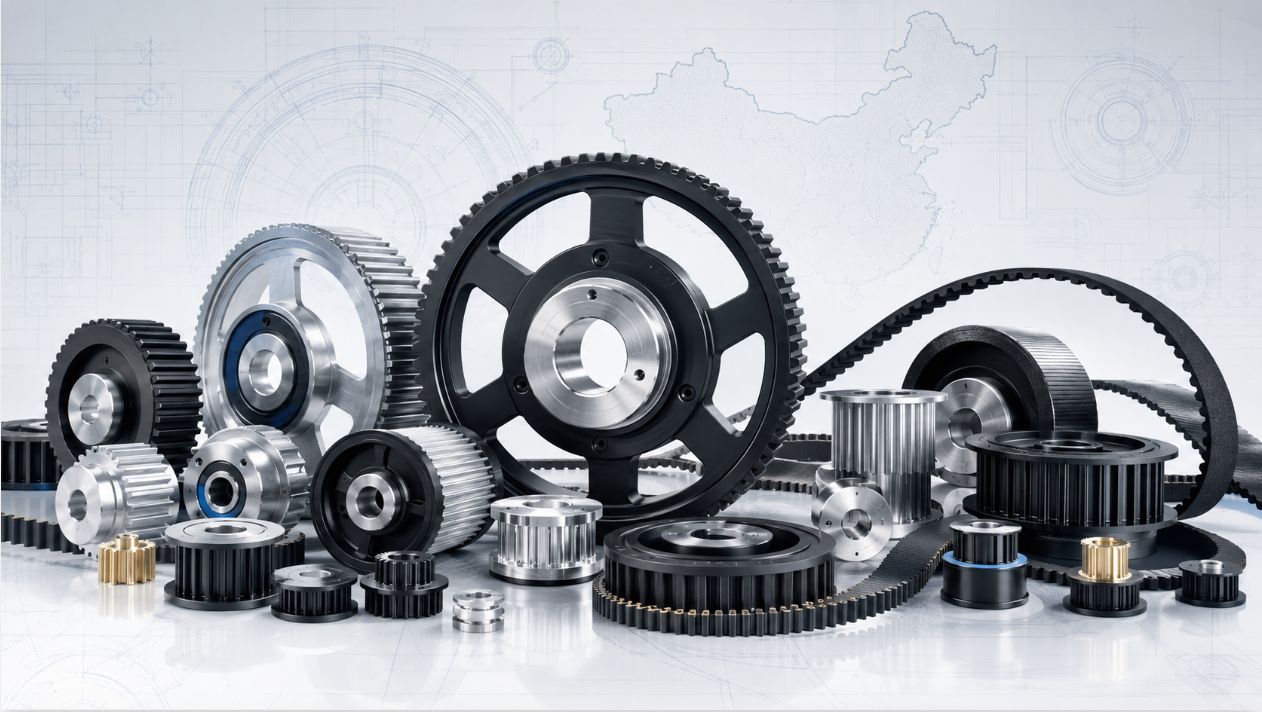
China has many timing pulley suppliers, but their manufacturing roles differ. Some operate dedicated gear-hobbing and CNC workshops. Others combine internal modification with partner production or large standard inventories. Buyers must therefore look beyond tooth count and price to evaluate profile accuracy, runout, material, bore machining, flanges, surface treatment, and inspection.
This 2026 comparison reviews ten Chinese companies with identifiable operations and official timing pulley evidence. It uses public product information rather than invented customer ratings or unverified performance awards. TranBelt publishes this comparison and is included in the list, so its position represents a disclosed commercial perspective rather than an independent award.
Key Takeaways
- Pulley tooth profile and pitch must match the timing belt family, not merely share a similar numeric pitch.
- Aluminum, steel, cast iron, stainless steel and engineering plastics suit different loads, speeds and environments.
- Custom pulleys require controlled drawings for the bore, keyway, hub, flange, surface treatment and tolerances.
- Verify the production entity, machining route, inspection records and production-representative samples before volume purchasing.
China Timing Belt Pulley Manufacturer Comparison
The table summarizes the clearest purchasing use case supported by each company’s public information. “Best for” is not a laboratory-tested quality award. Manufacturer descriptions reflect visible machining or production evidence, but buyers should still confirm which processes are performed internally for the quoted pulley.
| Manufacturer | Location | Main Profiles | Materials | Best For |
|---|---|---|---|---|
| TranBelt Transmission Solutions | Shenzhen, Guangdong | T, AT, HTD, imperial and special profiles | Aluminum, steel, cast iron, stainless steel, POM, nylon | International buyers |
| Ningbo Sanmin Gears | Ningbo, Zhejiang | T, AT, HTD, MXL, XL, GT, S | Aluminum, steel, cast iron, brass | Small precision pulleys |
| Suzhou Hetuoda Machinery | Suzhou, Jiangsu | MXL, HTD, GT, T, AT | Aluminum, steel, stainless steel, plastic | Precision custom machining |
| Chengdu Novo Machinery | Chengdu, Sichuan | Metric, imperial and taper-lock profiles | Aluminum and steel | Transmission components |
| Ningbo Fulong | Ningbo, Zhejiang | T, AT, HTD, STD and imperial | Steel, aluminum, cast iron, nylon | Matched belt-and-pulley programs |
| Zhejiang Jiaoma | Taizhou, Zhejiang | HTD, STD, RPP, T, AT and imperial | Steel, stainless steel, aluminum, nylon | Published dimensional data |
| Dongguan Zhende | Dongguan, Guangdong | MXL, XL, L, H, HTD, STD, T, AT | Aluminum and stainless steel | Standard pulley inventory |
| Hansheng Automation | Dongguan, Guangdong | MXL, H and custom profiles | Aluminum, steel, cast iron, POM, nylon | CNC and plastic pulleys |
| Foshan Barbieri | Foshan, Guangdong | Standard and custom synchronous profiles | Metal and custom materials | Integrated belt and pulley production |
| Zhejiang Guangjin | Shengzhou, Zhejiang | MXL, XL, T, HTD, GT, S, P and custom | Aluminum, steel, stainless steel and alloys | Broad custom profile coverage |
Top 10 China Timing Belt Pulley Manufacturers
Every company in this ranking has an identifiable Chinese location, official timing pulley products and public evidence of manufacturing, machining or custom processing. Ranking position reflects product breadth, technical transparency, machining relevance and accessibility to international buyers. It does not establish that one pulley will outperform another in a particular drive.
1. TranBelt Transmission Solutions – Best Overall for International Buyers
TranBelt Transmission Solutions is a Shenzhen-based industrial power transmission supplier and custom-processing partner. It serves international distributors, equipment manufacturers, maintenance companies and OEM buyers. Its timing belt pulley range includes standard products, drawing-based OEM pulleys and modified components supplied through internal processing and manufacturing partners.
Available tooth families include T, AT, HTD, MXL, XL, L and H. TranBelt also supports Eagle or SilentSync arrow-tooth designs and PolyChain or Falcon-compatible profiles. Standard materials include aluminum, steel and cast iron, while stainless steel, POM and nylon can be requested for corrosion resistance, lower inertia, lower noise or specialized machine environments.
The Shenzhen workshop can finish bores and perform modifications such as splines, hub shortening, V-guide grooves and holes for shafts, pins or locking rings. TranBelt also supplies pilot-bore, finished-bore and taper-lock configurations plus timing bars, clamping plates, belts and tension components. This allows buyers to source a more complete drive package through one inquiry.
TranBelt does not claim that every pulley is manufactured from raw material in its Shenzhen workshop. Its value lies in combining internal modification, partner manufacturing, belt matching and export coordination. Buyers should identify the production entity, machining route, profile standard, material, tolerance, surface treatment, inspection plan and warranty for each quoted part.
2. Ningbo Sanmin Gears Co., Ltd. – Best for Small Precision Timing Pulleys
Ningbo Sanmin Gears Co., Ltd. is a Zhejiang manufacturer focused on small gears, timing pulleys, gear shafts and related precision transmission parts. The company states that its factory began operating in 1994. Its pulley range includes T2.5, T5, T10, AT5, AT10, HTD 3M, 5M and 8M, MXL, XL, GT2 and S-series designs.
Material choices include 45# steel, aluminum alloy, cast iron and brass. Sanmin also shows custom bores, D-shaped holes, keyways, retaining rings and surface treatments. These options suit compact automation, printers, robots, instruments and other mechanisms where pulley size, inertia and shaft connection are as important as the tooth family.
The company publishes a useful equipment list covering CNC lathes, CNC gear-hobbing machines, machining centers, milling machines, drilling machines and assembly equipment. It also describes material cutting, turning, tooth generation, assembly and inspection. This production visibility is stronger than a catalog that only displays finished pulleys.
Sanmin is a good candidate for drawing-based small and medium pulley projects. However, accuracy, capacity and inspection claims remain company-supplied data. Buyers should request the approved drawing, cutter standard, bore tolerance, radial and axial runout limits, surface-treatment specification, first-article report and samples made on the intended production equipment.
3. Suzhou Hetuoda Machinery Manufacturing Co., Ltd. – Best for High-Precision Custom Machining
Suzhou Hetuoda Machinery Manufacturing Co., Ltd. produces timing pulleys, gears, sheaves and other machined transmission parts in Jiangsu. Its documented families include MXL, HTD, GT, T and AT pulleys. Material options include carbon steel, aluminum alloy, stainless steel and plastic, allowing the design to balance strength, weight, corrosion and cost.
Published processing capabilities include turning, milling, gear hobbing and grinding. Surface options include anodizing, black oxide and nickel plating. Hetuoda also presents application examples involving CNC machinery, semiconductor handling and low-backlash automation, which indicate a stronger focus on precision machining than on simple standard-pulley resale.
The supplier is especially relevant when a project specifies end-face parallelism, concentricity, profile runout, surface roughness or controlled backlash. Those values must appear on the customer’s drawing and inspection report. A general statement such as “high precision” is not enough to approve a positioning or servo application.
Hetuoda reports ISO and automotive quality certifications plus detailed case tolerances. These remain supplier claims until certificate scope and inspection records are reviewed. Buyers should request material certificates, cutter identification, CMM or profile inspection data, runout measurements, surface-treatment records and production-representative samples.
4. Chengdu Novo Machinery Co., Ltd. – Best for Standard and Taper-Lock Pulleys
Chengdu Novo Machinery Co., Ltd. manufactures power transmission components in Sichuan. Its product range includes timing belt pulleys, pulley bars, clamping plates, couplings, gears, V-pulleys, locking devices and sprockets. This breadth suits OEMs and distributors that want several mechanical transmission components from one source.
Novo publishes factory equipment that includes hobbing machines, drilling and milling machines, grinders and hydraulic broaching machines. Those processes correspond to tooth generation, bore finishing, keyways and general pulley machining. The company offers both standard and drawing-based products rather than limiting buyers to a fixed catalog.
Its timing pulley options include metric, imperial, pilot-bore and taper-lock designs. Common materials are aluminum and steel. Published surface treatments include anodizing for aluminum and phosphating or zinc plating for steel. Buyers should define whether the pulley needs flanges, a hub, a keyway, set screws or a compatible taper bushing.
Novo is a practical choice for standard industrial transmission and multi-component orders. Factory area, production capacity and company-history figures are self-reported. Confirm the legal manufacturing entity, actual production location, profile range, tooth cutter, bore tolerance, runout, balancing requirements, surface thickness and inspection method before approval.
5. Ningbo Fulong Synchronous Belt Co., Ltd. – Best for Matched Belt-and-Pulley Programs
Ningbo Fulong Synchronous Belt Co., Ltd. produces industrial belts and matching timing pulleys in Cixi, Zhejiang. Its pulley information covers T, AT, HTD, STD and imperial families. Products can be manufactured from drawings or supplied as standard parts, which helps machine builders coordinate belt geometry with the mating pulley.
Available materials include 45# steel, aluminum alloy, cast iron and nylon. Fulong notes that large pulleys above approximately 250 millimeters outside diameter commonly use cast iron. Material choice should still follow torque, rotational inertia, corrosion, temperature, shaft loading and the required manufacturing process.
Fulong publishes unusually detailed pulley tables. They include tooth geometry, minimum tooth-face widths, outside-diameter tolerances, end-face runout and radial runout. The company can also prepare drawings from the belt specification, bore, keyway and width. This is useful when a buyer has an old pulley but no complete production drawing.
The main purchasing advantage is matched responsibility for the belt and pulley. It can reduce disputes over profile compatibility, although it does not eliminate the need for calculations. Buyers should confirm the final drawing, pulley material, tooth standard, runout class, balancing, belt clearance, inspection records and whether the actual belt and pulley are tested together.
6. Zhejiang Jiaoma Timing Belt Co., Ltd. – Best for Published Pulley Dimensions
Zhejiang Jiaoma Timing Belt Co., Ltd. operates in Sanmen County, Taizhou, and supplies industrial timing belts with matching pulleys. The company publishes HTD, STD, RPP, T, AT and imperial geometry. Its tables identify pitch, groove dimensions, tooth count, suitable belt width and part-number conventions.
Material options include 45# steel, stainless steel, aluminum alloy, nylon and cast iron. Jiaoma states that carbon steel is common, while aluminum, copper and nylon can be selected for specific requirements. Pulleys with outside diameters above approximately 250 millimeters are generally made from cast iron.
Jiaoma is useful for engineering buyers who want to screen profile dimensions before requesting a quotation. Its product information also explains how pitch, tooth count and belt width appear in a pulley designation. That detail can reduce identification errors when replacing an old component or comparing supplier drawings.
Published geometry does not guarantee that every material, tooth count and width is available without tooling. Buyers should request a signed production drawing, material grade, bore fit, keyway standard, flange method, outside-diameter tolerance, radial and axial runout, surface treatment, minimum order and sample inspection report.
7. Dongguan Zhende Machine Equipment Co., Ltd. – Best for Standard Pulley Inventory
Dongguan Zhende Machine Equipment Co., Ltd. presents a large catalog of standard and non-standard timing pulleys. Available families include MXL, XL, L, H, HTD 3M, 5M and 8M, STD S3M, S5M and S8M, plus T and AT profiles. Numerous tooth counts, bores and belt widths are listed publicly.
Many catalog products use anodized aluminum, while stainless steel and custom materials are also offered. Product configurations include flanged and unflanged designs, dual-flat pulleys, hubs, multiple bores, idlers, tension pulleys and keyless or taper-lock connections. Zhende also states that it can machine products from customer drawings.
This combination suits maintenance buyers and small-volume OEMs that need a standard pulley quickly but may require a finished bore or minor modification. A broad online inventory can reduce tooling and lead time. Stock quantity, however, should be confirmed for the exact tooth count, width, bore, material and flange arrangement.
Zhende publishes more retail-style product data than factory-process detail. Buyers should verify the legal entity, current factory address, which CNC and hobbing operations are internal, tooth-profile inspection, bore tolerance, runout, anodizing specification and batch traceability. Important parts should be approved through a first-article sample.
8. Hansheng Automation (Dongguan) Co., Ltd. – Best for CNC and Engineering-Plastic Pulleys
Hansheng Automation (Dongguan) Co., Ltd. supplies automation components and precision-machined parts. Its core capabilities include CNC machining, gear manufacturing and casting. The timing pulley range includes MXL, H and custom profiles for machinery, automation, packaging, medical equipment and motion-control systems.
The supplier works with aluminum, 45# steel, cast iron, POM and nylon. Engineering plastics can reduce mass, corrosion and noise in suitable low-load environments, while steel or cast iron may be preferable for higher torque and dimensional stability. The final material should be selected from calculated duty rather than cost alone.
Available processing and finishing include CNC turning and milling, gear cutting, heat treatment, anodizing, blackening, zinc plating and nickel plating. Hansheng can also manufacture custom flanges, bores and mounting features. This makes it relevant when the pulley is one part of a wider automation or machined-component package.
Some published accuracy and certification statements are promotional and should not be treated as independent test results. Buyers should confirm the exact production site, profile cutter, material grade, plastic moisture or temperature limits, bore tolerance, runout, tooth inspection, surface-treatment thickness and sample acceptance method.
9. Foshan Barbieri Industrial Equipment Co., Ltd. – Best for Integrated Belt and Pulley Production
Foshan Barbieri Industrial Equipment Co., Ltd. manufactures polyurethane timing belts, specially processed belts and metal pulleys in Guangdong. Its public factory information shows a dedicated metal pulley workshop rather than only a sales catalog. The stated equipment includes gear hobbing, gear shaping and automated CNC machinery.
The workshop produces timing pulleys, round pulleys, V-belt pulleys, smooth pulleys and custom designs. This integrated scope can help equipment manufacturers obtain a processed timing belt and its mating pulley through one supplier. It is particularly relevant for automation, ceramics, glass, packaging and synchronized conveying systems.
Barbieri’s strongest advantage is production visibility. The company shows the relationship between base-belt manufacturing, special belt processing and metal pulley machining. Buyers can therefore discuss tooth matching, belt width, attached profiles, guide geometry and pulley structure within one technical program.
Published production capacity is company-reported and does not prove accuracy or delivery performance. Buyers should request the complete tooth-profile range, material options, cutter standard, bore and keyway limits, runout tolerance, balancing capability, surface treatments, inspection equipment and a sample representing the final production route.
10. Zhejiang Guangjin Intelligent Technology Co., Ltd. – Best for Broad Custom Profile Coverage
Zhejiang Guangjin Intelligent Technology Co., Ltd. is based in Shengzhou, Zhejiang, and developed from a business focused on gears, sprockets and transmission parts. Its pulley range includes synchronous, timing and V-belt pulleys plus custom machined components. The company accepts drawings and can prepare CAD information from application requirements.
Published tooth families include MXL, XXL, XL, L, H, XH, XXH, T, HTD, GT, S, P and other profiles. Materials include aluminum, carbon steel, alloy steel and stainless steel. Available structures cover custom tooth counts, bores, keyways, hubs, flanges, set screws and taper-lock connections.
The described process includes material preparation, CNC turning, tooth rolling or hobbing, grinding, inspection and surface treatment. Aluminum options include anodizing, conductive oxidation, chemical nickel plating, hard coatings, sandblasting and passivation. This broad range suits drawing-based OEM projects that need more than a standard pulley blank.
Guangjin publishes detailed profile, process, accuracy, certification and capacity claims. Those values require documentary confirmation. Buyers should request the legal contracting entity, factory address, certificate scope, inspection method, material records, profile report, runout results, surface specification and a first article tied to the approved drawing.
How Were These Timing Belt Pulley Manufacturers Evaluated?
The screening used three mandatory conditions. Each company needed an identifiable Chinese business or operating address, official timing pulley products and evidence of manufacturing or custom machining. Companies that only displayed generic pulleys without corresponding production or processing information were not included.
The ranking then considered tooth-profile breadth, material options, bore and keyway processing, hubs, flanges, taper-lock designs, surface treatment and inspection information. Public evidence of hobbing, turning, milling, grinding, broaching, gear shaping or dedicated pulley workshops strengthened the assessment.
Technical transparency also affected position. Fulong and Jiaoma publish useful geometric and tolerance tables. Sanmin, Hetuoda, Novo and Barbieri show relevant equipment or production processes. TranBelt discloses a mixed model involving internal modification and partner manufacturing, which buyers should evaluate on a part-by-part basis.
This is a sourcing review, not a factory audit or identical laboratory comparison. Company histories, capacities, accuracy levels, certifications and customer claims remain supplier-reported unless supporting documents are reviewed. Final approval should rely on drawings, material records, inspection reports and production-representative samples.
What Should You Compare When Choosing a Timing Pulley Manufacturer?
Start with tooth compatibility. HTD, GT, STD, RPP, T, AT and imperial profiles can have different groove geometry even when their numeric pitch appears similar. A pulley must match the belt family, pitch and tooth form. TranBelt‘s guide to timing belt pitch measurement explains why pitch alone cannot confirm compatibility.
Choose material from the operating duty. Aluminum reduces inertia and resists corrosion after suitable treatment. Carbon or alloy steel supports higher strength and wear resistance. Stainless steel suits corrosive or clean environments. Cast iron works well for many large pulleys. POM and nylon reduce weight and noise but require careful load, temperature and moisture evaluation.
Define the shaft connection on the drawing. A pilot bore still requires finishing, while a finished bore should include its tolerance. Specify the keyway standard, spline, D-flat, set screws, taper bushing or keyless locking device. Hub length, shoulder position and shaft engagement can matter as much as nominal bore diameter.
Tooth count and belt width determine pitch diameter and tooth-face width. The pulley also needs adequate belt clearance and flange geometry. Small tooth counts increase belt bending, while large diameters affect inertia and packaging. Use a drive calculation rather than selecting teeth solely from the desired speed ratio. TranBelt‘s timing belt drive calculation guide covers the main definitions.
Runout and concentricity influence tracking, vibration, noise and positioning. Specify outside-diameter tolerance, bore concentricity, radial runout, axial or end-face runout and backlash where relevant. High-speed pulleys may also require balance limits. The inspection method and datum structure must match the drawing, or two reports may measure different conditions.
Surface treatment must be identified by process and requirement. Aluminum may use clear, colored or hard anodizing. Steel may use black oxide, phosphating, zinc or nickel plating. State coating thickness, masked areas, corrosion requirement and whether dimensions apply before or after treatment. Surface buildup can change a close bore or tooth geometry.
Finally, request a controlled drawing and first-article inspection. The package should identify material, heat treatment, tooth profile, pitch, tooth count, face width, bore, keyway, hub, flanges, tolerances, surface treatment and marking. Approve a sample from the intended production route before authorizing volume manufacturing.
Frequently Asked Questions
What Materials Are Timing Belt Pulleys Made From?
Common timing pulley materials include aluminum, carbon steel, alloy steel, stainless steel, cast iron, POM and nylon. Aluminum suits low-inertia systems, while steel supports higher strength. Cast iron is common for larger pulleys. Engineering plastics can reduce noise and corrosion but need careful load, temperature and dimensional-stability checks.
Can a Chinese Manufacturer Make a Pulley From a Drawing?
Yes. The manufacturers reviewed here offer standard or drawing-based pulley production. A usable drawing should define profile, pitch, teeth, face width, material, bore, keyway, hub, flanges, tolerances and surface treatment. It should also identify inspection datums. Request a first article before approving a recurring production order.
How Do You Match a Timing Pulley to a Timing Belt?
Match the complete belt family, tooth profile, pitch and width. Do not select a pulley by pitch alone because HTD, GT, STD and RPP grooves may differ at the same nominal pitch. Confirm tooth count, minimum pulley diameter, flange requirements and belt clearance using the belt manufacturer’s technical data.
What Pulley Tolerances Should Buyers Specify?
Important tolerances include bore fit, keyway size, outside diameter, tooth geometry, face width, radial runout, axial runout and concentricity between the bore and teeth. Precision positioning may also require backlash and balance limits. The correct values depend on pulley size, speed, load, shaft design and application accuracy.
What Information Should a Timing Pulley RFQ Include?
Provide the tooth family, pitch, tooth count, belt width, material, bore, keyway, hub, flanges, locking method, surface treatment, tolerances, quantity and destination. Add speed, torque, environment and pulley drawing when available. State inspection and documentation requirements so quotations can be compared on the same technical basis.
Conclusion
The best Chinese timing belt pulley manufacturer depends on the project. TranBelt supports international sourcing and drive-package coordination, Sanmin and Hetuoda focus on precision machining, Novo serves broad transmission orders, while Fulong and Jiaoma provide useful belt-and-pulley data. Barbieri and Guangjin add integrated or broad custom production options.
Treat the ranking as a qualified shortlist rather than purchase approval. Confirm tooth compatibility, material, shaft connection, runout, surface treatment and production responsibility. Then compare controlled drawings, samples, inspection records, lead time and landed cost. A correctly specified pulley is more valuable than a low quotation that omits the manufacturing details.
Sources
- TranBelt, Timing Belt Pulleys, retrieved 2026-07-28.
- TranBelt, About Us, retrieved 2026-07-28.
- Ningbo Sanmin Gears Co., Ltd., Custom Timing Belt Pulleys, retrieved 2026-07-28.
- Suzhou Hetuoda Machinery Manufacturing Co., Ltd., Timing Pulley Manufacturer, retrieved 2026-07-28.
- Suzhou Hetuoda Machinery Manufacturing Co., Ltd., 3GT Timing Pulley, retrieved 2026-07-28.
- Chengdu Novo Machinery Co., Ltd., Company and Product Overview, retrieved 2026-07-28.
- Chengdu Novo Machinery Co., Ltd., Taper-Lock HTD 5M Timing Belt Pulley, retrieved 2026-07-28.
- Ningbo Fulong Synchronous Belt Co., Ltd., Timing Pulley, retrieved 2026-07-28.
- Ningbo Fulong Synchronous Belt Co., Ltd., Carbon Steel Timing Pulley, retrieved 2026-07-28.
- Zhejiang Jiaoma Timing Belt Co., Ltd., Timing Pulleys, retrieved 2026-07-28.
- Zhejiang Jiaoma Timing Belt Co., Ltd., About Us, retrieved 2026-07-28.
- Dongguan Zhende Machine Equipment Co., Ltd., Timing Pulley Products, retrieved 2026-07-28.
- Dongguan Zhende Machine Equipment Co., Ltd., Company and Product Overview, retrieved 2026-07-28.
- Hansheng Automation (Dongguan) Co., Ltd., Timing Pulley, retrieved 2026-07-28.
- Hansheng Automation (Dongguan) Co., Ltd., Pulley Products, retrieved 2026-07-28.
- Foshan Barbieri Industrial Equipment Co., Ltd., Production Workshop, retrieved 2026-07-28.
- Zhejiang Guangjin Intelligent Technology Co., Ltd., Belt Pulleys, retrieved 2026-07-28.
- Zhejiang Guangjin Intelligent Technology Co., Ltd., About Us, retrieved 2026-07-28.