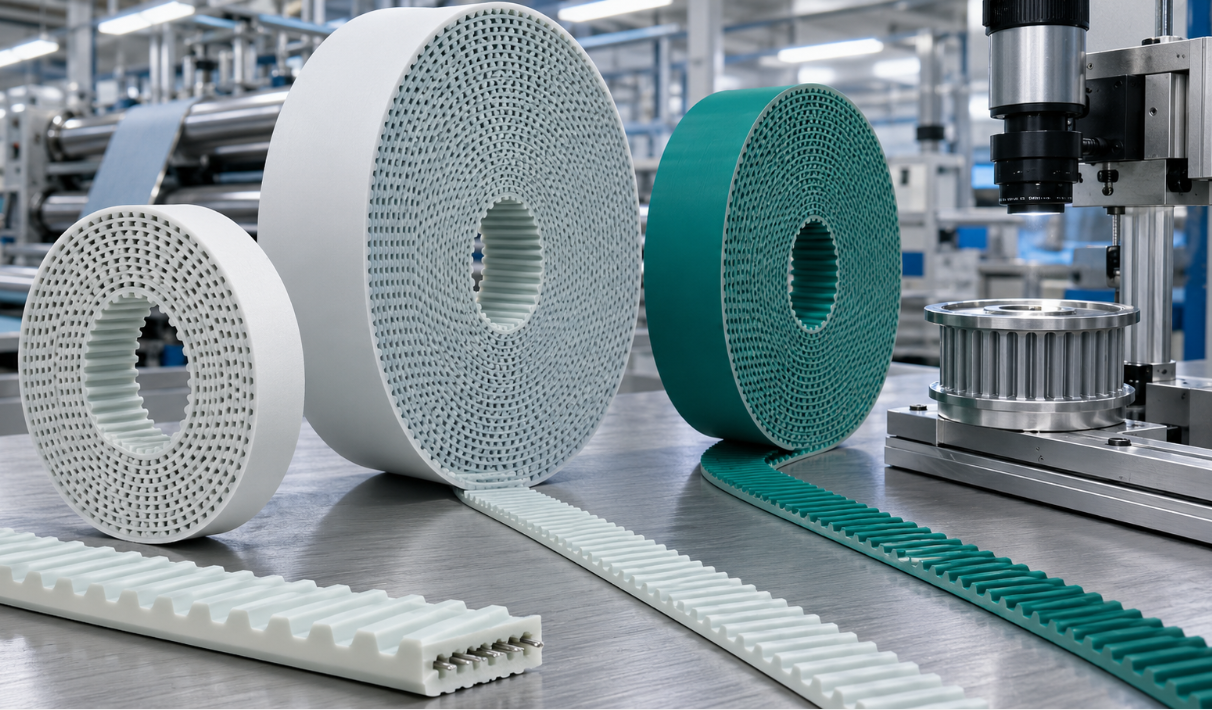
China has many timing belt companies, but relatively few publish enough information to confirm a genuine open-ended range. Suitable suppliers must understand linear positioning, roll production, width cutting, tensile cords, tooth geometry, and further processing. A company that sells endless rubber belts is not automatically qualified to supply open-ended polyurethane belting.
This 2026 review examines ten Chinese suppliers with identifiable businesses and official open-ended product evidence. It compares their public product ranges, materials, profiles, processing capabilities, and likely purchasing fit. It is not a factory audit or laboratory comparison. TranBelt publishes this article and appears in the ranking, so that commercial relationship is disclosed.
Key Takeaways
- PU open-ended belts dominate precise linear motion, while rubber versions offer different flexibility, noise, and handling characteristics.
- CSH and Jiaoma publish particularly useful information for comparing rubber and polyurethane constructions.
- Roll width, cord type, joint strength, profile availability, and further processing matter more than a long generic product list.
- Verify the legal entity, production route, drawings, samples, inspection records, minimum order, and delivery terms before volume purchasing.
China Open-Ended Timing Belt Supplier Comparison
The table summarizes the strongest capability that each supplier documents publicly. “Best for” identifies a practical sourcing use case, not an independently tested quality award. Manufacturer descriptions are based on company information and visible product evidence. Buyers should still confirm which operations are completed in-house for their specific belt.
| Supplier | Location | Open-Ended Materials | Main Capabilities | Best For |
|---|---|---|---|---|
| TranBelt | Shenzhen, Guangdong | PU and neoprene | Broad profiles, custom lengths, coverings and sourcing support | International buyers |
| Ningbo Fulong | Ningbo, Zhejiang | PU | Wide mother rolls, cut-to-size supply and multiple constructions | Volume PU programs |
| Shaoxing CSH Belt | Shaoxing, Zhejiang | PU and rubber | Extruded PU, spiral-cut rubber and welded belts | Rubber and PU comparison |
| Zhejiang Jiaoma | Taizhou, Zhejiang | PU and rubber | Multiple cord options and detailed dimensional data | Specification-led purchasing |
| Ningbo FRK Power | Ningbo, Zhejiang | PU | Broad metric and imperial profile coverage | Multi-profile inquiries |
| Shanghai Puteken | Shanghai and Suzhou | PU and neoprene | Open, welded and endless configurations | Configuration options |
| Foshan Xinzhen | Foshan, Guangdong | PU | Specially processed timing belts | Custom PU fabrication |
| Foshan Uliflex | Foshan, Guangdong | PU | Coverings, tensile cords and further processing | Fabricated belt systems |
| Boledon | Foshan, Guangdong | PU | Cleats, coatings, welding and production equipment | Synchronous conveying |
| Zhejiang Pioneer | Taizhou, Zhejiang | PU and rubber | Steel-cord PU and fiberglass-reinforced rubber | General industrial applications |
Top 10 China Open-Ended Timing Belt Suppliers
The reviews below use a common standard. Each supplier must show an operating address in China and explicitly present open-ended timing belts on its own website. The assessment then considers materials, tensile members, profile breadth, processing, technical transparency, and suitability for international purchasing.
No position guarantees performance in a particular machine. Open-ended belts can serve linear drives, door systems, positioning axes, product handling, and synchronous conveying. Those duties impose different requirements. The final choice must follow the application drawing, allowable tension, pulley geometry, environment, and sample results.
1. TranBelt – Best Overall for International Buyers
TranBelt is based in Shenzhen, Guangdong, and combines international sourcing with its own OEM timing belt supply. Its open-ended timing belt range covers polyurethane and neoprene constructions for linear positioning, conveying, indexing, packaging, and automation. Custom lengths can range from prototypes to long production quantities.
The PU construction uses steel tensile cords for dimensional stability and controlled movement. Neoprene open belts use fiberglass cords and suit applications that benefit from a more flexible rubber construction. Optional nylon fabric can be added to reduce friction, noise, and tooth wear. Buyers can also request backing materials for gripping, cushioning, or product-handling functions.
Published profile families include T, AT, ATL, ATN, HTD, STD, RPP, imperial, and helical offset PU designs. Rubber options include GT, HTD, STD, T, and imperial profiles. This range gives machine builders several routes for replacing an existing belt or developing a custom linear-motion assembly.
TranBelt also supplies industrial belts from Gates, Continental, Bando, Megadyne, Mitsuboshi, Optibelt, and other established brands at distributor-level pricing. That branded distribution service is separate from TranBelt’s own high-quality OEM open-ended belt program. Buyers should not assume that every imported brand or profile is held as open-ended stock without written confirmation.
TranBelt publishes this review, so its first-place position is not independent. It reflects broad sourcing support, product coverage, and export communication rather than a controlled claim of superior service life. Production samples and application data remain necessary before approval.
2. Ningbo Fulong Synchronous Belt – Best for Volume PU Belt Programs
Ningbo Fulong Synchronous Belt Co., Ltd. is located in Cixi, Zhejiang, and reports a manufacturing history beginning in 1984. Its product portfolio covers industrial and automotive rubber belts, polyurethane belts, pulleys, and related transmission products. The company provides more open-ended production dimensions than many suppliers reviewed here.
Fulong describes its open PU timing belt as a linear and reciprocating transmission product. Published standard lengths include 50, 100, and 200 meters. Mother widths include 200 and 500 millimeters before cutting. These dimensions can suit distributors and machine builders that need several finished widths from a larger production roll.
The company distinguishes three constructions. Open PU belting is intended for linear transmission and can be cut to length. Connected PU belts serve lower-demand, light-load transmission and traction. Seamless PU belts target higher power, dynamic load, and positioning requirements. This separation helps prevent a welded loop from being treated as equivalent to a seamless belt.
Fulong is a strong candidate when volume, repeat cutting, and construction choice matter. However, not every profile and reinforcement combination appears on the same page. Confirm finished width, edge quality, roll tolerance, cord arrangement, minimum cut width, partial-roll availability, material grade, and batch inspection on a signed drawing.
3. Shaoxing CSH Belt – Best for Rubber and PU Open-Ended Belts
Shaoxing CSHBELT Co., Ltd. is based in Shengzhou, Zhejiang, and reports producing industrial rubber and polyurethane timing belts since 2007. It publishes separate technical pages for rubber and PU open-ended constructions. That distinction makes CSH one of the clearest suppliers for buyers comparing material systems.
CSH’s rubber open-ended belts use a chloroprene body, glass-fiber tensile cords, and nylon tooth fabric. They are produced by spiral cutting and target automatic doors, CNC equipment, printers, and other linear-motion systems. The company publishes profile-specific width and roll-length tables for classical, T, HTD, STD, and RPP families.
Its PU open-ended belts use thermoplastic polyurethane and different tensile members in an extrusion process. Published profiles include MXL through XH, T, AT, HTD, STD, RPP, and special tracking designs. The company also offers welded endless belts, flights, profiles, coatings, and tooth-side fabrics for synchronous conveying and indexing.
CSH is especially relevant when a project team has not yet decided between rubber and PU. Its main limitation concerns joined products. Ask whether the supplied belt is spiral-cut, extruded, welded, or truly endless, then confirm allowable tension, cord continuity, joint geometry, pulley diameter, temperature, tolerances, and the effect of any coating.
4. Zhejiang Jiaoma Transmission Belt – Best for Detailed Specifications
Zhejiang Jiaoma Timing Belt Co., Ltd. operates in Sanmen County, Taizhou, Zhejiang. Its official open-ended belt information distinguishes chloroprene rubber from thermoplastic polyurethane and provides detailed profile dimensions. The company lists industrial applications including automatic doors, linear reciprocating drives, positioning, and logistics.
Jiaoma states that its rubber open belts are spiral-cut from large molded constructions. Published rubber widths are generally limited to less than 25 millimeters, while practical lengths can reach approximately 100 to 200 meters. These process limits are valuable because they show that rubber and extruded PU open belts cannot share every width option.
The PU range can be joined into a loop and may include green elastic fabric on the tooth side. Jiaoma publishes a maximum open width of 150 millimeters and continuous-length supply. Reinforcement choices include fiberglass, steel, and aramid cords. Steel supports dimensional stability, while the final cord selection must still match bending, tension, and pulley requirements.
Available families include MXL, XL, L, H, HTD, STD, and RPP. The technical page publishes pitch, tooth height, and belt thickness for several series. The tables remain supplier data, so verify material and cord availability, production limits, minimum order, roll tolerance, fabric, splice method, allowable tension, and the quotation drawing.
5. Ningbo FRK Power Transmission – Best for Broad Profile Coverage
Ningbo FRK Power Transmission is located in Yuyao, Ningbo, Zhejiang. Its website explicitly lists open-ended timing belts and PU open-ended belts alongside rubber timing belts, CPU endless belts, PU joined belts, coated belts, V-belts, ribbed belts, flat belts, and pulleys. The breadth makes FRK relevant to multi-profile inquiries.
Published PU reinforcement options include steel and Kevlar cords. Listed tooth families extend across MXL, XL, L, H, XH, XXH, T, AT, HTD, STD, and RPP ranges. This mix covers both imperial and metric systems and can simplify purchasing when several machines use different profile families.
FRK distinguishes PU open-ended, joined, and cast endless products at the category level. That is useful, but its public pages provide less detailed dimensional and engineering data than CSH or Jiaoma. Buyers should not interpret a profile list as proof that every pitch, width, roll length, cord, and coating combination is continuously available.
FRK suits distributors seeking several profiles and secondary-processing options from one contact. Before ordering, request the legal entity, production address, current profile table, mother width, roll length, cord layout, tolerance, material declaration, and inspection plan. Confirm whether coating, welding, or pulley work is subcontracted and sample the planned production route.
6. Shanghai Puteken Transmission System – Best for Belt Configuration Options
Shanghai Puteken Transmission System Co., Ltd. reports a Shanghai sales operation and a production base in Suzhou. Its open-ended range includes polyurethane with steel or aramid cords and neoprene rubber with fiberglass reinforcement. The products target precise linear motion where custom cut length and stable tooth engagement are required.
Puteken publishes one of the broadest profile lists in this group. It includes HTD, STD, RPP, T, AT, imperial, ATN, ATL, and ATK designs. Green or black fabric can be added to the teeth or belt back. These options support friction control, abrasion resistance, tracking, and custom product handling.
The supplier also explains open-ended, mechanically joined, finger-welded, and seamless molded configurations. That framing is useful because buyers often use “endless” without identifying how the loop is produced. Puteken notes that joint choice must follow load, precision, and service requirements rather than convenience alone.
Puteken is a practical candidate for comparing several belt configurations and further-processing options. Factory size, staffing, certifications, and quality-system statements are company declarations. Buyers should request the registered production entity, certificate copies, process ownership, material records, dimensional reports, joint-strength data, and samples from the quoted construction.
7. Foshan Xinzhen Industrial Belt – Best for Custom PU Fabrication
Foshan Xinzhen Industrial Belt Co., Ltd. is located in Foshan, Guangdong, and specializes in polyurethane timing belts. Its official catalog includes an HTD14M open-ended product and several connected or specially processed timing belts. The company also presents pulleys and application-specific fabrication for industrial equipment.
Xinzhen’s product examples include tooth-side fabric, added polyurethane, coatings, stoppers, grooves, tracking features, and mechanical attachment designs. These options suit packaging, glass, ceramics, woodworking, printing, food equipment, logistics, and automation. The strongest fit is a PU belt that needs additional processing rather than a plain cut length alone.
Xinzhen publishes fewer open-ended profiles and roll dimensions than the higher-ranked specialists. Buyers should request the complete profile list, maximum width, standard roll length, cord type, extrusion tolerance, and available fabrics. Any coating, stopper, guide, or hole pattern should appear on a controlled drawing with acceptance criteria.
For joined or fabricated belts, confirm joint efficiency, minimum pulley diameter, attachment method, backing adhesion, and permissible tension after processing. A sample should include the actual coating, stopper, guide, or hole pattern. Testing an unprocessed base belt would not validate the finished custom product.
8. Foshan Uliflex Transmission Technology – Best for Coverings and Further Processing
Foshan Uliflex Transmission Technology Co., Ltd. is based in Foshan, Guangdong. Its official catalog includes polyurethane open-ended, PU endless, molded PU, rubber, profiled, and fabricated timing belts. The open-ended product supports custom width and length, optional fabric, and steel or Kevlar tensile cords.
Uliflex presents a wide processing range. Available work includes finger welding, rubber or PU backing, foam, sponge, patterned surfaces, nylon fabric, cleats, grinding, perforation, and notching. These processes are relevant to glass, ceramics, textiles, packaging, food equipment, and automation where the belt must grip or carry a product.
Uliflex is a reasonable option for a finished belt assembly that needs several fabrication stages. Its public material and customization information supports inclusion. However, parts of its website contain template placeholders, so company-history, patent, certification, capacity, and precision claims should not be repeated without supporting documents.
Ask for the legal entity, manufacturing address, process map, cord construction, base-belt origin, fabric grade, backing hardness, welding method, and final inspection plan. Confirm whether technical values apply before or after coatings, holes, cleats, and joining, and approve a sample representing the finished build.
9. Boledon Transmission Technology – Best for Customized PU Conveying Belts
Boledon Transmission Technology (Guangdong) Co., Ltd. operates in Foshan, Guangdong. Its website has a dedicated Open Ended PU Timing Belts category and separates open, spliced, welded, truly endless, cleated, false-tooth, double-sided, and specially processed products. This organization supports its relevance to customized synchronous conveying.
Product examples include T10 and AT-series open belts, tooth-side fabric, cleats, guides, PU additions, felt, sponge, APL coverings, grooves, holes, and custom surfaces. The company also presents machinery for hot-melting cleats and grinding belt edges or surfaces. These capabilities can help buyers who need the belt and its fabrication route from one supplier.
Boledon states that it designs and produces PU timing belts, rubber timing belts, conveyor belts, and pulleys at its Foshan operation. Its strongest documented open-ended capability is PU. The article therefore does not classify Boledon as a complete specialist in rubber open-ended belts without a corresponding detailed product page.
The supplier is best suited to applications where attachments or coatings influence performance. Buyers must define load position, cleat spacing, backing geometry, tracking forces, pulley diameter, and the cleaning environment. Company size and market claims are self-reported, so request current certificates, process lists, material records, joint data, attachment testing, and a representative sample.
10. Zhejiang Pioneer Transmission Technology – Best for General Industrial Applications
Zhejiang Pioneer Transmission Technology Co., Ltd. lists a manufacturing address in Sanmen County, Zhejiang. Its official open-ended timing belt page describes both rubber and polyurethane constructions for textiles, light industry, chemical equipment, machine tools, printers, robots, food processing, and other general machinery.
The rubber belt uses synthetic neoprene, fiberglass tensile cords, and nylon 66 tooth fabric. The PU version uses thermoplastic polyurethane and steel cords. Pioneer also describes optional nylon fabric and added polyurethane for special operating characteristics. Customers can cut the supplied open belt to the required working length.
Pioneer is a suitable general-purpose candidate for buyers wanting both rubber and PU options. However, its page lacks the profile-by-profile roll and width tables published by CSH or Jiaoma. Request a complete size list, temperature limits, maximum width, cord arrangement, allowable tension, minimum pulley diameter, and fabric-placement options.
The company reports long experience in automotive and industrial transmission belts, but that history remains a company claim unless independently documented. Verify the legal entity, factory address, current certificates, process ownership, mold or extrusion capability, inspection equipment, and sample traceability before a large order.
How Were These Open-Ended Timing Belt Suppliers Evaluated?
The screening began with three mandatory conditions. Each business needed an identifiable Chinese company or operating address, an official page explicitly showing open-ended timing belts, and enough product information to confirm material or processing capability. This excluded companies that only listed generic timing belts or described joined belts without clearly offering open stock.
The ranking then considered material coverage, tensile cords, profile breadth, width and roll information, further processing, construction clarity, and international purchasing accessibility. Suppliers gained credit for separating open-ended, welded, and truly endless products because those constructions have different strength and application limits.
Technical transparency also affected position. CSH and Jiaoma publish useful dimensions and process limits. Fulong discloses mother-roll sizes and separates connected from seamless PU products. Smaller suppliers with genuine products but limited public data remain eligible, although buyers must complete more verification during quotation and sampling.
This is an evidence-based sourcing shortlist, not a controlled performance test. No identical belts were purchased and tested from all ten companies. Supplier websites remain primary evidence for much of the product information. Company-reported history, capacity, certifications, patents, markets, and staffing are not treated as independently verified facts unless supporting records are reviewed.
What Should Buyers Compare Before Choosing a Supplier?
Open-ended belt purchasing starts with construction. A belt supplied as a straight roll can be clamped at both ends for linear motion. The same base belt may be finger-welded into a loop for conveying. A truly endless belt uses a different manufacturing route and may support higher cyclic loads. The three descriptions should never be used interchangeably.
Material choice comes next. Thermoplastic PU open belts commonly use parallel steel or aramid cords and support accurate linear positioning. Neoprene rubber versions often use fiberglass cords and can offer different flexibility, noise, and environmental behavior. Neither material is universally better. Load, speed, bending, temperature, contamination, and pulley geometry determine the correct construction.
Profile names must match the pulleys exactly. T10, AT10, HTD 8M, STD S8M, and RPP 8M are not interchangeable merely because some share a numeric pitch. TranBelt’s guide to timing belt pitch and measurement explains why pitch, tooth form, width, and pulley geometry must be confirmed together.
Roll specifications influence cost and conversion. Ask for standard roll length, maximum mother width, finished width tolerance, minimum cut width, edge condition, roll-length tolerance, cord pitch, and partial-roll policy. A low price per meter can become expensive if the supplier’s standard roll produces excessive waste or cannot hold the required width.
Further processing requires a controlled drawing. Define tooth-side and back-side fabrics, backing material, hardness, thickness, cleats, guides, grooves, perforations, grinding, and joining. Request allowable tension after processing. Welding, machining, heating, and cutting can change cord continuity, bending behavior, surface adhesion, and service life.
Send the same technical request to every shortlisted supplier. Include profile, pitch, cut length, width, material, cord, pulley tooth counts, speed, load, acceleration, environment, processing, quantity, and destination. TranBelt’s timing belt drive calculation guide provides the main definitions needed for a useful engineering discussion.
Finally, verify the contracting business. Match the legal company name with the bank account, invoice, contract, and export documents. Ask which production stages are internal and which are subcontracted. For critical equipment, audit the production route and test samples made with the exact material, cord, profile, width, joint, and processing planned for the order.
Frequently Asked Questions
What Is an Open-Ended Timing Belt?
An open-ended timing belt is supplied as a straight length or roll instead of a closed loop. Its teeth engage with a matching pulley while its ends are normally clamped in a linear-motion system. Common applications include automatic doors, positioning axes, printers, robots, CNC equipment, elevators, and synchronized handling systems.
Can an Open-Ended Timing Belt Be Joined Into a Loop?
Thermoplastic PU open-ended belts can often be finger-welded into a loop. The resulting belt is usually called joined or welded, not truly endless. Its joint interrupts the original cord structure and may reduce allowable tension. The supplier must confirm joint efficiency, minimum pulley diameter, speed, and suitability for the intended conveying or drive duty.
Are Welded Timing Belts Suitable for Power Transmission?
Welded timing belts are commonly used for conveying and indexing, but they are not automatically suitable for high-load power transmission. Joint strength can be substantially lower than base-belt strength. Use a welded belt only when the supplier approves the calculated tension, duty cycle, pulley size, acceleration, and safety factor for that exact construction.
Is PU or Rubber Better for Linear Motion?
PU with steel cords is widely used where low elongation and positioning stability are priorities. Rubber with fiberglass cords can provide different flexibility, noise, and handling properties. Selection depends on load, travel, acceleration, pulley diameter, temperature, contamination, and mounting. Compare application-specific ratings instead of choosing by material name alone.
What Information Should You Send to a Chinese Supplier?
Send the tooth profile, pitch, width, cut length, material, cord, pulley details, load, speed, acceleration, travel, environment, and quantity. Add drawings for fabrics, coatings, cleats, guides, holes, or joining. Include the delivery country and required documents. Clear acceptance criteria make quotations easier to compare and reduce sample revisions.
Conclusion
The best Chinese open-ended timing belt supplier depends on construction and purchasing needs. TranBelt supports international sourcing and OEM programs, Fulong suits wide-roll PU procurement, CSH and Jiaoma document both rubber and PU options, while Xinzhen, Uliflex, and Boledon focus more heavily on fabricated PU products.
Use this ranking as a qualified shortlist, not automatic purchase approval. Match the profile and pulley, define the cord and processing, verify the legal and production entities, and test a representative sample. A technically complete quotation is more valuable than the lowest per-meter price without construction, tolerance, inspection, and joint information.
Sources
- TranBelt, Open-Ended Timing Belt, retrieved 2026-07-28.
- TranBelt, Timing Belts, retrieved 2026-07-28.
- TranBelt, About Us, retrieved 2026-07-28.
- Ningbo Fulong Synchronous Belt Co., Ltd., Open Ended PU Timing Belt, retrieved 2026-07-28.
- Ningbo Fulong Synchronous Belt Co., Ltd., About Fulong, retrieved 2026-07-28.
- Shaoxing CSHBELT Co., Ltd., Rubber Open End Timing Belts, retrieved 2026-07-28.
- Shaoxing CSHBELT Co., Ltd., PU Open End Timing Belts, retrieved 2026-07-28.
- Shaoxing CSHBELT Co., Ltd., The Company, retrieved 2026-07-28.
- Zhejiang Jiaoma Timing Belt Co., Ltd., Open-End Timing Belts, retrieved 2026-07-28.
- Ningbo FRK Power Transmission Co., Ltd., Product and Company Overview, retrieved 2026-07-28.
- Shanghai Puteken Transmission System Co., Ltd., Open-Ended Timing Belt, retrieved 2026-07-28.
- Shanghai Puteken Transmission System Co., Ltd., About Us, retrieved 2026-07-28.
- Foshan Xinzhen Industrial Belt Co., Ltd., Open Timing Belt, retrieved 2026-07-28.
- Foshan Xinzhen Industrial Belt Co., Ltd., About Us, retrieved 2026-07-28.
- Foshan Uliflex Transmission Technology Co., Ltd., Polyurethane Open Ended Timing Belt, retrieved 2026-07-28.
- Foshan Uliflex Transmission Technology Co., Ltd., About Uliflex, retrieved 2026-07-28.
- Boledon Transmission Technology (Guangdong) Co., Ltd., Open Ended PU Timing Belts and Company Profile, retrieved 2026-07-28.
- Zhejiang Pioneer Transmission Technology Co., Ltd., Open Ended Timing Belt, retrieved 2026-07-28.
- Zhejiang Pioneer Transmission Technology Co., Ltd., About Us, retrieved 2026-07-28.