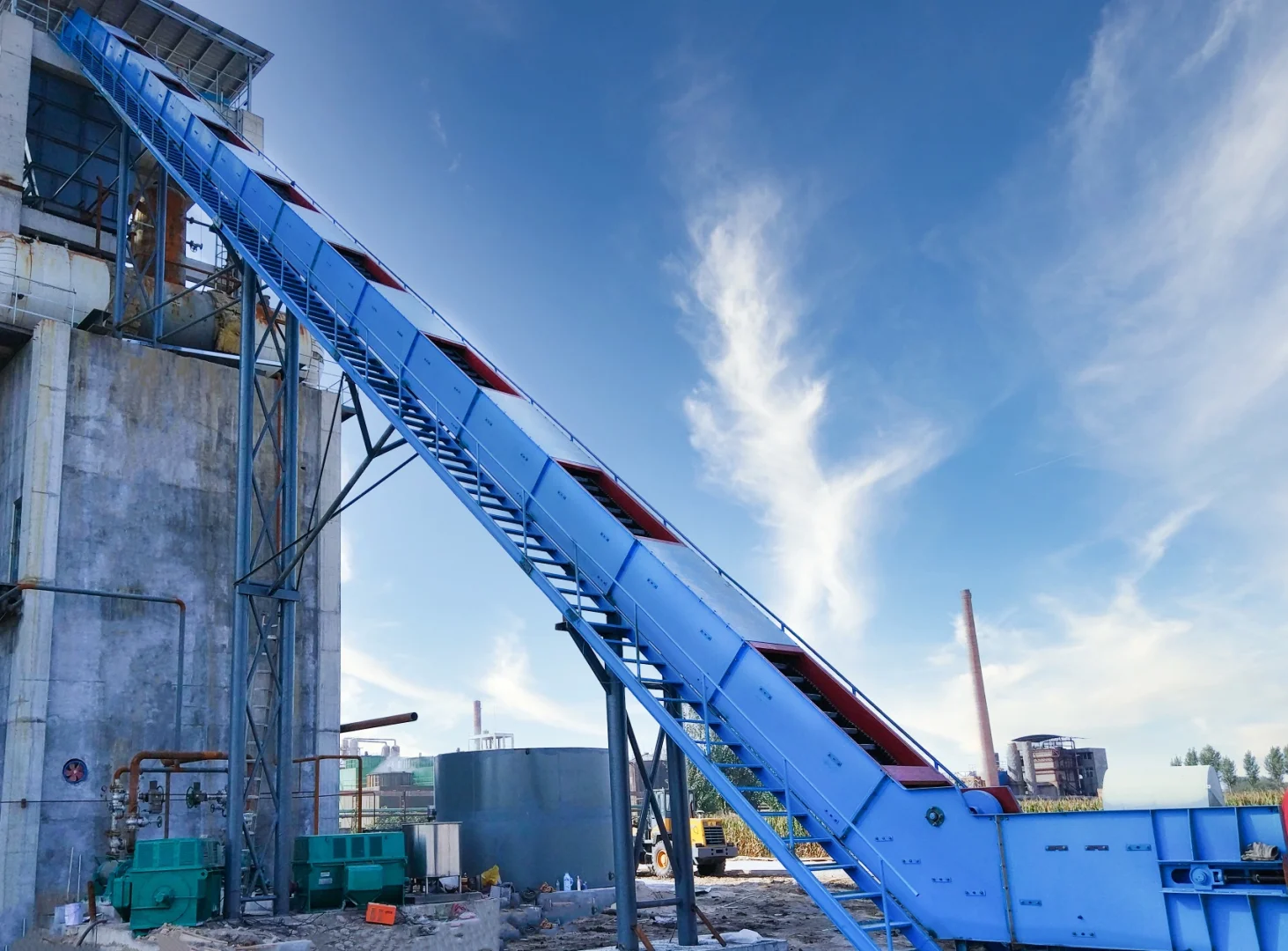
A slat belt conveyor carries products on a continuous surface made from linked plastic or metal slats. The slats engage drive sprockets and slide on wear strips or tracks, combining the positive drive of a chain with a flat product-supporting surface.
These conveyors are widely used for bottles, cans, cartons, food packages, components, hot parts, and assembly fixtures. Plastic tabletop chains suit clean, lightweight conveying, while steel or apron-style slats handle heat, impact, and heavier loads. This guide compares the main types, materials, applications, benefits, and limitations.
Key Takeaways
- A slat belt conveyor uses linked rigid plates driven by sprockets.
- Plastic and steel slats suit different loads, temperatures, and environments.
- Straight, side-flexing, apron, and low-back-pressure designs serve distinct layouts.
- Product stability, accumulation, curves, cleaning, and load determine the best construction.
What Is a Slat Belt Conveyor?
A slat belt conveyor is a chain-driven conveyor whose carrying surface consists of individual rigid or semi-rigid slats. Each slat is connected to adjacent links or attached to one or more roller chains. Together, the slats form a continuous top surface that supports products while the chain moves around sprockets.
The terms slat belt conveyor, slat conveyor, slat chain conveyor, tabletop chain conveyor, and plate-link conveyor often overlap. In many packaging and beverage applications, the product is technically a slat-top chain rather than a flexible belt. Heavy-duty systems may instead use steel plates bolted to parallel attachment chains.
Unlike a fabric or rubber belt, a slat chain does not rely on friction at a drive pulley. Its links engage sprocket teeth, creating a positive drive. The product still moves by contact with the slat surface, so friction, guides, accumulation, and product stability remain important.
Habasit describes slat-top plastic and steel chains as part of a broader conveyor-chain range that also includes low-back-pressure, flexi, snap-on, multiflex, and case chains. Straight chains are commonly used for bottles, cans, and packaged products in food and packaging operations (Habasit, Conveyor Chains, 2026).
How Does a Slat Belt Conveyor Work?
An electric motor and gearbox turn the drive shaft. Sprockets mounted on that shaft engage the slat chain and pull it along the conveyor track. At the discharge end, the chain wraps around the drive sprockets, enters the return path, travels beneath the conveyor, and loops around idlers at the opposite end.
The carrying run is normally supported by UHMW polyethylene or another low-friction wear strip. The slat surface supports the product, while side guides control bottles, cans, packages, or components. Chain tabs, bevels, or magnetic retention can hold side-flexing chains within curved tracks.
Chain tension develops from product load, sliding friction, curves, elevation changes, return resistance, and sprocket engagement. The return strand normally needs controlled catenary sag rather than the high pretension associated with many friction-driven belts. Excessive tension increases wear on pins, hinges, sprockets, tracks, and bearings.
Curved systems require side-flexing links and compatible corner tracks. A standard straight-running chain cannot simply be forced around a curve. FlexLink describes its plastic chain systems as guided by low-friction slide rails and capable of horizontal and vertical bends when the selected multiflex chain and beam system are designed together (FlexLink, Plastic Chain Conveyor Systems, 2026).
What Are the Main Types of Slat Belt Conveyors?
The main types are plastic tabletop chains, steel slat-top chains, hinged apron conveyors, side-flexing chains, and low-back-pressure accumulation chains. The correct type depends on product load, line layout, temperature, impact, friction, sanitation, and whether products must accumulate.
Plastic Tabletop Chain Conveyor
Plastic tabletop chains use molded links made from materials such as acetal, polypropylene, or polyethylene. Their flat surfaces support bottles, cans, jars, cartons, pouches, and trays. Available options include low-friction compounds, high-friction inserts, perforations, flights, and detectable materials.
These conveyors are light, corrosion resistant, relatively quiet, and available in many widths. They suit beverage, food, pharmaceutical, personal-care, packaging, and general product handling. Material selection must account for water, chemicals, temperature, wear, static, and food-contact requirements.
Steel Slat Conveyor
Steel slat-top chains use stainless or carbon-steel carrying plates. Stainless steel is common for glass bottles, hot containers, metal packages, and applications requiring temperature resistance or electrical conductivity. Steel slats provide a rigid surface and tolerate loads or impacts that can damage some plastics.
Metal-on-track friction, noise, lubrication, corrosion, plate deformation, and product marking require review. Habasit’s slat-chain catalog identifies steel variants for beverage, heavy-duty, high-temperature, and static-electricity applications (Habasit, HabaCHAIN Product Range, 2021).
Hinged Slat or Apron Conveyor
Hinged slat and apron conveyors use larger steel plates or pans attached to heavy chains. The plates may overlap to form a durable deck that carries castings, forgings, scrap, hot parts, bulk solids, or fixtures. Side plates and deep pans can contain material during horizontal or inclined transport.
These systems are heavier and slower than packaging tabletop chains. They need robust frames, shafts, bearings, sprockets, and guards. Their strengths are impact resistance, heat tolerance, and load capacity rather than delicate package handling or compact sanitary design.
Side-Flexing Curved Slat Conveyor
Side-flexing chains articulate laterally through horizontal curves and may also negotiate selected vertical bends. Tabs, bevels, or magnetic systems retain the chain in the track. A single chain can therefore connect machines around corners without a separate conveyor and transfer point.
Curves add chain pull and wear because the chain reacts against the guide track. Radius, speed, product load, lubricant, chain material, and track design must stay within the manufacturer’s limits. Tight curves can also affect tall-container stability and product spacing.
Accumulation Slat Conveyor
Accumulation conveyors allow products to stop while the chain keeps moving. Standard flat slats may work for short, controlled accumulation when product and chain friction are acceptable. Low-back-pressure chains add small rollers or sliding elements that reduce contact force during longer accumulation.
Habasit lists low-back-pressure chains equipped with small rollers for case accumulation. The reduced friction can lower product pressure and chain load, but accumulation still requires suitable stops, guides, sensors, controls, and a defined maximum queue length (Habasit, Conveyor Chains, 2026).
Which Materials Are Used for Conveyor Slats?
Slat material determines strength, friction, wear, temperature range, chemical resistance, noise, weight, and product contact. Generic material names are only a starting point. Manufacturers formulate several grades of acetal, polypropylene, polyethylene, stainless steel, and carbon steel for different operating conditions.
| Slat Material | Main Strengths | Typical Uses | Main Limitations |
|---|---|---|---|
| Acetal or POM | Strength, dimensional stability, low friction | Bottles, cans, cartons, general packaging | Chemical, chlorine, and temperature limits vary |
| Polypropylene | Chemical resistance and lower density | Wet, chemical, and selected food environments | Lower stiffness and wear performance in some duties |
| Polyethylene | Impact resistance and low-temperature options | Cold rooms and selected package handling | Lower temperature and load limits depend on grade |
| Stainless steel | Heat, rigidity, corrosion resistance, conductivity | Bottles, hot products, food packages, metal parts | Higher mass, noise, cost, and track wear |
| Carbon or coated steel | Strength and economical heavy-duty construction | Industrial parts, fixtures, apron conveyors | Corrosion protection and lubrication may be required |
Acetal is common in high-speed packaging because suitable grades combine strength with low sliding friction. Lubricated, dry-running, antistatic, flame-retardant, metal-detectable, and food-contact options may be available. Water absorption, aggressive chemicals, and temperature still need product-specific confirmation.
Stainless steel handles elevated temperature, rigid loads, sharp packages, and selected hygiene requirements. Carbon steel suits protected industrial environments and heavy apron constructions. Metal plates may need surface treatments, edge finishing, or replaceable wear components to control corrosion, friction, noise, and product damage.
For direct food contact, verify the complete chain rather than only the slat material. Links, pins, inserts, flights, lubricants, wear strips, and cleaning limits can affect suitability. TranBelt’s food conveyor belt guide explains the distinction between material compliance and hygienic conveyor design.
Where Are Slat Belt Conveyors Used?
Slat conveyors are used when products need a stable, positively driven surface and the line benefits from narrow tracks, curves, accumulation, or rigid carrying plates. Their applications range from lightweight bottles to hot metal parts, but the chain design changes substantially across that range.
Bottling and Beverage
Beverage plants use plastic and stainless-steel tabletop chains for empty and filled bottles, cans, jars, and multipacks. Straight and side-flexing chains link fillers, rinsers, cappers, labelers, packers, and palletizers. Low-friction surfaces support high throughput, while side guides keep unstable containers upright.
Accumulation is common where one machine pauses while upstream equipment continues running. Chain friction, guide pressure, container material, lubrication, and queue length must be coordinated to prevent bottle scuffing, label damage, excessive back pressure, or unstable flow.
Food and Packaging
Food and packaging lines convey trays, cartons, pouches, cans, jars, and wrapped products. Plastic slats offer corrosion resistance and configurable surfaces, while stainless chains suit selected hot, wet, or demanding duties. Curved tracks can route products around machines and reduce the number of transfer points.
Automotive and Manufacturing
Manufacturing systems use steel slats, snap-on chains, and heavy plastic chains for components, fixtures, pallets, batteries, and assembly work. A rigid slat surface provides repeatable support and can carry products that would mark or puncture a fabric belt.
Heavy or Hot-Product Handling
Steel slat and apron conveyors carry castings, forgings, hot containers, scrap, chips, and bulk materials. Overlapping pans can contain irregular material and withstand impact. These systems are common near ovens, presses, foundries, machining cells, and heat-treatment equipment.
What Are the Benefits and Limitations?
Slat conveyors provide positive sprocket drive, stable product support, and modular replacement. Individual links or slats can often be changed without replacing the entire carrying surface. Straight and side-flexing designs can form compact routes, while different widths, materials, inserts, and attachments adapt the chain to varied products.
Rigid slats support bottles, containers, fixtures, and hot parts better than many flexible belts. Plastic chains resist corrosion and can run quietly in suitable conditions. Steel slats provide heat, impact, and load capability. Curved chains can reduce transfers by following one continuous path around machinery.
The first limitation is sliding friction. Chain links move on wear strips, and curves increase side force. Friction generates wear, heat, and drive load. Chain pull must include product load, accumulation, track friction, return resistance, curve factors, and elevation changes.
Accumulation can scuff products and increase back pressure unless low-friction or roller-top designs are used. High-friction inserts improve incline grip but can prevent products from sliding during accumulation. Habasit’s engineering guide notes that GripTop inserts used for steeper inclines are incompatible with accumulation behavior (Habasit, HabaCHAIN Engineering Guide, 2025).
Slat conveyors also have chordal action as chain links engage sprockets. Larger chain pitch and small sprockets can increase speed variation and vibration. The manufacturer’s minimum sprocket size, maximum speed, allowable chain pull, curve radius, and track recommendations should govern the layout.
Slat Conveyor vs Belt Conveyor vs Roller Conveyor
A slat conveyor is strongest when positive drive, rigid support, curves, or modular links are needed. Belt conveyors provide a continuous flexible surface for small or irregular products. Roller conveyors are efficient for rigid packages with a base long enough to span multiple rollers.
| Conveyor Type | Best For | Main Strength | Main Limitation |
|---|---|---|---|
| Slat conveyor | Bottles, cans, packages, fixtures, hot parts | Positive drive and configurable chain path | Sliding wear, hinges, and higher complexity |
| Belt conveyor | Small parts, bags, bulk products, general transport | Continuous support and broad belt choices | Tracking, pulley grip, and belt damage |
| Roller conveyor | Cartons, totes, pallets | Low rolling resistance and simple accumulation | Unsuitable for small or soft-bottom products |
Slat and belt conveyors can both handle inclines, but their methods differ. A belt may use texture or cleats, while a slat chain can use friction inserts or molded flights. TranBelt’s guide to different conveyor types compares broader conveyor layouts and operating principles.
The final choice should reflect product geometry, load, speed, path, transfers, accumulation, environment, and cleaning. A stable carton on a straight dry route may need only rollers, while a bottle line with curves and accumulation strongly favors purpose-designed slat chain.
Frequently Asked Questions
Is a slat belt conveyor the same as a slat chain conveyor?
Usually. The term slat belt conveyor commonly describes a chain of linked slats forming a continuous carrying surface. Tabletop systems use integral plastic or steel slat-top links, while heavy-duty versions may attach separate plates to roller chains. Product drawings should clarify the construction.
Can a slat conveyor go around curves?
Yes, when it uses a side-flexing chain and compatible corner track. Tabs, bevels, or magnetic retention guide the chain through the curve. A straight-running chain should not be forced into a curved path because link geometry and retention differ.
Can products accumulate on a slat conveyor?
Yes, if the product and chain are designed for sliding accumulation. Standard flat-top chains may suit limited accumulation, while low-back-pressure chains use small rollers to reduce friction. High-friction inserts can prevent sliding and are normally unsuitable for accumulation zones.
Are plastic slats suitable for food contact?
Selected plastic chains are available with food-contact documentation, but suitability depends on the exact material, pins, inserts, temperature, food, cleaning chemicals, and market. The complete conveyor must also be accessible, drainable, and cleanable for the intended process.
What drives a slat belt conveyor?
Drive sprockets engage the chain links and are powered by a motor and gearbox. Unlike a friction-driven flat belt, the slat chain does not depend on pulley grip. Sprocket profile, tooth count, shaft alignment, and chain series must match.
Conclusion
A slat belt conveyor uses linked plastic or metal plates to create a stable, positively driven conveying surface. Plastic tabletop, steel slat, apron, side-flexing, and low-back-pressure chains each serve different loads, routes, temperatures, and accumulation needs.
Choose the system from product behavior and operating conditions. Confirm chain material, width, pitch, curve radius, support track, sprockets, accumulation, environment, and allowable pull with the manufacturer’s engineering method. A properly matched slat conveyor offers flexible routing, durable support, and reliable product flow.
Sources
- Habasit, Conveyor Chains, retrieved 2026-07-20.
- Habasit, HabaCHAIN Product Range, retrieved 2026-07-20.
- Habasit, HabaCHAIN Engineering Guide, retrieved 2026-07-20.
- FlexLink, Plastic Chain Conveyor Systems, retrieved 2026-07-20.
- mk Technology Group, Conveyor Chains and Equipment, retrieved 2026-07-20.