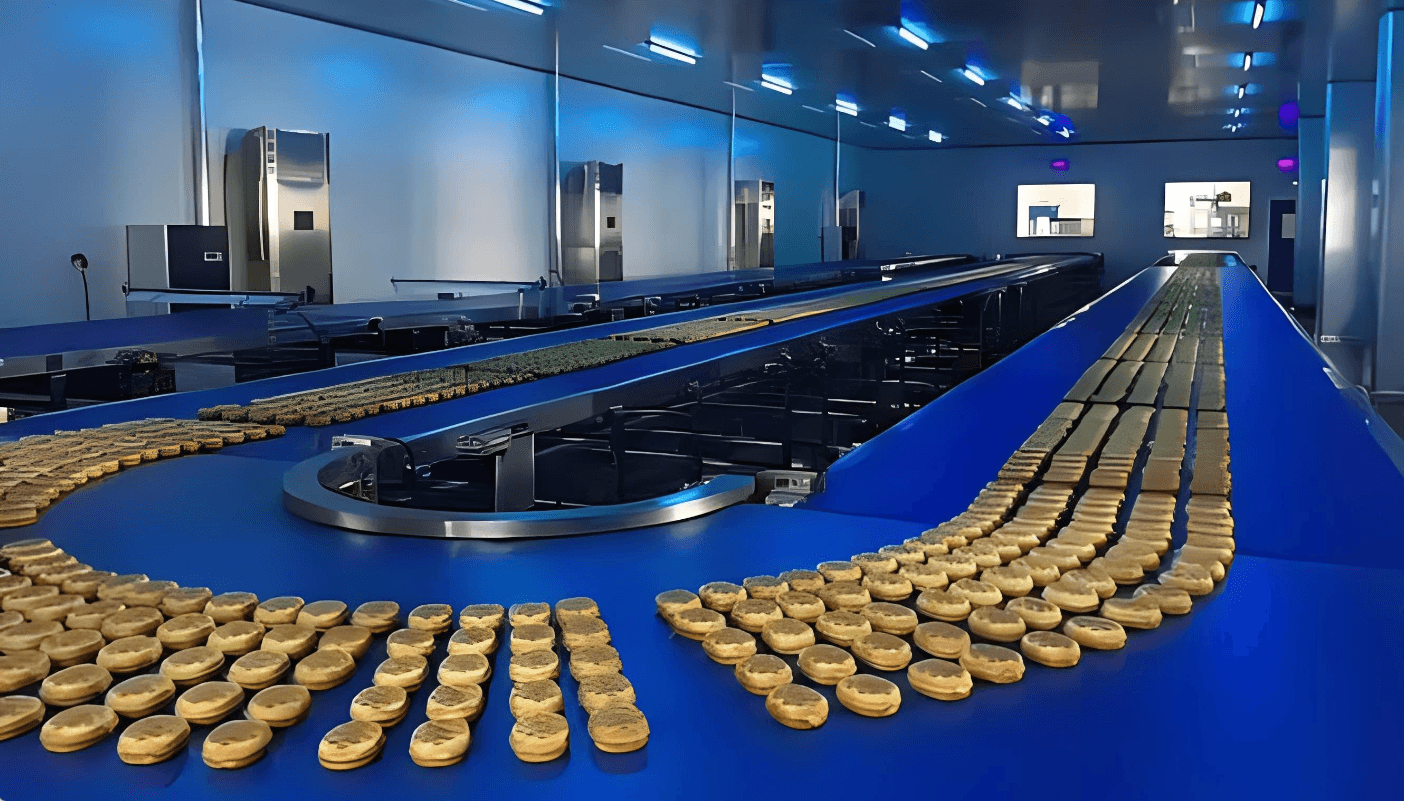
A food conveyor belt moves ingredients, unpackaged food, or packaged products through processing, cooking, cooling, inspection, and packing operations. Unlike a general-purpose belt, its complete construction must suit the food, operating temperature, cleaning method, and applicable food-contact requirements.
The right belt is not determined by color or polymer name alone. Surface finish, edges, splices, flights, drive method, and conveyor access all affect hygiene and performance. This guide compares the main types, materials, and applications.
Key Takeaways
- Food-contact compliance must cover the finished belt and its intended conditions of use.
- PU, PVC, silicone, modular plastic, and metal belts solve different processing problems.
- Product properties, sanitation chemicals, temperature, and conveyor geometry should guide selection.
- Hygienic conveyor design matters as much as the belt material itself.
What Is a Food Conveyor Belt?

A food conveyor belt is a moving surface designed to transport food or food packaging through a production process. It may carry products directly, as with dough, meat, or vegetables, or indirectly by moving trays, cartons, bottles, and sealed packs.
For direct contact, the belt must be suitable for the defined food and operating conditions. The European Union’s Regulation (EC) No 1935/2004 applies to materials intended, already used, or reasonably expected to contact food. It requires materials not to endanger health, unacceptably change food composition, or impair sensory properties under normal or foreseeable use.
In the United States, the phrase “FDA approved belt” can be misleading. FDA requirements concern food-contact substances and their permitted uses, rather than providing one universal approval badge for every finished conveyor belt. Buyers should request the relevant regulatory basis, food type, temperature, contact time, and any limitations for the exact belt construction.
Compliance does not guarantee hygienic operation. A compliant belt installed on a frame with inaccessible rollers, poor drainage, rough welds, or product traps may still create contamination risks. The FDA’s fresh-cut produce guidance recommends smooth, sealed, non-absorbent, durable, and easily cleanable food-contact surfaces, including conveyor belts.
What Are the Main Types of Food Conveyor Belts?

Food conveyor belts are usually grouped by construction and drive method. Flat coated-fabric belts handle many light and medium duties, while monolithic and modular belts suit demanding washdown environments. Mesh constructions provide airflow, drainage, or heat transfer. Each type changes how the conveyor tracks, cleans, transfers, and releases products.
Flat Coated-Fabric Belts
Flat belts use a woven fabric carcass covered with PU, PVC, silicone, or another polymer. The reinforcement provides tensile strength and dimensional stability, while the cover contacts the product. These belts can run over small pulleys and support thin knife-edge transfers, making them useful for bakery, confectionery, produce, and packaged-food lines.
Damaged covers, exposed fabric edges, and poorly finished splices can absorb moisture or retain food soil. Sealed edges and carefully fabricated splices reduce these risks. The correct construction depends on belt thickness, pulley size, sanitation, and whether food contacts both surfaces.
Monolithic Homogeneous Belts
Monolithic belts are formed from a single thermoplastic material without a fabric carcass. Their solid construction removes exposed textile layers and can simplify inspection after cuts or edge damage. Many designs use positive-drive sprockets, reducing the tension needed to transmit motion and helping control tracking in wet production areas.
These belts are common in meat, poultry, seafood, dairy, and produce processing. They still require a hygienic splice, cleanable flights, suitable supports, and access beneath the belt. A homogeneous surface cannot compensate for a frame that traps water.
Modular Plastic Belts
Modular belts consist of interlocking plastic modules connected by hinge rods. Damaged sections can be replaced without changing the entire belt, and molded flights, side guards, perforations, and friction inserts are available. Positive sprocket engagement makes modular belts useful for curves, inclines, accumulation, cooling, and washdown applications.
Hinges and rods create more interfaces than a smooth belt. Product size, open area, cleaning access, transfer gap, and turning radius must be checked together. TranBelt’s overview of different types of belt conveyors explains how modular construction fits broader layouts.
Metal Mesh and Wire Belts
Stainless-steel wire, balanced-weave, chain-edge, and flat-wire belts tolerate heat and provide open area for airflow, oil drainage, washing, or cooling. They are used in ovens, fryers, freezers, blanchers, and cooling tunnels where conventional polymers may not withstand the process.
Metal belts are not automatically easy to clean. Wire intersections, chain joints, and support rails can retain soil, while open structures may mark delicate products. Evaluate alloy grade, temperature cycling, product release, wear, and cleaning access.
Cleated and Sidewall Belts
Cleats, flights, or corrugated sidewalls help carry loose food on inclines and divide products into controlled portions. They are available on coated-fabric, monolithic, and modular belts. Typical uses include lifting vegetables, snacks, frozen pieces, dough portions, and packaged products between processing levels.
Every profile adds surfaces and joints to inspect. Rounded bases, smooth welds, compatible materials, and open pockets generally improve cleaning. Cleat height and spacing must suit pulley diameter, return supports, loading, and discharge behavior.
Which Materials Are Used for Food Conveyor Belts?
Material selection begins with the process, not a generic ranking. Food chemistry, moisture, temperature, abrasion, cleaners, and loading change performance. Two PU or PVC belts may use different formulations, fabrics, pigments, and surfaces, so product-specific documentation remains essential.
| Belt Material | Common Strengths | Typical Applications | Points to Verify |
|---|---|---|---|
| PU or TPU | Flexible, abrasion resistant, good oil and fat performance in suitable grades | Meat, bakery, dairy, seafood, produce | Hydrolysis, sanitizer, heat, splice and edge limits |
| PVC | Economical, broad range of textures and profiles | Dry foods, packaged goods, light processing | Plasticizer, oil, cold, chemical and direct-contact suitability |
| Silicone | Release properties and useful heat resistance | Bakery, confectionery, sticky or warm products | Cut resistance, tracking, abrasion and maximum temperature |
| Modular plastic | Replaceable modules, positive drive, drainage options | Washdown, cooling, accumulation, packaged foods | Hinge cleaning, transfer gaps, module and rod materials |
| Stainless steel | High-temperature capability and open area | Frying, baking, cooking, cooling and freezing | Alloy, wear, product marking, release and cleaning access |
| Food-contact rubber | Grip, impact tolerance and heavy-duty construction | Selected bulk food and packaged-product duties | Compound documentation, fat, water, cracking and sanitation limits |
PU and TPU belts are widely used where flexibility, abrasion resistance, and resistance to animal fats or vegetable oils are important. Monolithic PU constructions can remove fabric exposure, while coated-fabric versions allow thinner belts and smaller transfers. Water temperature, alkaline cleaners, acids, and long-term hydrolysis still need to be checked against the supplier’s data.
PVC remains practical for many dry-food and packaged-product conveyors. It offers numerous textures, profiles, and economical constructions. However, direct food contact, oil resistance, low-temperature flexibility, and cleaning-chemical compatibility depend on the formulation. PVC should not be rejected or accepted solely because of its material name.
Silicone provides useful release for sticky dough, sugar products, and warm bakery items. It can also tolerate temperatures beyond many standard thermoplastics when the exact grade and construction are suitable. Its limitations may include lower cut resistance, lower abrasion life, and more demanding tracking on certain conveyor layouts.
Where Are Food Conveyor Belts Used?

The application determines which belt characteristics matter most. A dough belt needs gentle release and accurate transfer. A raw-poultry belt prioritizes cleanability, fat resistance, and washdown access. A fryer belt requires temperature resistance and oil drainage. Treating all food conveyors as one duty is a common cause of premature failure.
Bakery and Confectionery
Bakery lines convey flour, dough, pastry, bread, biscuits, chocolate, and wrapped products. Thin PU or PVC belts can support small nose-bar transfers, while silicone surfaces improve release for sticky products. Belt texture must balance grip with cleaning, because deep patterns can retain flour, sugar, fats, and allergens during product changeovers.
Meat, Poultry, and Seafood
Wet raw-protein lines often use monolithic PU, hygienic positive-drive, or carefully specified modular belts. The belt must tolerate fats, cutting exposure, cold conditions, frequent washdown, and sanitation chemicals. Smooth edges and accessible undersides are particularly important because damaged fabric, hinge zones, and shadow areas can retain organic material.
Fruit and Vegetable Processing
Produce conveyors handle soil, water, leaves, acids, and products that bruise easily. Open modular belts support washing and drainage, while smooth PU belts suit inspection, trimming, and delicate transfers. The FDA specifically identifies conveyors and belts as food-contact surfaces in its fresh-cut produce guidance and recommends designs that avoid cracks, crevices, exposed threads, and difficult-to-clean joints.
Dairy and Cheese
Dairy applications may expose belts to fat, protein, moisture, salt, acids, and cold rooms. Smooth PU and homogeneous belts are common for cheese portions and unpackaged products. Release behavior matters because sticky curd can increase carryback, while aggressive scraping can damage the belt and create fragments or rough surfaces.
Frozen and Chilled Foods
Low temperatures can stiffen covers, splices, and hinges. A belt that performs normally at room temperature may crack or resist flexing in a freezer. Confirm minimum temperature, start-up behavior, impact resistance, and compatibility with frost, defrost cycles, and cleaning.
Packaged Food and Beverage
Packaged products usually create less direct-contact risk, but the conveyor still needs suitable grip, tracking, wear life, and cleanability. PVC, PU, rubber, and modular belts are all used for cartons, pouches, bottles, cans, and trays. Side-flexing modular designs can combine curves and straight runs where floor space is limited.
How Do Food-Grade Belt Materials Compare?
No material wins every category. PU is a strong starting point for oily or unpackaged foods, but silicone may release sticky products better. Modular plastic suits positive drive and complex layouts, while steel handles high heat. PVC can be the most economical choice for mild dry or packaged-food duties.
Compare more than purchase price. A lower-cost belt may need more tensioning, cleaning, or replacement. A hygienic belt may reduce sanitation time but require new sprockets or supports. Total cost includes installation, downtime, cleaning, labor, product loss, and service life.
Blue is popular because fragments are easier to see against many foods, but color does not prove compliance. White is not automatically cleaner, and metal-detectable compounds still need validation with the plant’s detector, product effect, line speed, and target fragment size. TranBelt’s food-safe conveyor belt selection guide covers these documentation and validation questions in greater depth.
How Should You Choose a Food Conveyor Belt?
Start by defining the product and process conditions. Record whether contact is direct, the food’s fat and moisture content, particle size, stickiness, temperature, throughput, belt speed, incline, transfer points, and contamination controls. A supplier cannot recommend a reliable belt from width and length alone.
Next, document sanitation. State the cleaning frequency, water temperature, detergent, sanitizer, concentration, exposure time, pressure, and whether the conveyor is cleaned in place or disassembled. The FDA Food Code 2022 defines easy cleanability in terms of effective soil removal and the material, design, construction, and installation of the surface.
Match the belt construction to the conveyor. Confirm pulley or sprocket dimensions, take-up travel, support bed, tracking system, return rollers, scrapers, nose bars, and available access. Positive-drive belts may reduce tension but require compatible sprockets and geometry. Small transfers may favor thin fabric belts, provided hygiene and service conditions permit them.
Then request documentation for the complete finished product. Check the base polymer, reinforcement, pigments, surface coating, splice, sealed edges, flights, sidewalls, adhesives, and repair materials. For EU use, ask for applicable food-contact declarations and traceability. For U.S. use, request the relevant regulatory basis and conditions of use rather than a vague “FDA approved” statement.
Finally, validate the belt on the actual line. Inspect tracking, transfer, product release, carryback, cleaning access, drying, and the condition of edges and splices. EHEDG’s hygienic design guidance for belt conveyors applies where food contacts the conveyor or indirect contamination is possible, especially in wet-cleaning environments.
In 2026, 3-A Sanitary Standards released the third edition of its foundational General Requirements Standard for hygienic equipment design. The update reinforces that material choice, construction, and equipment design must be considered together. A belt specification should therefore be reviewed with the complete conveyor and plant sanitation program, not as an isolated spare part.
Frequently Asked Questions
What is the best material for a food conveyor belt?
There is no universal best material. PU often suits oily, wet, or unpackaged foods, while PVC can be economical for dry and packaged products. Silicone helps release sticky bakery products, modular plastic supports positive-drive layouts, and stainless steel handles high temperatures. The correct grade depends on the complete process and sanitation conditions.
Are all blue conveyor belts food safe?
No. Blue color can improve visual detection against many foods, but it does not establish food-contact compliance. Verify the exact belt, splice, edge treatment, flights, and intended conditions of use. A blue general-purpose belt may still contain materials or components that are unsuitable for direct food contact.
What is the difference between a food-grade and hygienic conveyor belt?
A food-grade belt has documented suitability for defined food-contact conditions. A hygienic belt is also constructed and installed to support effective cleaning, drainage, inspection, and maintenance. A compliant material can still perform poorly in hygiene if the splice, underside, supports, or conveyor frame creates inaccessible contamination traps.
Is PU better than PVC for food processing?
PU often provides better oil, fat, abrasion, and low-temperature performance in suitable grades. PVC can cost less and offers many surface patterns. Neither material is automatically superior. Compare the exact formulation, food-contact documentation, chemical exposure, temperature, release, pulley requirements, and expected service life before deciding.
How often should a food conveyor belt be replaced?
Replace a belt when wear exceeds the site’s defined acceptance limits, not after a fixed calendar period. Warning signs include cracks, delamination, exposed fabric, damaged edges, rough splices, deep cuts, missing modules, persistent tracking problems, or surfaces that can no longer be cleaned effectively. Inspection frequency should reflect product and process risk.
Conclusion
A food conveyor belt should be selected as part of the complete processing and sanitation system. Flat fabric, monolithic, modular plastic, cleated, silicone, and metal belts each solve different problems, so the best choice depends on the food, temperature, cleaning chemicals, transfers, drive method, and hygienic risk.
Define the application before comparing products, then verify the complete construction and its regulatory basis. A short production trial should confirm tracking, release, cleanability, and inspection criteria. This process produces a belt that is not only suitable for food contact but also practical to operate and maintain.
Sources
- European Union, Regulation (EC) No 1935/2004 on materials and articles intended to come into contact with food, retrieved 2026-07-17.
- U.S. Food and Drug Administration, Food Code 2022, retrieved 2026-07-17.
- U.S. Food and Drug Administration, Guide to Minimize Microbial Food Safety Hazards of Fresh-cut Fruits and Vegetables, retrieved 2026-07-17.
- EHEDG, Guideline 43: Hygienic Design of Belt Conveyors for the Food Industry, retrieved 2026-07-17.
- 3-A Sanitary Standards, Inc., General Requirements Standard Third Edition, retrieved 2026-07-17.