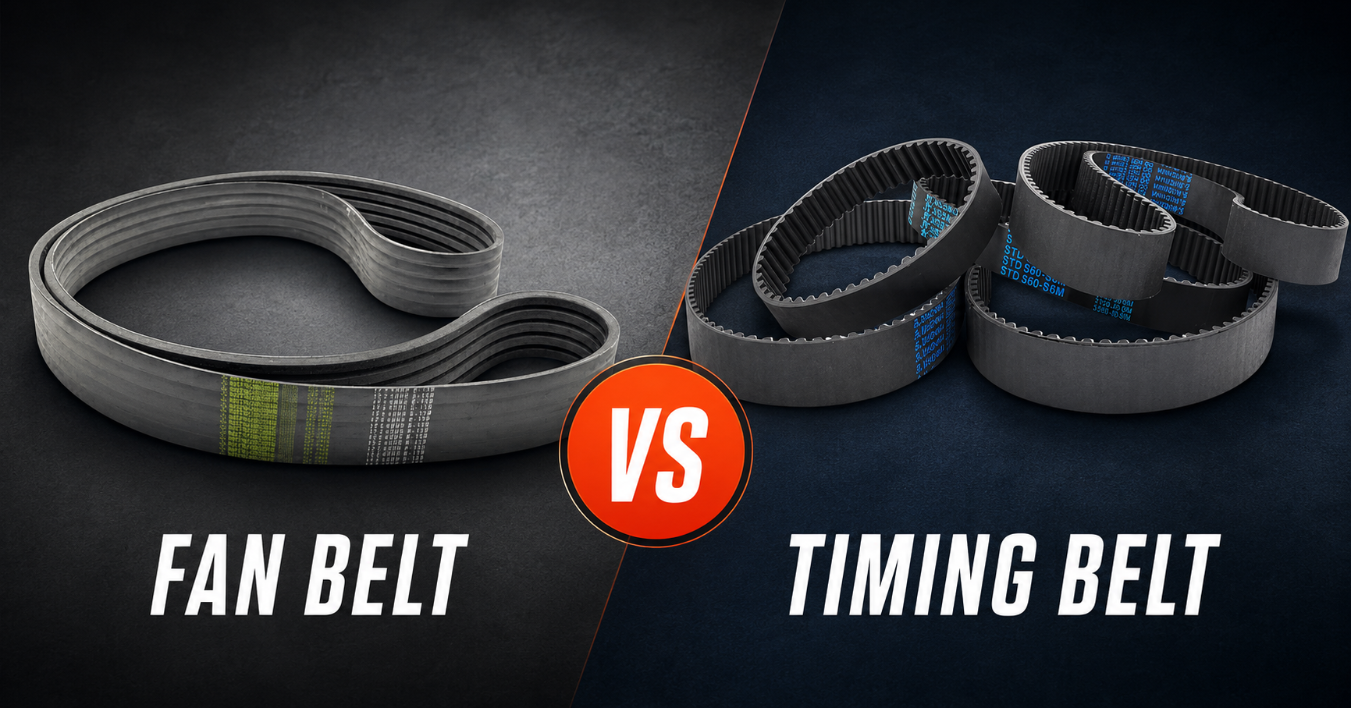
A fan belt is an external friction-drive belt associated with engine accessories such as a mechanical cooling fan, water pump, alternator, or air-conditioning compressor. A timing belt is a toothed synchronous belt that coordinates crankshaft and camshaft rotation inside the engine timing system.
The phrase fan belt is often a legacy or informal name. Many modern vehicles use an electric cooling fan and one serpentine belt for several accessories. Others use separate V-belts. This guide explains the functional difference without assuming every engine has the same fan, accessory, or timing arrangement.
Key Takeaways
- A fan belt drives external accessories through friction; a timing belt synchronizes internal engine rotation.
- Modern vehicles often use a serpentine belt instead of a dedicated fan belt.
- Fan-belt failure can stop cooling, charging, steering assistance, or air conditioning, depending on layout.
- Timing-belt failure stops synchronization and may damage an interference engine.
What Is a Fan Belt?
A fan belt is traditionally a V-belt that transfers crankshaft power to an engine-driven cooling fan and often the water pump. Depending on vehicle design, the same belt may also drive the alternator or another accessory.
The term dates from engines with mechanically driven radiator fans. Modern passenger vehicles frequently use electric fans controlled independently of the accessory belt. In those vehicles, drivers and parts sellers may still use fan belt as a general name for the external serpentine or accessory drive belt.
AAA distinguishes older dedicated fan belts from modern serpentine systems and notes that a fan belt may drive the radiator fan, water pump, and sometimes another accessory (AAA, A Guide to Automotive Belts and Hoses).
A traditional V-belt has a trapezoidal section. Its sidewalls wedge into matching pulley grooves. A serpentine belt is wide and thin with multiple longitudinal ribs. It winds around several accessory pulleys and may contact smooth idlers on its backing side.
Both designs transmit power by friction. Belt tension creates contact force at the pulley. Insufficient tension, worn ribs, oil, coolant, poor alignment, or a seized component can cause slip, heat, noise, and reduced accessory output.
Fan belt is not a precise ordering term. A correct replacement requires vehicle identification, engine code, production date, accessory options, belt route, rib count or V-profile, and effective length. TranBelt’s alternator belt versus timing belt guide explains the related alternator terminology.
What Is a Timing Belt?
A timing belt is a toothed belt connecting the crankshaft to one or more camshafts. It keeps valve movement synchronized with piston position. Some timing belts also drive a water pump, oil pump, injection pump, or balance shaft.
The belt normally runs behind protective covers. Its transverse teeth engage matching pulley spaces, so the crankshaft and camshaft maintain a fixed rotational relationship without normal operating slip.
AAA explains that timing belts differ from serpentine and V-belts in both function and design, using crosswise teeth to maintain crankshaft and camshaft relationship (AAA, Make Sense of Car Care: Belts and Hoses).
Timing belts contain tensile cords, molded teeth, backing rubber, and tooth-facing fabric. Pitch, tooth profile, width, and tooth count match the engine pulleys. A physically similar belt cannot be substituted unless the exact vehicle application confirms compatibility.
Not every engine uses a timing belt. Alternatives include timing chains and gears. Some newer engines use wet timing belts operating in engine oil. Service intervals, oil specifications, inspection methods, and replacement procedures differ by engine.
Because the timing system controls internal engine movement, installation requires exact crankshaft and camshaft positions. TranBelt’s guide to timing belt pitch explains the underlying tooth geometry, but vehicle service data must govern repair.
Fan Belt vs Timing Belt: What Are the Main Differences?
The fan belt powers external accessories through pulley friction. The timing belt synchronizes internal engine components through tooth engagement. The table describes typical designs; the exact driven components depend on the vehicle.
| Feature | Fan Belt | Timing Belt |
|---|---|---|
| Main function | Drives fan, water pump, alternator, or other accessories | Synchronizes crankshaft and camshaft |
| Common modern equivalent | Serpentine or accessory drive belt | Toothed timing belt |
| Typical profile | V-belt or multi-rib belt | Transverse-tooth synchronous belt |
| Drive method | Friction against pulley grooves | Positive tooth engagement |
| Location | Outside the engine timing cover | Behind protective timing covers |
| Normal slip | Possible when grip or tension is insufficient | Not permitted during operation |
| Failure effect | Stops the accessories on that belt | Stops or disrupts engine timing |
| Main risk | Overheating, charging loss, steering change, breakdown | No-start and possible internal engine damage |
| Inspection basis | Belt, tensioner, pulleys, and driven accessories | Belt, tensioner, idlers, seals, and related timing components |
| Replacement basis | Vehicle schedule and condition | Manufacturer’s engine-specific interval |
A fan or serpentine belt has longitudinal ribs or V-shaped sidewalls. A timing belt has teeth running across its width. Longitudinal accessory-belt ribs should not be confused with timing teeth.
The belts may both receive rotation from the crankshaft, but they run on separate pulley paths. The external belt tolerates controlled friction behavior. The timing belt must preserve exact tooth engagement.
Fan belts are generally more visible and accessible. Timing belts are covered to protect them from debris and contamination. Cover removal, engine support, special tools, and timing procedures can make timing-belt service more complex.
Neither belt has a universal replacement interval. Use the maintenance schedule for the exact engine. Mileage, time, operating conditions, leaks, tensioner wear, and repair history can affect service needs.
Parts and repair costs differ by layout. A simple V-belt can be relatively quick to replace. A timing-belt job may include tensioners, idlers, seals, and a water pump, plus substantial access work.
How Do Fan Belts and Timing Belts Work?
Fan belts and timing belts transfer crankshaft rotation using different contact mechanics. The fan or accessory belt depends on friction and tension. The timing belt depends on teeth, pitch, and controlled engagement.
Friction Drive in Fan and Serpentine Belts
The crankshaft pulley pulls the belt around accessory pulleys. Tension presses V-belt sidewalls or serpentine ribs into grooves. Friction then transfers torque to the fan, water pump, alternator, compressor, or steering pump.
The required torque changes as accessories switch on and off. Electrical charging demand, air-conditioning compressor load, steering load, and cooling conditions can increase belt force. A healthy tensioner or correctly adjusted V-belt maintains contact.
AAA describes modern serpentine belts as multi-rib belts that follow a twisting path around accessory pulleys (AAA, The Serpentine Belt: One Belt to Rule Them All). The backing may run over smooth idlers or drive a smooth accessory pulley.
Slip converts motion into heat and wear. It may produce squeal, glazing, rib loss, poor charging, weak cooling, or reduced air-conditioning output. Replacing the belt without correcting a worn tensioner, pulley, misalignment, or seized accessory can repeat the failure.
Synchronous Tooth Engagement in Timing Belts
Timing-belt teeth enter matching crankshaft and camshaft pulley spaces. Every tooth advances a fixed pitch, keeping the shafts in their required ratio and phase. Belt tension controls engagement without creating excessive bearing or cord load.
Tensile cords limit elongation. Tooth fabric reduces wear, while the rubber body transfers force between cords and teeth. A skipped tooth changes valve timing even if the belt remains intact.
Gates describes automotive timing belts as heat-, wear-, and contamination-resistant systems built around toothed synchronous operation (Gates, Automotive Timing Belts).
Incorrect tension, locked idlers, water-pump failure, oil, coolant, debris, damaged pulleys, or installation errors can cause tooth damage or breakage. Timing marks and manufacturer procedures must be followed during service.
What Happens When a Fan Belt Fails?
When a fan belt breaks or slips, every component driven by that belt loses speed or stops. The consequences depend entirely on the engine layout and whether the belt is dedicated or shared.
If the belt drives a mechanical fan or water pump, coolant temperature can rise quickly. Some engines use an electric fan but still drive the water pump from the accessory belt. Others drive the pump through the timing system or an electric motor.
If the belt drives the alternator, the charging warning light may illuminate and the battery will discharge. If it drives a hydraulic steering pump, steering effort can rise sharply. Air conditioning may also stop.
AAA warns that serpentine-belt failure can remove coolant circulation or power-steering assistance on designs where those components share the belt (AAA, The Serpentine Belt: One Belt to Rule Them All).
A broken fan belt can whip nearby wiring, hoses, covers, or another belt. Loose fragments should be removed only after the engine is stopped, cool, and secured. Never reach near moving pulleys.
Stop safely if a warning light, rising coolant temperature, heavy steering, burning smell, or sudden accessory loss appears. Continuing to drive can turn a belt failure into overheating or electrical damage.
What Happens When a Timing Belt Fails?
When a timing belt breaks, strips teeth, or jumps, the camshaft no longer remains correctly synchronized with the crankshaft. The engine may stop, crank without starting, misfire, lose power, or produce abnormal internal noise.
In an interference engine, pistons and valves share overlapping space at different times. Lost timing can allow contact that bends valves or damages pistons and cylinder-head components. A non-interference engine usually stops without this collision, but still requires timing-system repair.
AAA notes that some engines are designed with clearance, while interference engines can suffer piston and valve damage after timing-belt failure (AAA, Car Maintenance Guide: Belts).
Failure can originate from the belt, tensioner, idler, water pump, pulley, seal leak, cover damage, or foreign material. Gates recommends viewing the timing belt, pulleys, tensioners, guides, and water pump where applicable as a system (Gates, Timing Belt Drive Systems).
Do not repeatedly crank an engine after suspected timing failure. A technician should verify timing and engine condition using vehicle-specific procedures. Installing a new belt without checking damage can create another failure.
How Can You Identify Fan Belt and Timing Belt Problems?
Fan-belt problems usually create external accessory symptoms, visible wear, or friction noise. Timing-belt problems can create no-start, misfire, correlation faults, or internal engine symptoms. Sounds alone are not a reliable diagnosis.
Squealing, Chirping and Visible Accessory-Belt Wear
Squealing often indicates accessory-belt slip from low tension, contamination, worn ribs, or excessive pulley resistance. Chirping may indicate misalignment, pulley runout, damaged ribs, or a bearing problem.
With the engine off and cold, inspect for frayed edges, missing ribs, glazing, contamination, hardened surfaces, and abnormal tensioner position. Modern EPDM belts can lose rib material without obvious cracking, so visual condition is only part of inspection.
Do not use belt dressing, oil, or solvent to silence noise. Diagnose the belt, tensioner, idlers, pulleys, alignment, and driven accessories. TranBelt’s serpentine belt cleaning guide explains when cleaning is appropriate.
Overheating, Steering and Charging Symptoms
Rising coolant temperature can indicate loss of a belt-driven fan or water pump, but cooling-system faults have many other causes. A charging warning light can indicate belt slip, alternator failure, wiring, battery, or control problems.
Heavy steering can follow loss of a belt-driven hydraulic pump. Electric power steering does not depend on such a pump, although low charging voltage may still affect electrical systems.
Check the routing diagram before deciding which component stopped. One serpentine belt may drive all accessories, while older engines can have several V-belts with different functions.
No-Start, Misfire and Timing Symptoms
A broken timing belt often produces sudden shutdown followed by fast or uneven cranking. A jumped belt may cause misfire, reduced power, fault codes, hard starting, or no-start.
These symptoms also occur with ignition, fuel, sensor, battery, starter, or compression faults. Because the timing belt is covered, professional testing may be needed before dismantling.
Do not rely on visible backing condition to extend a scheduled timing-belt interval. Cord, tooth, or adhesion deterioration may not be externally obvious.
Is a Fan Belt the Same as an Alternator or Serpentine Belt?
Fan belt, alternator belt, drive belt, and serpentine belt can refer to overlapping systems, but they are not always exact synonyms. The correct meaning depends on the vehicle and which accessories share each belt.
On an older engine, one V-belt may drive the fan and water pump, while another drives the alternator or air-conditioning compressor. That creates genuinely separate fan and alternator belts.
On many modern engines, one serpentine belt drives the alternator and several accessories. If the cooling fan is electric, the belt may not drive the fan at all, even if someone informally calls it a fan belt.
AAA describes the serpentine belt as a single belt powering multiple accessories and notes that dedicated V-belts were common in older layouts (AAA, A Guide to Automotive Belts and Hoses).
Use the vehicle’s parts catalog and routing label instead of relying on the informal name. Specify engine, year, model, production information, air-conditioning, steering, and accessory options when ordering.
Frequently Asked Questions
Is a fan belt the same as a timing belt?
No. A fan belt is an external friction belt that drives one or more accessories. A timing belt is a toothed synchronous belt coordinating the crankshaft and camshaft. They use different pulleys and cannot replace each other.
Do modern cars still have fan belts?
Many no longer have a dedicated fan belt because the cooling fan is electric. They may still use a serpentine belt for the alternator, water pump, air conditioning, or steering pump. Some engines use multiple accessory belts.
Can a car run with a broken fan belt?
It may run briefly, but the consequences depend on what the belt drives. Charging, coolant circulation, or steering assistance may stop. Watch for warning lights and temperature rise, stop safely, and obtain vehicle-specific assistance.
Can a car run with a broken timing belt?
No. The engine normally stops or cannot start because camshaft synchronization is lost. An interference engine may suffer internal damage. Avoid repeated starting attempts and have the timing system inspected.
How often should fan and timing belts be replaced?
Follow the vehicle manufacturer’s maintenance schedule and inspection procedure. Timing intervals are engine-specific. Accessory belts may use condition-based or scheduled replacement. Age, leaks, tensioner wear, climate, and service history can require earlier attention.
Conclusion
A fan belt drives external cooling or accessory components through friction. A timing belt uses toothed engagement to synchronize crankshaft and camshaft movement. Their location, construction, symptoms, service procedures, and failure risks are different.
Because fan belt is often an informal name, identify the exact vehicle belt route before ordering. Follow engine-specific maintenance guidance and inspect the complete accessory or timing system whenever a belt shows trouble.
Sources
- AAA, A Guide to Automotive Belts and Hoses, retrieved 2026-07-28.
- AAA, Make Sense of Car Care: Belts and Hoses, retrieved 2026-07-28.
- AAA, Car Maintenance Guide: Belts, retrieved 2026-07-28.
- AAA, The Serpentine Belt: One Belt to Rule Them All, retrieved 2026-07-28.
- Gates, Automotive Timing Belts, retrieved 2026-07-28.
- Gates, Timing Belt Drive Systems, retrieved 2026-07-28.
- Gates, Complete Micro-V Kits, retrieved 2026-07-28.
- Continental, Automotive Power Transmission Solutions, retrieved 2026-07-28.