A conveyor belt with cleats has raised profiles attached across or along its conveying surface. The cleats support, separate, position, or contain products that might otherwise slide, roll, or flow backward, especially on inclined and declined conveyors.
Cleated belts are used for food, packaging, agriculture, recycling, logistics, manufacturing, and bulk handling. The correct design depends on product shape, conveyor angle, belt speed, transfer method, cleaning requirements, pulley size, and whether side containment is needed.
This guide compares cleat shapes, belt materials, applications, benefits, limitations, and the information a supplier needs to build the correct belt.
Key Takeaways
- Cleats support products during incline, decline, separation, and indexing.
- Straight, T, L, V, chevron, and scoop profiles serve different materials.
- Cleat and belt materials must be compatible with each other and the process.
- Sidewalls contain bulk products but add bending and cleaning requirements.
- A useful quote needs product, conveyor, dimensions, layout, and environment data.
What Is a Conveyor Belt with Cleats?
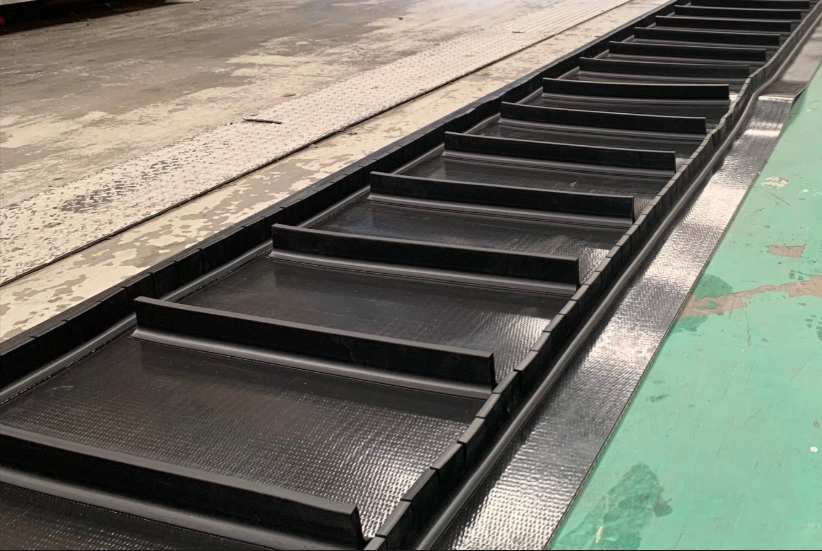
A cleated conveyor belt is a flat, monolithic, modular, rubber, or timing belt fitted with raised profiles. These profiles are also called flights, lugs, or carriers. They create pockets or barriers that control product movement as the belt travels.
Habasit describes thermoplastic cleats as accessories used mainly for incline and decline transport, where they assist conveying and product placement (Habasit, Conveyor Belt Accessories). A transverse cleat supports material against rollback. A longitudinal profile may guide the product or form a low side barrier.
Cleats act on the conveyed product; they do not automatically increase traction at the drive pulley. The conveyor must still provide adequate drive force.
A textured belt increases friction across its face, while cleats create physical barriers. Intralox notes that high-grip surfaces can sometimes handle inclines without flights (Intralox, ThermoDrive Belt Surfaces).
Corrugated or straight sidewalls run near the edges to contain loose material. They can combine with transverse cleats to form pockets.
What Are the Main Cleat Types and Shapes?
Cleat shape determines how the belt supports, releases, and contains the product. A tall rigid profile may hold a carton securely but damage soft food or struggle around a small pulley. A flexible profile bends easily but may deflect under a heavy bulk load.
| Cleat Type | Shape and Behavior | Typical Products |
|---|---|---|
| Straight rectangular | Simple transverse barrier | Boxes, bags, parts, produce |
| T-shaped | Wide top with a narrower base | Sticky or loose food, general incline transport |
| L-shaped | Angled lip supports the product | Trays, packages, components |
| V-shaped | Angled profiles direct material inward | Grain, produce, loose pieces |
| Chevron | Repeating V or arrow pattern | Aggregates, agricultural products, bulk solids |
| Scoop or bucket | Curved or pocket-like carrier | Powders, granules, small bulk products |
| Peg or finger | Individual projections rather than a full bar | Delicate products, sorting, positioning |
Straight rectangular cleats are the most versatile. They can run across the full width or stop short of each edge. Habasit’s rectangular TPEE profiles are designed to secure products during incline and decline transport and can also be mounted longitudinally as barriers (Habasit, TPEE Rectangular Cleats Product Data).
T-shaped profiles provide a broad contact face and useful stiffness. Habasit’s Cleanline TPO food range offers 20, 30, 40, and 50 mm heights for applications including sticky bakery products (Habasit, Cleanline TPO Cleats and Profiles).
V and chevron profiles direct loose material inward while resisting rollback. Open spaces can improve discharge or drainage.
Scoop and bucket profiles create deeper pockets for steep elevation. Large pockets require suitable discharge, return clearance, and pulley flexibility.
Peg and finger cleats separate delicate products, support round items, or locate components, but their narrow contact points can increase local pressure.
Which Belt and Cleat Materials Are Available?
The base belt and cleat must suit the product, load, temperature, cleaning method, and drive system. They must also bond reliably. Welding two visually similar thermoplastics does not guarantee a durable or hygienic joint.
| Material | Main Strength | Common Cleated-Belt Use | Main Limitation |
|---|---|---|---|
| PVC | Economical and available in many covers | Packaging, logistics, general industry | Temperature and chemical limits vary |
| PU or TPU | Abrasion, oil, and food-processing options | Food, packaging, small parts | Product-specific hydrolysis and heat limits |
| TPO | Release and chemical resistance in selected food duties | Sticky bakery and confectionery products | Must match compatible belt systems |
| Rubber | Grip, impact resistance, and heavy-duty construction | Agriculture, recycling, bulk handling | Heavier and less suited to hygienic washdown |
| Monolithic thermoplastic | No exposed fabric and easy-clean surfaces | Meat, produce, bakery, wet food processing | Requires compatible fabrication and drive design |
| Plastic modular | Replaceable modules and positive drive | Food, packaging, industrial handling | Hinges and joints affect cleaning and transfers |
PVC cleats are commonly welded to compatible PVC belts for packaging, logistics, and general handling. Food contact, oil resistance, and temperature behavior depend on the compound.
PU and TPU offer wear resistance and broad fabrication options. Metal- and X-ray-detectable cleats are available where food-line controls require detectable components (Habasit, Detectable Rectangular Cleats).
TPO profiles can improve release for sticky products. Habasit’s Cleanline range pairs TPO cleats and sidewalls with compatible food-processing belts, emphasizing chemical resistance, hydrolysis resistance, and cleanability (Habasit, Cleanline Profiles: TPO Cleats and Sidewalls, 2026).
Rubber cleated belts suit impact, outdoor duty, agriculture, aggregates, and recycling. Their cover grade must match oil, abrasion, heat, flame, and weather exposure.
Monolithic belts avoid exposed fabric, while modular belts can use molded flights and side guards. Both require compatible frames, drives, and return supports.
Where Are Cleated Conveyor Belts Used?

Cleated belts are used whenever gravity, acceleration, or product spacing makes a smooth belt unreliable. Incline transport is the most common purpose, but cleats also divide batches, establish pitch, prevent rolling, and control discharge.
In food processing, cleated belts elevate produce, snacks, meat, bakery items, and frozen foods. Profiles need smooth welds, compatible materials, and food-contact documentation (Habasit, Belt Engineering and Accessories).
Packaging conveyors separate cartons, bags, parcels, and trays into pockets for counting, labeling, filling, or transfer.
Agricultural systems convey grain, seed, produce, feed, and fertilizer. Profiles should limit rollback without bruising or trapping material.
Recycling equipment uses heavy cleats for plastics, paper, metal, and mixed material, requiring strong carcasses and attachments.
Manufacturing lines use small profiles for fasteners, molded parts, wood, and metal components. Timing belts with carriers can also provide accurate positioning.
What Are the Benefits and Limitations?
The main benefit is product control. Cleats allow a shorter conveyor footprint by supporting material on an incline. They can also maintain spacing, reduce rollback, and move products that would roll or tumble on a smooth surface.
Controlled pockets can improve throughput, while sidewalls reduce edge loss. Custom profiles can support fragile or irregular products.
The first limitation is added flexing. Every cleat must bend or move through the conveyor return path. Tall or rigid profiles require suitable pulley diameters and return support. A standard flat return roller may interfere with full-width cleats, requiring split rollers, discs, rails, or support between profiles.
Cleats also create more surfaces to clean. Corners, weld toes, sidewalls, and pocket bottoms can retain crumbs, powders, oils, or water. Rounded hygienic profiles and compatible welds reduce this risk but do not replace a validated cleaning process.
Product release may become harder if the cleat is too tall, too flexible, or shaped like a closed pocket. Sticky material can carry over around the return. Scrapers must be designed around the cleat pattern rather than contacting the full belt width.
Custom fabrication adds cost and lead time. Incorrect spacing can also create an abnormal pocket at the splice.
Sidewalls improve containment but increase stiffness, bending resistance, and cleaning complexity. Intralox notes that incline troughs and engineered surfaces can sometimes contain or grip bulk products without flights, reducing accessories in suitable applications (Intralox, ThermoDrive Belt Configurations).
How Do You Choose the Right Cleated Belt?
Start with the conveyed product and required elevation. A supplier needs the product dimensions, weight, condition, temperature, flow behavior, and required throughput before choosing the base belt or cleat.
For boxes and rigid parts, select a profile that supports the product without striking its center of gravity too high. For loose bulk material, consider V, chevron, scoop, or sidewall pockets. For sticky food, prioritize release, radiused welds, and compatible cleanable materials.
The conveyor angle affects the cleat’s workload, but there is no universal maximum angle for a particular profile. Product friction, acceleration, vibration, belt speed, cleat deflection, fill level, and side containment all matter. Test the real product when the duty is steep or variable.
Cleat height should support the product without interfering with loading or discharge. Spacing should create enough capacity and prevent one product from bridging across adjacent cleats. Leave appropriate edge clearance for tracking, side skirts, weld access, and pulley flanges.
Check the return path before approving a profile. Record drive and tail pulley diameters, snub rollers, take-up travel, return rollers, scrapers, and guards. The tallest profile must clear every stationary component while the belt is loaded and tensioned.
Choose an attachment method that matches the base belt and load. Thermoplastic cleats are often welded, rubber cleats may be molded or vulcanized, and modular flights are molded into or attached to belt modules. Mechanical attachments can suit special removable carriers but may add fasteners and cleaning zones.
For food applications, verify the complete finished construction. A compliant base belt does not automatically make the cleat, sidewall, weld, adhesive, edge treatment, or mechanical fastener suitable. TranBelt’s food-safe conveyor belt guide explains the documentation and hygienic-design checks involved.
What Should a Buying Specification Include?
A complete buying specification reduces drawing revisions and prevents a belt that fits the conveyor but mishandles the product. Provide machine and process data rather than only an old belt photograph.
- Identify the conveyor manufacturer, model, and existing belt number.
- State the product name, dimensions, weight, temperature, and surface condition.
- Provide required capacity, belt speed, conveyor angle, and operating hours.
- Specify belt width, endless length, thickness, and preferred base material.
- Define cleat shape, material, height, base width, and hardness where known.
- Provide cleat spacing, orientation, edge clearance, and placement tolerance.
- State whether corrugated sidewalls, guides, or sealed edges are required.
- Show the splice position and whether spacing must remain equal across the joint.
- List pulley diameters, return supports, scrapers, take-up, and available clearance.
- Describe oil, water, chemicals, abrasion, impact, and cleaning exposure.
- Identify food-contact, detectable-material, flame, antistatic, or other compliance needs.
- Attach a dimensioned drawing and approve a sample for critical applications.
Measure the belt under the supplier’s stated tension method. An old belt may have stretched, and worn cleats may no longer represent the original height. If the pattern must synchronize with a machine cycle, define the reference cleat and its position relative to the splice or drive feature.
Frequently Asked Questions
What are cleats on a conveyor belt?
Cleats are raised profiles attached to the belt surface. They support, separate, position, or contain products during incline, decline, indexing, and bulk transport. They are also called flights, lugs, or carriers.
What is the difference between cleats and sidewalls?
Cleats usually run across or diagonally over the belt to resist backward movement. Sidewalls run near the belt edges and prevent lateral product loss. They can be combined to create carrying pockets.
Can cleats be added to an existing conveyor belt?
Sometimes. The belt material, surface, age, construction, and proposed attachment method must support a reliable bond. A worn, contaminated, or incompatible belt should not be fabricated without supplier approval.
Which cleat material is best for food conveyors?
PU, TPU, TPO, monolithic thermoplastic, and modular materials all have food-processing options. The best choice depends on the food, temperature, oils, cleaning chemicals, release behavior, and required compliance for the complete belt.
Do cleated belts need special return rollers?
Often. Full-width or tall cleats may collide with flat return rollers. The conveyor may need split rollers, discs, rails, or support paths positioned between cleats. Check the entire return route before ordering.
Conclusion
A conveyor belt with cleats controls products that would slide, roll, separate poorly, or spill on a smooth belt. Straight, T, L, V, chevron, scoop, and finger profiles each solve different handling problems.
Select the complete system: base belt, cleat material, profile, attachment, side containment, pulleys, return supports, cleaning method, and compliance. A dimensioned product and conveyor specification gives the supplier enough information to recommend a reliable construction.
Sources
- Habasit, Conveyor Belt Accessories, retrieved 2026-07-16.
- Habasit, Belt Engineering and Accessories, retrieved 2026-07-16.
- Habasit, TPEE Rectangular Cleats Product Data, retrieved 2026-07-16.
- Habasit, Detectable Rectangular Cleats, retrieved 2026-07-16.
- Habasit, Cleanline TPO Cleats and Profiles, retrieved 2026-07-16.
- Habasit, Cleanline Profiles: TPO Cleats and Sidewalls, 2026, retrieved 2026-07-16.
- Intralox, ThermoDrive Belt Surfaces, retrieved 2026-07-16.
- Intralox, ThermoDrive Belt Configurations, retrieved 2026-07-16.