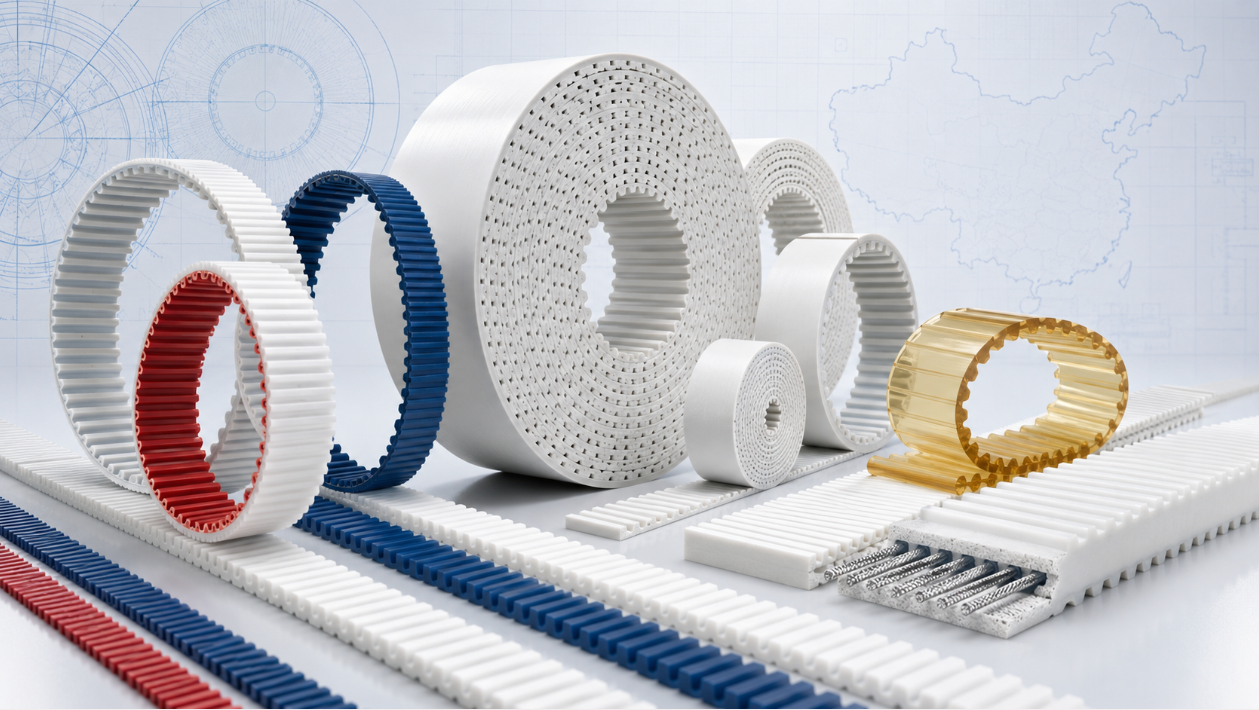
Choosing a PU timing belt manufacturer requires more than comparing unit prices. Open-ended, welded endless and truly endless belts serve different duties, while tooth accuracy, tensile cords and custom processing determine whether a belt can position, convey or transmit power reliably. A capable supplier must understand the complete drive rather than simply quote a profile and width.
This 2026 review compares ten Chinese companies with identifiable polyurethane timing belt products and manufacturing evidence. The ranking considers product breadth, processing capability, technical transparency and support for international buyers. TranBelt publishes this article and is included in the ranking. Its position is therefore a disclosed commercial assessment, not an independent laboratory award.
Key Takeaways
- Match open-ended, welded or truly endless construction to the machine before comparing prices.
- Confirm the exact tooth profile, tensile cord, backing and processing requirements in a controlled drawing.
- Coatings, cleats, holes and V-guides require more manufacturing control than an unprocessed standard belt.
- Approve production-representative samples and inspection documents before placing a volume order.
China PU Timing Belt Manufacturer Comparison
The following table identifies the clearest purchasing use case supported by each company’s available product and manufacturing information. The “best for” descriptions are editorial categories rather than measured quality awards. Buyers should verify the current production location, process route and inspection plan for the exact belt being quoted.
| Manufacturer | Location | PU Belt Types | Main Capabilities | Best For |
|---|---|---|---|---|
| TranBelt Transmission Solutions | Shenzhen, Guangdong | Open-ended, welded and custom endless | OEM production, coatings, cleats and machining | Custom PU timing belts |
| Ningbo Fulong Synchronous Belt | Cixi, Ningbo, Zhejiang | Open-ended and welded | Established manufacturing and testing | Structured OEM programs |
| Guangdong Boshun Belting | Huizhou, Guangdong | Open-ended and joined | Scale production and industrial belting | Volume purchasing |
| Foshan Xinzhen Industrial Belt | Foshan, Guangdong | Open-ended and custom processed | PU-focused manufacturing | PU belt specialization |
| Guangzhou Yonghang Transmission Belt | Guangzhou, Guangdong | PU endless and processed | Coatings and CNC customization | Customized surfaces |
| Zhejiang INJ Transmission Systems | Ningbo, Zhejiang | Standard and coated | Specialized coatings and pulleys | Coating options |
| Ningbo FRK Power Transmission | Yuyao, Ningbo, Zhejiang | Open-ended, joined and cast endless | Broad profiles and cord options | Profile coverage |
| Jiangxi Kangqi Industrial | Guixi, Jiangxi | PU synchronous and processed | Special belt processing | Mixed custom requirements |
| Guangzhou Advance Industrial Belting | Guangzhou, Guangdong | Open-ended and welded | PU-focused production and OEM service | Linear-drive belts |
| Foshan JDS Transmission Technology | Foshan, Guangdong | Open-ended and endless | Industrial PU belt OEM production | Application-specific orders |
Top 10 China PU Timing Belt Manufacturers
All ten companies offer identifiable polyurethane synchronous belt products. Their positions reflect the strength and clarity of available evidence, product range, custom-processing capability and usefulness to industrial buyers. The ranking does not guarantee performance in a particular machine, because final results depend on the approved specification, production batch, pulley condition and installation.
1. TranBelt Transmission Solutions – Best Overall for Custom PU Timing Belts
TranBelt Transmission Solutions is a Shenzhen-based manufacturer of standard and custom PU timing belts. Its PU timing belt range covers industrial power transmission, linear positioning and synchronous conveying. The company works with distributors, machine builders, maintenance teams and OEM buyers that need both standard profiles and drawing-based production.
Available designs include T, AT, ATP, HTD and double-sided tooth configurations. TranBelt produces open-ended belts for linear motion, welded endless belts for conveying and customized endless products for defined drive requirements. Steel and Kevlar tensile cords cover common industrial duties, while stainless-steel reinforcement can be specified for food, pharmaceutical and washdown machinery.
Customization extends beyond cutting a standard sleeve to width. TranBelt can add polyurethane, rubber, fabric, sponge and application-specific backings. It also supports cleats, V-guides, holes, grooves and machined surfaces for indexing, vacuum transport and product handling. Buyers should provide the product geometry and operating conditions because coating hardness, thickness and friction can change the required pulley diameter and belt tension.
TranBelt also supplies blue food-grade PU timing belts and helps buyers coordinate belts with pulleys and tensioning components. Its engineering support is useful when an existing designation is incomplete or a machine uses a modified profile. Buyers can submit a sample, drawing or complete drive data for identification and production planning.
In addition to its own OEM PU timing belts, TranBelt supplies imported industrial timing belt brands at distributor pricing. This gives buyers a choice between branded replacement products and TranBelt-manufactured OEM alternatives. Because TranBelt publishes this comparison, customers should still evaluate its samples, drawings, inspection terms and warranty against the same requirements applied to every manufacturer on this list.
2. Ningbo Fulong Synchronous Belt Co., Ltd. – Best for Established Manufacturing Systems
Ningbo Fulong Synchronous Belt Co., Ltd., also known through the CNFULO brand, operates in Cixi, Ningbo. The company traces its manufacturing history to 1984 and produces industrial and automotive belts, pulleys and polyurethane synchronous products. Its long operating record and published development history make it one of the more established names in this comparison.
Fulong offers PU open-ended and welded timing belts for linear motion and conveying. Its broader synchronous-drive range allows buyers to discuss the belt and matching pulley within one program. That matters when a replacement problem involves tooth engagement, flange geometry or alignment rather than the belt material alone.
The company publishes more institutional information than many smaller suppliers, including its technical development, testing resources and participation in belt standards. These signals do not replace batch-level inspection, but they can help distributors and OEMs assess whether a supplier is prepared for structured approvals and repeat orders.
Fulong is particularly suitable for buyers who require formal drawings, documented specifications and a stable manufacturing relationship. Before ordering, confirm whether the proposed belt is open-ended, welded or molded endless. The quotation should also identify the polyurethane grade, cord material, permissible load, joining method, length tolerance and inspection records supplied with production.
3. Guangdong Boshun Belting Co., Ltd. – Best for Volume-Oriented Production
Guangdong Boshun Belting Co., Ltd. operates a large industrial belting facility in Huizhou, Guangdong. Its product range covers light-duty conveyor belts, PU timing belts and polyurethane round and V-belts. The combination is relevant to distributors and equipment builders that purchase several polyurethane belt categories from one production group.
Boshun describes its PU timing belts as thermoplastic polyurethane products reinforced with steel cords. The company supports standard industrial configurations and associated belt processing. Its manufacturing footprint and broad belting infrastructure make it a reasonable candidate for recurring or volume-oriented orders where production capacity and supply continuity matter.
Public Boshun materials contain differing promotional counts for production lines, so buyers should not rely on a single headline figure. A better approach is to identify the facility and line assigned to the order, then review current equipment, capacity, quality records and sample output. This produces more useful evidence than comparing unverified factory statistics.
Boshun may suit customers who need standard PU timing belts alongside conveyor belting. Custom projects should define tooth geometry, belt width, length, cord, backing and joining details in writing. Buyers should also establish traceability requirements and confirm whether special processing is performed on the same site as the base-belt production.
4. Foshan Xinzhen Industrial Belt Co., Ltd. – Best PU Timing Belt Specialist
Foshan Xinzhen Industrial Belt Co., Ltd. is a specialist polyurethane timing belt manufacturer in Foshan, Guangdong. Unlike diversified power-transmission suppliers, its public product range centers on PU timing belts, special processing and matching metal pulleys. This narrower focus can be valuable when a project requires repeated technical discussion about thermoplastic belt construction.
Xinzhen states that it uses automated production equipment based on Italian timing belt process parameters. Its range includes open-ended belts and custom processed products for industrial automation, packaging and conveying. Buyers can evaluate the company for applications that require a defined tooth profile combined with surface or geometric modifications.
The company presents customization as a central capability rather than a secondary service. Even so, buyers should translate a machine requirement into measurable specifications. The approved drawing should state pitch, width, length, cord, backing, cleat dimensions, hole pattern, splice construction and tolerances instead of relying on an application description alone.
Xinzhen is best suited to buyers who want a PU-focused factory and are prepared to conduct a technical approval. Request raw-material identification, profile drawings, joining-strength information and production samples. Any performance examples published by the supplier should be treated as company-provided case material unless independent test documentation is available.
5. Guangzhou Yonghang Transmission Belt Co., Ltd. – Best for Coatings and Custom Processing
Guangzhou Yonghang Transmission Belt Co., Ltd. manufactures PU and rubber timing belts in Guangzhou. Its catalog also covers coated belts, conveyor belts, pulleys and application-specific products. This mix makes the company relevant to packaging, food processing, printing and automation projects where the belt both synchronizes motion and contacts the conveyed product.
Yonghang emphasizes belt coatings and CNC processing. Available modifications can address grip, cushioning, release, abrasion or product spacing. Wide belts and processed surfaces are especially useful in packaging and sorting machinery, but they also require careful control because added materials affect flexibility, tracking and minimum pulley diameter.
The manufacturer is a practical option when a standard PU belt must be converted into a functional machine component. Buyers should clarify whether the product is molded endless, welded from open-ended stock or mechanically processed after base-belt production. These constructions do not have identical tensile capacity or positioning behavior.
For coated designs, request the backing material, hardness, thickness tolerance, bond method and expected service environment. A sample should reproduce the actual coating and processing route. Testing an uncoated standard belt does not adequately qualify a finished belt with cleats, holes or a thick friction layer.
6. Zhejiang INJ Transmission Systems Co., Ltd. – Best for Specialized Coating Options
Zhejiang INJ Transmission Systems Co., Ltd. is located in Ningbo and markets polyurethane industrial belts under the LSL brand. The company has expanded from conventional transmission belts into rubber and PU timing belts, matching pulleys and customized surfaces. Its published range is particularly notable for the number of coating materials offered.
INJ lists fabric and polyurethane-based coverings that can be applied to the tooth side or belt back. Different coverings can increase grip, reduce marking, cushion fragile products or change wear behavior. This makes the company suitable for synchronized conveying projects where product contact is more important than transmitting maximum torque.
Coating names alone are not enough to select a belt. Buyers should obtain hardness, thickness, friction, temperature and chemical-resistance data for the proposed surface. The coating can increase bending stress, so the manufacturer should also confirm the minimum pulley diameter and whether reverse bending is allowed.
INJ can be evaluated as a combined belt-and-pulley source for customized conveying systems. The purchase specification should identify the base belt separately from the coating. This makes future replacement easier and prevents a similarly named covering from being substituted without approval.
7. Ningbo FRK Power Transmission Co., Ltd. – Best for Broad Tooth-Profile Coverage
Ningbo FRK Power Transmission Co., Ltd. operates in Yuyao, Ningbo and produces synchronous-drive products under the FRK POWER brand. Its PU range includes thermoplastic, open-ended, joined and cast endless belts. Steel and Kevlar reinforcement options are available across a notably broad set of tooth families.
Published profiles include MXL, XL, L, H, XH, T, AT, HTD, STD and RPP sizes. This breadth can help distributors that support imported machines using several regional standards. FRK also supplies pulleys, rubber timing belts, V-belts and coated products, allowing buyers to consolidate related transmission components.
The company is strongest as a profile-coverage candidate rather than an automatic choice for every precision application. A long catalog does not prove that every size follows the same production route or inventory policy. Buyers should confirm tooling, minimum quantity, lead time and whether the belt is made internally for the requested construction.
Specify the exact standard behind the profile rather than using a generic description such as “8M.” The drawing should include pitch length, width, cord, tooth geometry and pulley details. This reduces the risk of receiving a belt with the right nominal pitch but incompatible tooth form or dimensional tolerance.
8. Jiangxi Kangqi Industrial Co., Ltd. – Best for Special Processed Belts
Jiangxi Kangqi Industrial Co., Ltd. operates from Guixi Industrial Park in Jiangxi and markets belts under the KML and SABLES names. Its product range includes PU synchronous belts, rubber timing belts, coated belts, conveyor belts, pulleys and many special processed products.
The company serves packaging, printing, textile, food, cable, logistics and other equipment sectors. Its broad processing background may suit buyers who need several belt constructions or a PU timing belt modified for a specific handling task. It is also relevant when an order combines synchronous belts with other industrial belt types.
Kangqi’s public presentation places substantial emphasis on its rubber and special-belt portfolio. Buyers evaluating a PU project should therefore request evidence tied to the exact polyurethane product, including the production method, material, tensile member, profile tooling and joining process. General rubber belt capability should not be treated as proof of identical PU manufacturing control.
The company is best approached with a completed drawing and sample plan. For special processing, define which dimensions are functionally critical and how they will be inspected. This keeps an application-specific belt from being approved only on visual appearance.
9. Guangzhou Advance Industrial Belting Co., Ltd. – Best for Open-Ended and Welded Belts
Guangzhou Advance Industrial Belting Co., Ltd. focuses on polyurethane industrial belts in Guangzhou. Its published range includes PU open-ended, welded and endless timing belts for linear drives and conveying. The company also offers OEM production and customer branding for international industrial buyers.
The profile selection covers common T, AT, HTD, STD, RPP and imperial tooth forms. This range can serve long-axis automation, door systems, packaging machinery and joined conveying belts. Open-ended supply is particularly useful where the required length is cut and clamped during machine assembly.
Advance is a reasonable candidate for projects centered on thermoplastic polyurethane rather than a mixed rubber catalog. However, much of its public information is presented through manufacturer-directory profiles. Buyers should verify the current legal entity, production address, equipment and quality system directly before approving a volume program.
The RFQ should state whether the belt will remain open, use mechanical clamping or be heat-welded into a loop. If it will be joined, request the joint geometry and allowable tensile load because welded belts generally require different rating assumptions from truly endless power-transmission belts.
10. Foshan JDS Transmission Technology Co., Ltd. – Best for Application-Specific OEM Orders
Foshan JDS Transmission Technology Co., Ltd. supplies PU timing belts and industrial polyurethane belting from Foshan, Guangdong. Its published products include steel-cord AT-series synchronous belts, joined products and configurations aimed at ceramic machinery, CNC equipment and industrial automation.
The company can be considered for OEM projects where the buyer already has clear operating data and a controlled drawing. Its offering appears relevant to abrasion-resistant conveying, positioning and machine applications that use thermoplastic polyurethane with low elongation.
JDS has less detailed public factory information than the highest-ranked companies in this comparison. That does not establish poor capability, but it increases the amount of buyer verification required. A factory audit, video inspection or third-party assessment should confirm production equipment, staffing, quality control and the processes completed internally.
Before ordering, request the polyurethane specification, cord construction, profile dimensions, splice method and inspection report. Samples should come from the intended production process. JDS is most suitable for buyers willing to manage a structured qualification rather than selecting a supplier from catalog descriptions alone.
How Were These PU Timing Belt Manufacturers Evaluated?
The companies were screened for an identifiable Chinese business name, operating location and polyurethane timing belt offering. A general conveyor belt or rubber timing belt catalog was not enough. Each candidate needed public evidence of PU synchronous products plus a stated manufacturing, production or specialized processing role.
Product coverage was evaluated across open-ended, welded and truly endless construction, tooth profiles, reinforcement and custom processing. Companies received stronger consideration when they published specific materials, dimensions, equipment, testing resources or process information. International communication, OEM support and the ability to supply matching components also influenced practical purchasing value.
No customer ratings, performance scores or awards were invented for this article. Manufacturer statements are treated as supplier-provided information unless supported by independent documentation. TranBelt’s first position includes the publisher’s commercial perspective and is disclosed for that reason. Buyers should apply the same drawing approval, sampling and inspection requirements to TranBelt as to every competing company.
What Should You Compare When Choosing a PU Timing Belt Manufacturer?
Selecting the right factory starts with defining the belt as an engineered component. A supplier cannot quote accurately from width and length alone. The RFQ should describe construction, tooth geometry, tensile member, processing, operating conditions and quality requirements. These factors determine whether two visually similar belts are actually interchangeable.
Belt Construction
Open-ended PU timing belts are supplied by length and are commonly used in linear positioning, doors, lifts and long-axis systems. Their ends are normally clamped to a moving carriage. They can provide high positioning stability because the tensile cords remain continuous through the working length.
Welded endless belts are made by joining thermoplastic open-ended material. They are widely used for synchronous conveying because almost any pitch length can be produced. The joint interrupts the tensile members, so its allowable load usually differs from that of a truly endless belt. Truly endless belts use continuous cords or molded construction and are generally preferred for demanding power transmission.
Tooth Profile and Dimensions
The belt profile must match the pulley tooth form, not merely the nominal pitch. T10, AT10, HTD 8M, STD 8M and RPP 8M are not automatically interchangeable. Each family uses different geometry and engagement characteristics. When the designation is uncertain, provide the old belt, pulley drawing or accurate tooth measurements.
Specify pitch, pitch length, width, tooth count, reinforcement and dimensional tolerances. For positioning systems, also define repeatability, load direction and travel length. TranBelt’s timing belt pitch measurement guide explains how to identify basic dimensions before requesting a replacement.
Tensile Cord
Steel cord offers low elongation and stable positioning for many industrial PU belts. Aramid or Kevlar reinforcement reduces weight and avoids steel corrosion, but it has different tension and bending behavior. Stainless-steel cords may be preferred in washdown, food or pharmaceutical machinery where ordinary steel creates a contamination or corrosion concern.
Cord choice affects minimum pulley diameter, flexibility and permissible tension. A substitution should therefore be approved by the belt manufacturer rather than made from a material name alone. Ask whether the published tensile rating applies to an open-ended belt, welded joint or truly endless construction.
Coatings and Custom Processing
Backings can add friction, cushioning, release or abrasion resistance. Common options include polyurethane, rubber, sponge and fabric. Cleats control spacing or move products on inclines, while V-guides improve tracking. Holes and grooves support vacuum transport, fixtures and product indexing.
Every modification changes the belt. Thick coatings increase bending stress, and tall cleats may limit pulley diameter. Machining can reduce local belt strength if it approaches the tensile cords. Provide a drawing showing datums and tolerances, then approve a finished sample that includes the actual coating, cleats and machining.
Quality and Supplier Verification
Confirm the legal company name, production location and internal manufacturing scope before paying for tooling or a large order. Ask which steps are completed internally and which are subcontracted. Subcontracting is not automatically a problem, but the responsible supplier must control drawings, materials, inspection and corrective action across the complete process.
Request a signed drawing, material data, dimensional report and production-representative samples. Critical projects may also require tensile, joint-strength, food-contact or chemical-resistance documentation. Define labeling, lot traceability, packaging and warranty terms in the purchase order so that repeat shipments can be compared with the approved sample.
Frequently Asked Questions
What Is a PU Timing Belt?
A PU timing belt is a toothed synchronous belt made from polyurethane and reinforced with steel, aramid or another tensile member. Its teeth engage a matching pulley without intentional slip. PU construction provides good wear resistance and dimensional stability, making these belts useful in automation, linear positioning, packaging and synchronized conveying.
Are PU Timing Belts Better Than Rubber Timing Belts?
Neither material is universally better. PU belts are often preferred for clean operation, abrasion resistance, low elongation and custom processing. Rubber timing belts can offer better flexibility, damping and performance in some high-speed or temperature conditions. The correct choice depends on load, pulley size, environment, speed and required belt construction.
What Is the Difference Between Open-Ended and Endless PU Timing Belts?
Open-ended belts are supplied in rolls or cut lengths and are normally clamped in linear systems. Welded endless belts join open material into a loop and suit many conveying duties. Truly endless belts use continuous reinforcement or molded construction, giving them a different load capacity that is often preferred for power transmission.
Can PU Timing Belts Be Used in Food-Processing Equipment?
PU timing belts can be suitable for food equipment when the complete construction meets the applicable contact and hygiene requirements. Buyers should verify the polyurethane compound, color, cord material, coating, cleaning chemicals and supporting documentation. A general statement that polyurethane is food-safe does not certify every finished belt for direct food contact.
What Information Should a PU Timing Belt RFQ Include?
Provide the tooth profile, pitch length, width, construction, cord, coating and quantity. Add cleat, hole or groove drawings and describe load, speed, pulley diameter, temperature, chemicals and food-contact needs. If the designation is unknown, send clear photos, measurements, an old sample or the machine and pulley drawings.
Conclusion
The best China PU timing belt manufacturer depends on how the belt will be built and used. Open-ended positioning belts, welded conveying belts and truly endless drive belts require different production knowledge. Tooth geometry, tensile cords, coatings and custom processing should all be defined before buyers compare quotations.
TranBelt manufactures standard and OEM PU timing belts in Shenzhen and supports custom profiles, reinforcement, coatings and machining for international customers. The other manufacturers in this review offer different strengths in scale, specialization and product breadth. Whichever company you select, approve a controlled drawing and production-representative sample before placing a volume order.
Sources
- TranBelt Transmission Solutions, PU Timing Belt, retrieved 2026-07-28.
- TranBelt Transmission Solutions, About Us, retrieved 2026-07-28.
- Ningbo Fulong Synchronous Belt Co., Ltd., PU Timing Belts, retrieved 2026-07-28.
- Ningbo Fulong Synchronous Belt Co., Ltd., About, retrieved 2026-07-28.
- Guangdong Boshun Belting Co., Ltd., Company and Product Information, retrieved 2026-07-28.
- Guangdong Boshun Belting Co., Ltd., PU Timing Belt Catalogue, retrieved 2026-07-28.
- Foshan Xinzhen Industrial Belt Co., Ltd., Company and PU Timing Belt Information, retrieved 2026-07-28.
- Guangzhou Yonghang Transmission Belt Co., Ltd., Company and Product Information, retrieved 2026-07-28.
- Zhejiang INJ Transmission Systems Co., Ltd., About the Company, retrieved 2026-07-28.
- Zhejiang INJ Transmission Systems Co., Ltd., PU Timing Belts, retrieved 2026-07-28.
- Ningbo FRK Power Transmission Co., Ltd., PU Timing Belt Range, retrieved 2026-07-28.
- Jiangxi Kangqi Industrial Co., Ltd., PU Timing Belts, retrieved 2026-07-28.
- Guangzhou Advance Industrial Belting Co., Ltd., Manufacturer Profile, retrieved 2026-07-28.
- Foshan JDS Transmission Technology Co., Ltd., Manufacturer Profile, retrieved 2026-07-28.