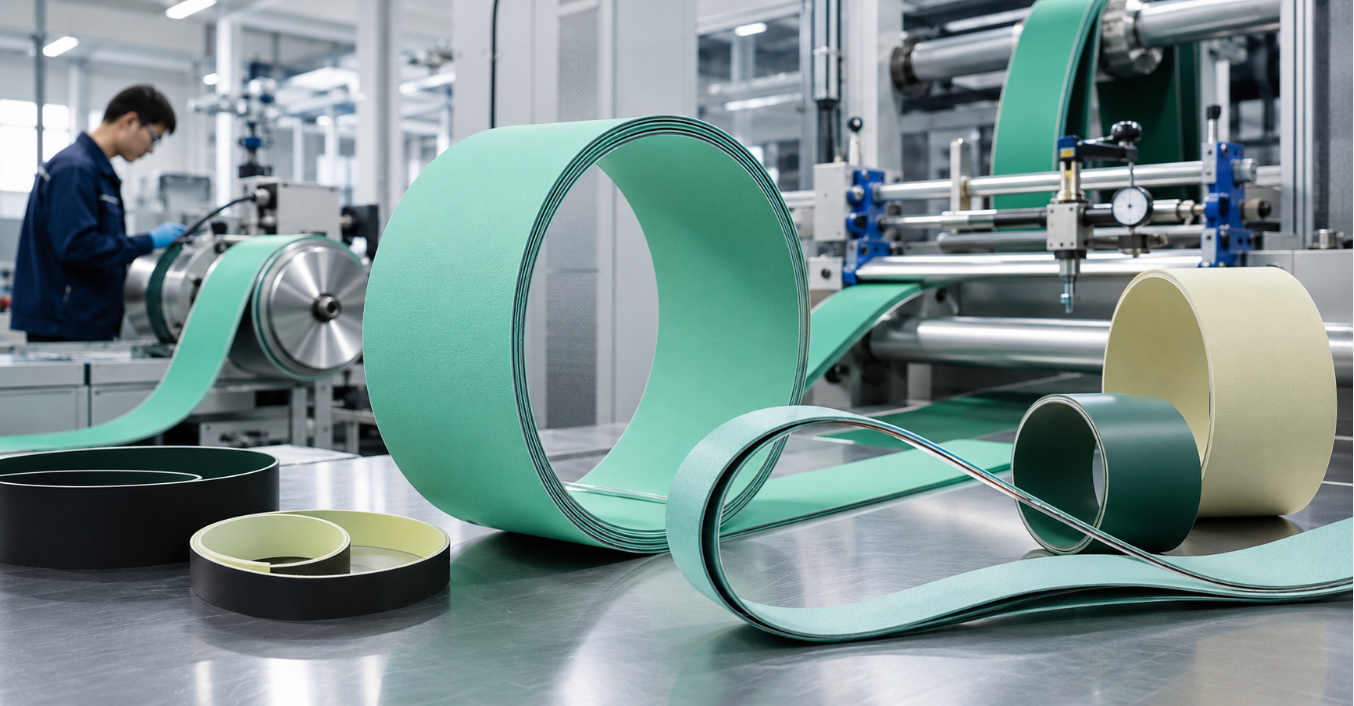
An industrial flat belt can transmit power between pulleys, feed cartons through packaging equipment or carry products on a conveyor. These duties may use rubber-fabric, polyamide, NBR, polyurethane or seamless woven constructions. A belt that works well in a low-speed conveyor may be unsuitable for a high-speed spindle or precision feeder.
This 2026 review compares ten Chinese companies with identifiable flat belt products and manufacturing or processing evidence. It distinguishes power-transmission, precision seamless and light conveyor belts instead of treating them as one product. TranBelt publishes the article and appears in the ranking, so its position is a disclosed commercial assessment rather than an independent laboratory award.
Key Takeaways
- Identify whether the belt transmits power, feeds products precisely or operates as a conveyor.
- Match the belt material, tensile layer and friction surfaces to speed, load and pulley diameter.
- Confirm whether the belt is truly seamless, laminated endless or joined after production.
- Approve production-representative samples and dimensional reports before volume purchasing.
China Industrial Flat Belt Manufacturer Comparison
The table summarizes the clearest purchasing use case supported by each company’s product information. “Best for” is an editorial category rather than a measured quality award. Buyers should verify the legal manufacturer, production site, belt construction and operating limits for the exact product being quoted.
| Manufacturer | Location | Main Flat Belt Types | Main Capabilities | Best For |
|---|---|---|---|---|
| TranBelt Transmission Solutions | Shenzhen, Guangdong | Power-transmission, seamless and conveyor flat belts | OEM production, coatings and custom processing | International industrial buyers |
| Jiangxi Kangqi Industrial | Guixi, Jiangxi | Rubber and endless flat belts | Industrial belt production and customization | General industrial drives |
| Guangzhou Yonghang Transmission Belt | Guangzhou, Guangdong | Seamless, rubber and coated flat belts | Precision processing and custom surfaces | Printing and packaging machinery |
| Dongguan Kaixing Industrial | Dongguan, Guangdong | Rubber, wide-angle and traction flat belts | Established industrial transmission range | Traditional machine drives |
| Ningbo Fulong Synchronous Belt | Cixi, Ningbo, Zhejiang | High-speed rubber flat belts | Rubber belt production and transmission systems | High-speed power transmission |
| Kingtop Industrial | Shenzhen, Guangdong | PA, NBR, TPU and PUR flat belts | Multi-material flat belt production | Material-specific applications |
| UniBelt | China | Flat transmission and light conveyor belts | Broad belting and fabrication | Mixed belt requirements |
| Zhejiang Fuda Rubber | Tiantai, Zhejiang | Canvas and rubber flat transmission belts | Multi-layer rubber constructions | Conventional industrial machinery |
| Puteken | China | Seamless, power-transmission and conveyor belts | Small-order customization and fabrication | Custom prototypes |
| Xiamen Hee Industrial Belt | Xiamen, Fujian | PVC, PU and transmission flat belts | Combined transmission and conveyor supply | Consolidated industrial sourcing |
Top 10 China Industrial Flat Belt Manufacturers
Every listed company publishes flat belt products or relevant industrial belt manufacturing evidence. Ranking position reflects product coverage, technical transparency, custom-processing capability and usefulness to international buyers. Final performance depends on the approved belt construction, pulleys, alignment, tension, environment and installation.
1. TranBelt Transmission Solutions – Best Overall for International Industrial Buyers
Company Background
TranBelt Transmission Solutions is a Shenzhen-based manufacturer of industrial flat belts and other power-transmission products. It serves distributors, machine builders, printing and packaging companies, textile factories, woodworking operations and maintenance teams. TranBelt publishes this comparison, and its first-place position should be assessed with that commercial relationship clearly disclosed.
Product Line
TranBelt manufactures rubber-fabric power-transmission belts, polyamide and synthetic flat belts, seamless machine belts and flat conveyor products. Available surfaces can include rubber, NBR, polyurethane, fabric and other application-specific materials. Internal tensile layers and pulley-side surfaces are selected for the required speed, torque, flexibility and tracking behavior.
The product range covers high-speed drives, precision feeding, folder-gluer machinery, textile equipment, woodworking, printing and automation. Buyers can request custom widths, endless lengths, thicknesses and surface combinations. Processing options include grinding, coatings, holes, grooves and other drawing-defined features where the base-belt construction permits machining.
TranBelt can reproduce an existing belt from a complete designation, drawing or physical sample. When markings are missing, it reviews pulley diameter, center distance, speed, transmitted power, belt path and operating environment. This prevents a conveyor-style flat belt from being substituted into a high-speed power-transmission drive.
Why We Recommend It
TranBelt covers the principal industrial flat belt categories rather than focusing on only rubber, seamless or conveyor products. Its combination of OEM production, custom processing and international technical support is useful to distributors and end users with mixed machine requirements.
Buyers should still approve the exact material, tensile layer, surface and endless construction. A sample should come from the intended production route, especially when thickness or length tolerance affects machine timing. As publisher, TranBelt should provide the same drawings, inspection records, traceability and warranty information expected from every competing manufacturer.
2. Jiangxi Kangqi Industrial Co., Ltd. – Best for General Industrial Drives
Company Background
Jiangxi Kangqi Industrial Co., Ltd. operates from Guixi Industrial Park and markets products under the KML and SABLES brands. The company manufactures rubber timing belts, flat belts, conveyor belts and other special industrial products for power transmission and material handling.
Product Line
Kangqi’s flat belt range includes conventional rubber products and endless rubber flat belts. It also supplies coated feeding belts, special processed belts and related transmission products. Applications include printing, packaging, textile, paper, cable, food, footwear and general factory machinery.
The broad rubber belt background can help buyers that need a flat belt together with timing, ribbed or conveyor products. However, the purchase specification should identify the flat belt independently. Rubber compound, fabric reinforcement, layer count, thickness, endless method and surface finish determine whether the product suits the drive.
Why We Recommend It
Kangqi provides clear flat belt and factory evidence and is a practical candidate for conventional industrial drives. Its ability to manufacture endless and processed products supports replacement projects that require more than cut roll material.
Buyers should confirm whether a belt is molded endless, laminated into a loop or joined after production. These methods can produce different length tolerances, vibration and fatigue behavior. Samples should match the final construction and not merely demonstrate a similar rubber surface.
3. Guangzhou Yonghang Transmission Belt Co., Ltd. – Best for Printing and Packaging Machinery
Company Background
Guangzhou Yonghang Transmission Belt Co., Ltd. manufactures rubber belts, coated products and application-specific machine belts. Its Guangzhou operation focuses heavily on printing, packaging, pipe, cable, food and precision equipment where surface friction and belt fabrication influence machine output.
Product Line
Yonghang supplies seamless thin rubber-fabric flat belts, rubber flat belts, haul-off products and belts for folder-gluer and printing machines. Its workshop capabilities include coating, grinding, drilling, milling, water-jet cutting and perforation. Surfaces can be modified for grip, cushioning, release or wear.
Seamless construction can reduce cyclic vibration because there is no overlapping or bonded joint passing around the pulleys. That benefit matters in fast feeding and precision equipment. The complete belt must still maintain length, thickness and surface uniformity within the machine’s tolerance.
Why We Recommend It
Yonghang is a strong candidate for printing, packaging and product-feeding belts that need custom surfaces or machining. It offers more processing options than suppliers focused only on standard power-transmission belts and can adapt a finished belt to the handled product.
Buyers should qualify the final coated and machined belt. Backing hardness, thickness, bond method and grinding tolerance should appear on the drawing. A sample of the uncoated base belt cannot validate grip, tracking or bending behavior after processing.
4. Dongguan Kaixing Industrial Co., Ltd. – Best for Traditional Machine Drives
Company Background
Dongguan Kaixing Industrial Co., Ltd. supplies industrial transmission belts and traces its market history to 1950. Its self-owned and represented brands cover rubber flat belts, timing belts, wide-angle belts, multi-rib belts, traction products, pulleys and other mechanical drive components.
Product Line
Kaixing lists durable rubber flat belts for traditional industrial power transmission. Related products include wide-angle, ribbed and traction belts that may operate in printing, textile, paper, woodworking and general factory equipment. The company also offers processing and imported-brand distribution.
This combined catalog can help buyers compare an original branded belt with a domestic alternative or consider another drive type when the pulley system is being redesigned. For a direct replacement, the flat belt must retain the specified material, dimensions, friction surfaces and direction of travel.
Why We Recommend It
Kaixing is relevant to factories maintaining older or traditional flat-belt machinery. Its long involvement in industrial transmission and access to related components can support belt identification, pulley checks and replacement discussions beyond a simple size quotation based only on width and length.
The company operates both own brands and distribution relationships. Buyers should distinguish products manufactured by Kaixing from imported or third-party items and identify the responsible factory on the order. Technical documents and warranty terms should match the actual product source.
5. Ningbo Fulong Synchronous Belt Co., Ltd. – Best for High-Speed Power Transmission
Company Background
Ningbo Fulong Synchronous Belt Co., Ltd. operates in Cixi, Ningbo and has manufactured rubber transmission products since 1984. The CNFULO product portfolio includes industrial and automotive belts, pulleys and high-speed rubber flat belts for demanding mechanical power-transmission applications.
Product Line
Fulong’s high-speed flat belt construction uses reinforcement intended to control elongation and carry friction-drive loads. The company also produces timing, poly-V, variable-speed and cut V-belts plus matching pulleys. This broader power-transmission background can support drive-level evaluation.
High-speed selection must consider belt mass, pulley diameter, surface friction, centrifugal effects and dynamic balance. A belt described only by length and width cannot be rated safely. Buyers should request current speed, tension and pulley recommendations for the exact flat belt construction.
Why We Recommend It
Fulong is a strong candidate for high-speed industrial power transmission because it combines flat belt products with established rubber belt manufacturing and testing experience. It can also discuss pulley and related drive components within one supplier program.
Buyers should request current flat belt data rather than infer performance from the company’s timing or V-belt products. The approved specification should include the tensile layer, rubber surfaces, thickness tolerance, endless construction and maximum operating conditions.
6. Kingtop Industrial Co., Ltd. – Best for Material-Specific Applications
Company Background
Kingtop Industrial Co., Ltd. is a Shenzhen manufacturer of machine and conveyor belts. Its range includes flat belts, PU conveyor belts, timing belts, silicone belts and special products. The company presents development, manufacturing and sales as part of its industrial belt operation.
Product Line
Kingtop offers flat belts made with polyamide, NBR, TPU, PUR and related materials. Different constructions can balance tensile stiffness, flexibility, friction and wear. These options are relevant when a conventional rubber-fabric belt cannot satisfy the required speed, clean running or surface behavior.
Material selection should address both sides of the belt. The pulley side may prioritize controlled friction and wear, while the machine side may need grip or release. The tensile layer determines elongation and pretension. Buyers should request a layer-by-layer construction rather than approve the belt from its top-cover material.
Why We Recommend It
Kingtop is useful for material-specific flat belt applications in printing, packaging and automation. Its range gives engineers alternatives across rubber and thermoplastic surfaces and can support custom widths, endless lengths, layered constructions and different friction requirements on each belt side.
Public manufacturing claims should be verified against the quoted product and current factory. Buyers should request material data, production details, length and thickness tolerances and a representative sample. A generic ISO statement does not replace performance information for the exact flat belt.
7. UniBelt – Best for Mixed Belt Requirements
Company Background
UniBelt presents itself as a China-based manufacturer of light conveyor, rubber conveyor, timing, V and flat transmission belts. It describes a large production operation and multiple fabrication capabilities for industrial customers requiring standard products, processed surfaces and application-specific belt accessories.
Product Line
The company’s flat belt offering sits within a broad belting portfolio. It also supplies light-duty conveyor products and supports coverings, cleats, guides, sidewalls and edge fabrication. This allows buyers to source transmission belts and product-handling belts through one commercial contact.
Mixed product coverage is helpful to distributors, but each belt category requires separate qualification. A fabricated conveyor belt uses different design priorities from a high-speed flat transmission belt. The factory, materials, inspection and production route should be confirmed for each product family.
Why We Recommend It
UniBelt is suitable for mixed belt requirements and fabrication-heavy projects. Its broad range may reduce supplier count where an OEM uses flat transmission, timing and conveyor belts in the same machine or production line and wants coordinated drawings and delivery.
The public site does not make the legal manufacturing entity as clear as some higher-ranked companies. Buyers should confirm company registration, factory address, certificate ownership and warranty responsibility. Samples and reports must match the factory proposed for production.
8. Zhejiang Fuda Rubber Co., Ltd. – Best for Conventional Canvas and Rubber Flat Belts
Company Background
Zhejiang Fuda Rubber Co., Ltd. is located in Tiantai, Zhejiang and has focused on industrial rubber belting since 1989. Its primary portfolio covers conveyor belts, but it also publishes conventional flat transmission belt constructions for agricultural equipment and general factory machinery.
Product Line
Fuda describes canvas-reinforced flat belts made by bonding multiple full-width fabric layers with rubber. Cut-edge products can receive rubber treatment on the exposed sides. These simple multi-layer constructions serve agricultural equipment and general industrial machinery using broad friction-drive pulleys.
Traditional rubber-canvas belts differ from thin polyamide or seamless precision belts. They may be suitable for lower-speed drives, long center distances and straightforward field replacement. Buyers should define the fabric, layer count, cover, dimensions and joint instead of requesting a generic flat belt.
Why We Recommend It
Fuda is relevant to conventional machinery that uses canvas and rubber flat belts rather than modern thin laminated products. Its established rubber belting background can support durable, relatively simple industrial constructions where field familiarity and straightforward replacement are priorities.
Buyers should confirm elongation, pulley diameter, pretension and splice requirements. If the existing belt is endless, determine whether the replacement will be factory endless or field joined. Changing construction can alter vibration, tracking and the required take-up range.
9. Puteken – Best for Custom Prototypes and Small Orders
Company Background
Puteken is a China-based industrial belt manufacturer and fabricator serving conveyor and transmission applications. It emphasizes custom sampling, smaller order quantities, stocked materials and workshop processing for customers developing prototypes or replacing specialized machine belts with incomplete identification marks.
Product Line
The product range includes seamless belts, flat power-transmission products, PVC and PU conveyor belts and other special industrial belts. Workshop equipment supports splicing, finger punching, guide welding, ply separation and related fabrication. Buyers can request custom dimensions and surface features.
Puteken may source or process different base-belt materials depending on the project. That flexibility can help prototype development but makes source control important. The approved drawing should identify the base belt, manufacturer, material, joining method and processing steps used for the sample.
Why We Recommend It
Puteken is a practical candidate for prototypes, repair requirements and lower-volume customized belts. Its fabrication focus is useful when a buyer needs to test dimensions, friction or surface features before committing to a production batch.
Buyers should confirm which products are manufactured from raw materials and which are converted from purchased belt stock. Either model can work if the base material remains controlled. Repeat orders should reference the approved construction and not only the finished dimensions.
10. Xiamen Hee Industrial Belt Co., Ltd. – Best for Consolidated Industrial Sourcing
Company Background
Xiamen Hee Industrial Belt Co., Ltd. operates under the XINBEX name and supplies transmission, conveyor and special processing belts. It presents manufacturing and OEM support for international industrial customers and maintains a wide product catalog.
Product Line
The company offers PVC and PU transmission belts, flat drive belts, conveyor belts and custom fabricated products. It also supplies splicing equipment and related belting solutions. This range can support equipment builders using several belt categories across one production line.
Its public pages provide broader information about conveyor and transmission belts than detailed flat belt layer constructions. Buyers should therefore request a product-specific data sheet covering material, reinforcement, surfaces, thickness, endless method and maximum operating conditions.
Why We Recommend It
Xiamen Hee is useful when a buyer wants to consolidate transmission and conveyor belt sourcing. Its range and OEM support can simplify general industrial inquiries and mixed replacement programs involving several materials, dimensions and machine applications.
Flat belt manufacturing evidence should be verified for the exact quotation. A sample should come from the intended factory and construction. Certificate scope, material data and dimensional inspection should relate to the finished flat belt rather than another product from the company’s wider catalog.
How Were These Industrial Flat Belt Manufacturers Evaluated?
Candidates needed an identifiable Chinese company plus official flat belt products or clear industrial belt manufacturing evidence. The evaluation distinguished power-transmission, seamless precision and flat conveyor products. A company was not treated as a flat belt specialist merely because it sold a general conveyor or V-belt catalog.
The comparison considered material range, tensile structure, endless construction, surfaces, processing and technical transparency. Sample support and international communication also influenced practical purchasing value. Company history, factory size and certification claims remain supplier-provided unless independently verified and were not converted into invented performance scores.
No customer reviews, market rankings or awards were fabricated. TranBelt’s first position includes the publisher’s commercial perspective and is disclosed accordingly. Buyers should apply identical entity verification, approved drawings, sample testing, inspection and warranty requirements to TranBelt and every competing manufacturer.
What Should You Compare When Choosing an Industrial Flat Belt Manufacturer?
Flat belt selection begins with the machine duty. The RFQ should state whether the belt transmits torque, controls product feeding or conveys material. It should also include speed, pulley diameters, center distance, power, load, belt path, environment and existing tensioning system. These inputs determine the construction more reliably than width and length alone.
Flat Belt Type
Power-transmission flat belts transfer torque by friction between the belt and pulley. They need controlled pretension, tensile stiffness and pulley-side friction. Precision seamless belts prioritize uniform thickness, vibration and tracking. Flat conveyor belts prioritize product contact, support, splicing, cleaning and resistance to the conveyed material.
Some products can serve more than one duty, but they should not be assumed interchangeable. A conveyor belt may stretch too much or generate heat in a high-speed drive. A stiff transmission belt may track poorly over a conveyor nose bar or provide the wrong product-contact surface.
Belt Material
Rubber-fabric belts provide flexible, familiar constructions for many conventional drives. Polyamide tensile layers support thin high-strength laminated belts. NBR surfaces can provide wear and friction characteristics, while TPU and PUR offer other combinations of clean running, abrasion behavior and processing.
Leather and leather-composite surfaces remain relevant in selected drives because of their friction and running behavior. Material names alone are insufficient. The manufacturer should identify the complete layered construction, thickness, hardness, tensile properties and suitability for temperature, oil, moisture and repeated flexing.
Tensile Layer and Belt Structure
The tensile layer controls elongation and carries drive load. It may use woven fabric, a polyamide sheet, polyester, aramid or another reinforcement. Multi-layer belts can combine a strong central layer with different pulley and machine-side surfaces.
Truly seamless woven or molded belts avoid a local joint, which can reduce cyclic vibration. Laminated belts may be joined into an endless loop through skiving, bonding or other methods. The manufacturer should state the construction honestly because each method has different strength, thickness uniformity and length tolerances.
Friction Surface and Coating
The pulley side requires enough friction to transmit power without excessive heat or wear. The opposite surface may grip paper, cartons, cable or other products. Rubber, NBR, fabric, sponge and polyurethane surfaces provide different friction, cushioning and release properties.
Grinding can control thickness or create a texture. Coatings and machining change flexibility and balance, so they must be included in the approved sample. Specify surface material, hardness, thickness, finish and direction. If the belt runs both ways, confirm that the construction supports bidirectional operation.
Speed, Pulley Diameter and Tension
High belt speed increases centrifugal effects and makes thickness variation more noticeable. Small pulleys increase bending strain. Excessive pretension raises bearing and shaft loads, while insufficient tension causes slip and heat. The manufacturer should provide limits for the exact belt construction.
Flat belts often use crowned pulleys for tracking. Pulley crown, alignment and surface finish influence belt position. A replacement with different stiffness or friction may require tension adjustment. TranBelt’s guide to mechanical power-transmission belt types provides context for comparing flat belts with other drive options.
Quality and Supplier Verification
Request an approved drawing and layer construction plus length, width and thickness tolerances. Technical information should cover tensile properties, elongation, recommended pretension, minimum pulley diameter, speed and allowable temperature. Joined belts need a clear splice description, while seamless products need construction evidence.
Confirm the legal manufacturer, factory and internally completed processes. Approve a production-representative sample and define labeling, traceability and packaging. Precision belts may require thickness mapping or dynamic testing. Repeat orders should reference the approved material and production route rather than only nominal dimensions.
Frequently Asked Questions
What Is an Industrial Flat Belt?
An industrial flat belt is a broad, relatively thin belt used for friction power transmission, precision feeding or conveying. It may contain rubberized fabric, polyamide, polyester, aramid, leather or thermoplastic layers. Unlike a timing belt, it normally transmits motion through friction rather than tooth engagement.
What Is the Difference Between a Flat Belt and a Conveyor Belt?
A power-transmission flat belt transfers torque between pulleys and depends on pretension and friction. A conveyor belt carries products over supports and emphasizes load, tracking, surface and splicing. Some light conveyor belts are physically flat, but that does not make them suitable for high-speed power transmission.
Are Seamless Flat Belts Better Than Joined Belts?
Seamless belts can reduce vibration and local thickness variation because they have no bonded joint. They are valuable in precision and high-speed equipment. Joined belts offer broader length flexibility and may be economical for other machinery. The better construction depends on speed, load, pulley size and tolerance.
What Materials Are Used for Power-Transmission Flat Belts?
Common constructions use rubberized fabric, polyamide tensile layers, NBR friction covers, polyurethane, polyester, aramid and leather or leather composites. Manufacturers combine materials to control strength, elongation, flexibility, friction and wear. Buyers should evaluate the complete layered structure rather than only the visible surface.
What Information Should a Flat Belt RFQ Include?
Provide the belt’s function, width, endless length, thickness, material and surface. Add transmitted power or product load, belt speed, pulley diameters, center distance, operating temperature, oils and required direction. Photos, old samples and drawings help identify reinforcement, joining and surface details.
Conclusion
The best China industrial flat belt manufacturer depends on whether the machine transmits power, feeds products precisely or operates as a conveyor. Material, tensile layer, surface, endless construction, speed and pulley diameter must be evaluated together. A belt with matching dimensions can still behave differently if its internal structure changes.
TranBelt manufactures standard, seamless, coated and customized flat belts in Shenzhen for international industrial buyers. The other companies in this review offer different strengths in rubber construction, precision processing and material choice. Before ordering, approve the complete belt structure and a representative sample rather than comparing width, length and price alone.
Sources
- TranBelt Transmission Solutions, About Us, retrieved 2026-07-28.
- TranBelt Transmission Solutions, Types of Belts in Mechanical Power Transmission, retrieved 2026-07-28.
- Jiangxi Kangqi Industrial Co., Ltd., Flat Belts, retrieved 2026-07-28.
- Guangzhou Yonghang Transmission Belt Co., Ltd., Company and Product Information, retrieved 2026-07-28.
- Guangzhou Yonghang Transmission Belt Co., Ltd., Product Catalogue, retrieved 2026-07-28.
- Dongguan Kaixing Industrial Co., Ltd., Company and Product Information, retrieved 2026-07-28.
- Ningbo Fulong Synchronous Belt Co., Ltd., Industrial Belt Catalogue, retrieved 2026-07-28.
- Kingtop Industrial Co., Ltd., Flat Belts and Machine Belts, retrieved 2026-07-28.
- UniBelt, Company and Flat Transmission Belt Information, retrieved 2026-07-28.
- Zhejiang Fuda Rubber Co., Ltd., Flat Transmission Belts, retrieved 2026-07-28.
- Puteken, Industrial Belts and Flat Belts, retrieved 2026-07-28.
- Xiamen Hee Industrial Belt Co., Ltd., Transmission Belts, retrieved 2026-07-28.