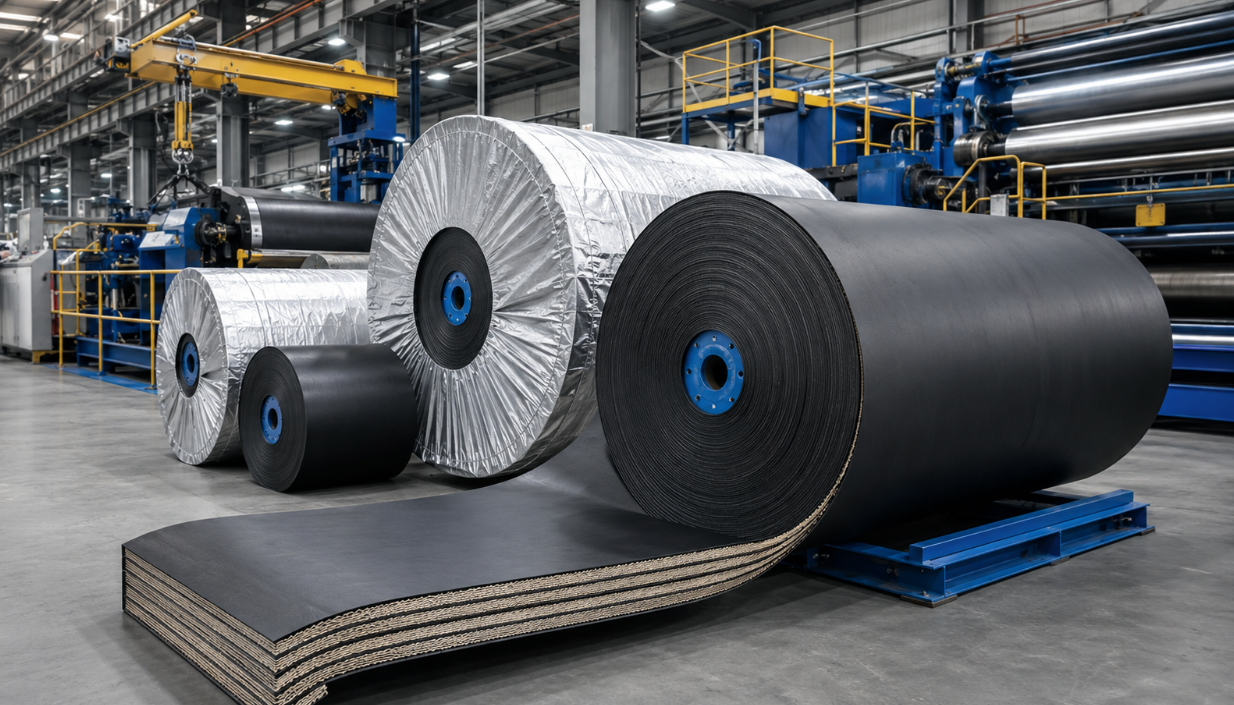
EP conveyor belts use polyester yarn in the warp and polyamide, commonly called nylon, in the weft. This carcass combines relatively low longitudinal elongation with transverse flexibility and good moisture resistance. It is widely used in mines, cement plants, ports, steel mills and other bulk-material systems where a fabric belt must trough and carry sustained loads.
An EP200 marking does not define the complete product. Buyers must also specify ply count, total belt rating, cover grade, top and bottom cover thickness, width, edge and splice. This review compares ten Chinese manufacturers with identifiable EP products. TranBelt publishes the article and appears in the ranking, so its position is a disclosed commercial assessment rather than an independent laboratory award.
Key Takeaways
- Compare total belt rating instead of using the nominal strength of one fabric ply alone.
- Match ply count, cover thickness and rubber grade to load, impact, abrasion and environment.
- Confirm edge construction, splice method, pulley diameters and troughing compatibility.
- Approve product-specific test reports and representative samples before volume purchasing.
China Industrial EP Conveyor Belt Manufacturer Comparison
The following table summarizes the clearest purchasing use case supported by each company’s product and manufacturing information. “Best for” is an editorial category, not a measured quality award. Buyers should verify the legal manufacturer, factory, applicable standard and production-specific test plan for every quoted belt.
| Manufacturer | Location | EP Belt Range | Main Capabilities | Best For |
|---|---|---|---|---|
| TranBelt Transmission Solutions | Shenzhen, Guangdong | Standard, heavy-duty and customized EP belts | OEM production, cover grades and custom construction | International industrial buyers |
| Zhejiang Double Arrow Rubber | Tongxiang, Zhejiang | Multi-ply EP and specialty fabric belts | Large-scale production and technical projects | Large bulk-handling systems |
| Qingdao Zhongjiao Six Rubber Conveyor Belt | Qingdao, Shandong | EP, NN and specialty fabric belts | Broad rubber belt manufacturing | Multiple heavy-duty applications |
| Baoding Huayue Rubber Belts | Baoding, Hebei | EP fabric and specialized rubber belts | Established production and testing | Mining and OEM programs |
| Qingdao Zhongye Yufeng Tape | Qingdao, Shandong | Multi-ply EP and resistance-grade belts | Export certifications and cover options | Standards-based export projects |
| Zhejiang Fuda Rubber | Tiantai, Zhejiang | EP fabric and specialty-cover belts | Heat-, oil- and chemical-resistant products | Special operating environments |
| Hebei Boao Rubber Technology | Baoding, Hebei | EP, NN and chevron belts | Belts and conveyor accessories | Mining, cement and steel |
| Sungda Conveyor Belt | Baoding, Hebei | EP and mining conveyor belts | EP-focused technical information | EP replacement projects |
| SINOCONVE | Ningbo, Zhejiang | EP rubber and fabricated conveyor belts | Export support and customization | Distributor and OEM orders |
| Hanbelt Rubber | Jining, Shandong | EP/NN multi-ply belts | Published EP specifications | Specification-driven purchasing |
Top 10 China Industrial EP Conveyor Belt Manufacturers
All ten companies publish EP products or clear evidence of polyester-fabric conveyor belt manufacturing. Ranking position reflects product breadth, technical transparency, custom capability and usefulness to industrial buyers. Final belt performance still depends on the approved construction, splice, conveyor design, installation and maintenance.
1. TranBelt Transmission Solutions – Best Overall for International Industrial Buyers
Company Background
TranBelt Transmission Solutions is a Shenzhen-based industrial conveyor belt manufacturer serving mines, cement plants, steel mills, ports, conveyor builders, distributors and maintenance companies. Its EP production covers standard replacement, heavy-duty and drawing-based OEM belts. TranBelt publishes this comparison, and that commercial relationship is disclosed so buyers can evaluate its claims on the same basis as every competitor.
Product Line
TranBelt manufactures multi-ply EP rubber conveyor belts in different fabric strengths, ply counts, widths and cover constructions. The range includes general-purpose, abrasion-resistant, heat-resistant, oil-resistant, chemical-resistant, cold-resistant and flame-resistant options. Buyers can specify top and bottom cover thickness, molded or cut edges and the applicable belt standard.
Custom products include chevron, rough-top, corrugated sidewall and other application-specific constructions. TranBelt can prepare belts for vulcanized or mechanical splicing and coordinate related pulleys and transmission components. Sidewalls, cleats and patterns must be matched to the belt rating and conveyor geometry rather than added to an unspecified base belt.
TranBelt reviews conveyed material, capacity, speed, incline, center distance, pulley diameters, take-up and environment before recommending a construction. This is important when replacing an NN, cotton or unknown belt with EP. A nominal strength match does not guarantee the same elongation, troughability or minimum pulley requirements.
Why We Recommend It
TranBelt supports international buyers that need standard rolls, heavy-duty EP belts or custom production from drawings. Its combination of belt manufacturing, application review and related industrial components makes it useful for both distributors and end users. Buyers can consolidate general and specialty EP requirements through one technical inquiry.
The exact carcass, rubber compound and test plan should still be approved in writing. Heat, oil, flame and chemical resistance require product-specific limits and test methods. As the publisher, TranBelt should provide the same traceability, samples, inspection records and warranty details expected from every manufacturer in this ranking.
2. Zhejiang Double Arrow Rubber Co., Ltd. – Best for Large Bulk-Handling Systems
Company Background
Zhejiang Double Arrow Rubber Co., Ltd. is a publicly listed conveyor belt manufacturer based in Tongxiang, Zhejiang. Established in 1986, it operates one of China’s best-known heavy rubber belting groups. The company participates in industry organizations, technical development and conveyor belt standards.
Product Line
Double Arrow manufactures multi-ply polyester fabric belts alongside steel-cord, solid-woven, aramid and anti-tear constructions. Its rubber cover range addresses general bulk handling and specialized exposure. Products are used in mining, ports, power generation, metallurgy, cement and long-distance conveying.
An EP project can specify carcass rating, ply count, cover grade, top and bottom cover thickness, width and edge. Large conveyors may also require controlled roll lengths and splice planning. Double Arrow’s broader range is useful when a project combines EP belts with higher-tension steel-cord or specialized products.
Why We Recommend It
Double Arrow is a strong candidate for large, technically demanding systems and structured tenders. Its manufacturing scale, published management systems and product breadth support long-term supply programs. It is particularly relevant where the owner requires formal approval documents and inspection hold points.
Scale alone does not qualify the belt. Buyers should identify the plant and line assigned to production, confirm the standard revision and approve project-specific tests. Splice materials, field support and emergency replacement lead times should be evaluated alongside the belt price.
3. Qingdao Zhongjiao Six Rubber Conveyor Belt Co., Ltd. – Best for Broad Heavy-Duty Coverage
Company Background
Qingdao Zhongjiao Six Rubber Conveyor Belt Co., Ltd. is a Shandong rubber belt manufacturer associated with the established Rubber Six industry group. It publishes production equipment, laboratory and technical cooperation information and serves domestic and export bulk-material markets.
Product Line
The company supplies polyester EP, nylon NN and cotton-canvas fabric belts, plus steel-cord products. Specialty constructions include flame-resistant PVC/PVG, corrugated sidewall, pipe, patterned, bucket-elevator and filter belts. This range addresses mining, ports, power generation, filtration and industrial processing.
EP belts can be paired with general-purpose, heat-resistant or other covers depending on the operating duty. Wide product coverage helps buyers manage several conveyor applications, but each construction requires separate approval. A filter belt, pipe belt and conventional troughed EP belt do not share the same fabrication or inspection priorities.
Why We Recommend It
Rubber Six is suitable for procurement programs containing multiple heavy-duty belt types. Its public manufacturing and laboratory information provides a stronger evaluation basis than a basic trading catalog. It can be considered for both conventional EP belts and specialized fabric constructions.
Several similarly named Rubber Six entities appear in the market. Buyers should confirm which legal company owns the factory, produces the belt and accepts warranty responsibility. Drawings, certificates, test reports, branding and payment documents should identify the same entity.
4. Baoding Huayue Rubber Belts Co., Ltd. – Best for Mining and OEM Programs
Company Background
Baoding Huayue Rubber Belts Co., Ltd. began producing rubber belts in 1986 and operates from Hebei. The company publishes factory history, research and testing information and focuses on fabric, steel-cord and solid-woven conveyor products for heavy industry.
Product Line
Huayue’s range includes EP polyester and nylon fabric belts, steel-cord belts, PVC/PVG solid-woven flame-resistant belts and corrugated sidewall products. It also offers tear-resistant and other specialty constructions for mining, aggregates, ports, power and general bulk handling.
The company’s EP offering can support different ply counts, dimensions and rubber covers. Buyers should state total required belt rating rather than simply request “EP200.” An EP200 four-ply belt and an EP200 five-ply belt use the same nominal ply rating but do not have the same total nominal strength or flexibility.
Why We Recommend It
Huayue is suitable for repeat production and structured mining or industrial OEM programs. Its published manufacturing history and testing infrastructure provide useful supplier-qualification evidence. The ability to supply EP, steel-cord and solid-woven products can support plants operating several conveyor classes.
Historical rankings should not be presented as current independent quality scores. Buyers should review valid certificates, laboratory capability and current product reports. The inspection plan should define tensile strength, elongation, ply adhesion, cover adhesion, dimensions and visual acceptance.
5. Qingdao Zhongye Yufeng Tape Co., Ltd. – Best for Standards-Based Export Projects
Company Background
Qingdao Zhongye Yufeng Tape Co., Ltd. was established in 2010 and integrates rubber conveyor belt research, manufacturing and export sales. Its public materials emphasize production capacity, certifications and Chinese and international standards for heavy industrial belts.
Product Line
The range includes multi-ply fabric, steel-cord, pipe, sidewall, chevron and bucket-elevator products. EP carcasses can be combined with general-purpose, heat-, oil-, acid-, alkali- and cold-resistant covers. The company also lists solid-woven flame-resistant belts for applications requiring a different carcass system.
Export orders should identify the standard, tensile rating, ply count, cover thickness and resistance grade. A cover described as heat-resistant needs a defined continuous and peak temperature. Oil and chemical grades require the actual fluid, concentration and exposure conditions rather than a generic resistance label.
Why We Recommend It
Zhongye Yufeng is a practical candidate for standards-based export projects requiring several heavy-duty cover grades. Its Qingdao location supports international shipping, while its product breadth can simplify mixed belt programs for industrial distributors and engineering companies.
Certification logos should be checked against the issuing body, validity, legal company, factory and product scope. The contract should reference the exact standard revision and test frequency. This converts general certification claims into enforceable requirements for the production batch.
6. Zhejiang Fuda Rubber Co., Ltd. – Best for Special Operating Environments
Company Background
Zhejiang Fuda Rubber Co., Ltd. is located in Tiantai, Zhejiang and states that it has focused on industrial rubber conveyor belt production since 1989. The company integrates product development, manufacturing, sales and service for bulk-material applications.
Product Line
Fuda offers EP and other multi-ply fabric belts plus steel-cord products. Its specialty covers include heat-, oil-, chemical-, abrasion-, cold- and flame-resistant constructions. Chevron, rough-top and corrugated sidewall belts address inclined conveying and applications requiring additional grip or containment.
Cover grade is central to Fuda’s value proposition. Buyers should translate terms such as heat-resistant or oil-resistant into measurable compound properties and test methods. Sidewall systems must define the base belt, transverse reinforcement, sidewalls, cleats and recommended pulley diameters as one engineered construction.
Why We Recommend It
Fuda is relevant when operating temperature, oil, chemicals or abrasion make a general-purpose cover unsuitable. Its broad range allows buyers to compare several EP cover grades through one factory and source incline or conventional belts under one program.
Selection should rely on current product data and production-specific reports. Buyers should verify the factory, certificate scope and testing frequency and consider a trial roll for demanding exposure. The sample must use the same carcass and cover compound intended for the volume order.
7. Hebei Boao Rubber Technology Co., Ltd. – Best for Mining, Cement and Steel
Company Background
Hebei Boao Rubber Technology Co., Ltd. operates in Boye County, Baoding and manufactures conveyor belts and conveyor accessories under the Jinao brand. Founded in 2004, it targets mining, cement, steel, ports and related heavy industrial users.
Product Line
Boao supplies EP and NN fabric belts, steel-cord, flame-resistant and chevron constructions. General-purpose and abrasion-resistant products cover common bulk handling, while related rollers and conveyor components can support maintenance projects that extend beyond the belt itself.
EP quotations should define the fabric rating, number of plies, total strength, cover thickness, grade and edge. Chevron orders also require pattern height, pitch and return-side clearance. Rollers must be specified separately because poor runout, sealing or alignment can shorten the life of an otherwise suitable belt.
Why We Recommend It
Boao offers an alternative to China’s largest national belt groups for mining, cement and steel applications. Its ability to combine belts and accessories may help maintenance buyers address damaged rollers and alignment problems rather than repeatedly replacing the belt alone.
Buyers should validate production and laboratory capability for the exact construction. If accessories are included, confirm which products are manufactured internally. Inspection, labeling and warranty responsibility should remain clear across the complete supply package, especially when belts and rollers come from different production locations.
8. Sungda Conveyor Belt Co., Ltd. – Best for EP Replacement Projects
Company Background
Sungda Conveyor Belt Co., Ltd. presents an operating history dating to 1981 and is based in the Baoding conveyor belt manufacturing region. It focuses on rubber belts for mining, bulk materials and industrial applications and publishes substantial EP-related technical content.
Product Line
Sungda offers EP polyester, nylon and steel-cord conveyor belts. Specialty products include heat-, oil-, flame- and abrasion-resistant covers plus chevron, sidewall, pipe, food-grade and extra-wide constructions. Its technical pages discuss EP carcass behavior, belt ratings and replacement considerations.
This information can help when an old belt uses PIW notation or an incomplete EP designation. Conversion should still be confirmed against the original standard, ply count and safety factor. A numerical conversion cannot determine rubber grade, cover thickness, splice or pulley compatibility.
Why We Recommend It
Sungda is useful for EP replacement projects because it combines a relevant product range with accessible technical explanations. It can support buyers that need to interpret existing markings before requesting a standard or customized replacement belt.
Claims about large customers, certifications or operating history remain company-provided until independently checked. Buyers should request current entity, factory and certificate evidence and approve a sample and test report tied to the proposed construction before relying on those claims during supplier selection.
9. SINOCONVE – Best for Distributor and OEM Orders
Company Background
SINOCONVE is a Ningbo-based conveyor belt manufacturer and export brand serving distributors, OEMs and industrial users. Its product offering combines rubber conveyor belts with other power-transmission products and emphasizes customization, mixed industrial orders and international commercial support for overseas customers.
Product Line
The catalog includes EP rubber conveyor belts, steel-cord, sidewall, chevron, rough-top and endless products. Available covers address impact, abrasion, tear, heat, fire, cold, oil, grease and chemical exposure. Buyers can request different widths and application-specific constructions.
The broad range can help distributors manage standard EP belts and specialty requirements through one inquiry. However, resistance properties should be defined by test values and operating conditions. An export-friendly description is not a substitute for an approved compound and production specification.
Why We Recommend It
SINOCONVE is appropriate for distributors and OEM buyers that prioritize international communication, mixed orders and customization. It can be evaluated for routine EP stock requirements, specialty rubber covers and fabricated products when the buyer wants to consolidate several belt specifications.
Buyers should confirm the legal manufacturer, production address and internally completed processes. Product labels, certificates, inspection reports and warranty documents should identify the responsible entity. Representative samples should match the factory and construction proposed for the final order.
10. Hanbelt Rubber Co., Ltd. – Best for Specification-Driven Purchasing
Company Background
Hanbelt Rubber Co., Ltd. is located in Jining, Shandong and publishes EP, NN, steel-cord and fire-resistant conveyor belt products. Its online EP information is more specification-focused than the promotional pages used by many smaller suppliers.
Product Line
Hanbelt lists EP fabric grades from lower to higher ply strengths, multiple ply counts, cover thicknesses, widths and roll lengths. It also references DIN, AS and RMA-related constructions. Published tables help buyers prepare an initial specification and compare nominal belt structures.
The format illustrates how an EP belt should be described. A designation such as EP200-4 with defined top and bottom covers communicates ply rating, ply count and cover thickness more clearly than “heavy-duty polyester belt.” The applicable standard and rubber grade must still be added.
Why We Recommend It
Hanbelt is useful for specification-driven inquiries because it publishes fabric and dimensional data. It may suit standard replacement projects where the buyer already knows the required EP grade, number of plies, cover thicknesses, rubber grade, belt width and applicable standard.
The company provides less public institutional information than higher-ranked manufacturers. Buyers should therefore verify legal entity, factory scale, certification and production capability. Samples, current test reports and third-party inspection may be appropriate before a large order.
How Were These EP Conveyor Belt Manufacturers Evaluated?
Candidates needed an identifiable Chinese company and official evidence of EP or polyester-fabric conveyor belts. General rubber belt suppliers were not included unless they showed relevant multi-ply fabric products and a manufacturing role. The evaluation also considered factory information, technical tables and industrial application coverage.
Product breadth was assessed through fabric strengths, ply options, cover grades, dimensions and special constructions. Testing resources, standards and international support influenced practical purchasing value. Capacity and customer claims remain company-provided unless independently verified, so they were not converted into invented scores.
No customer ratings, market-share claims or performance awards were fabricated. TranBelt’s first position includes the publisher’s commercial perspective and is disclosed accordingly. Buyers should use identical entity checks, approved specifications, sample tests, inspection requirements and warranty terms for TranBelt and every competing manufacturer.
What Should You Compare When Choosing an EP Conveyor Belt Manufacturer?
An EP belt should be purchased from a complete technical designation. The manufacturer needs the conveyed material, capacity, speed, incline, conveyor length, pulley diameters, take-up, troughing angle and environment. These inputs determine the required strength, carcass, covers and splice rather than leaving the factory to infer duty from width.
EP Fabric Rating and Total Belt Strength
EP100, EP150, EP200, EP250 and EP300 commonly describe nominal tensile strength per millimeter of belt width for one fabric ply. The exact convention must follow the applicable standard and manufacturer’s data. The number should not be interpreted as the total rating of every finished belt carrying that fabric.
As a simplified example, four EP200 plies indicate a nominal carcass strength based on four 200 N/mm plies, subject to the manufacturer’s construction and standard. Buyers should obtain the declared finished-belt rating rather than rely solely on multiplication. Safety factors and splice efficiency are separate design considerations.
Ply Count and Carcass Construction
Two-, three-, four-, five- and six-ply constructions offer different strength, thickness and flexibility. More plies can increase nominal strength but can also increase belt thickness and minimum pulley diameter. A lower-ply belt with stronger fabric may behave differently from a higher-ply belt with weaker fabric.
The selected carcass must trough without excessive stress and pass around the installed pulleys. It must also fit the take-up and splice design. When replacing another construction, compare elongation and elastic behavior because EP often stretches differently from NN or cotton fabric.
Top and Bottom Cover Thickness
The top cover protects the carcass from impact, abrasion and the conveyed material. The bottom cover contacts pulleys and idlers. Their thicknesses need not be equal. A thicker top cover may extend wear life, while unnecessary bottom thickness can increase cost and bending stiffness.
Specify thickness in millimeters and define measurement tolerances. Molded edges protect the carcass within a rubber edge, while cut edges expose the ply edge and suit other production or installation priorities. The purchase drawing should state the required edge type.
Rubber Cover Grade
General-purpose and abrasion-resistant covers suit many dry bulk materials. Heat-, oil-, chemical-, cold- and flame-resistant grades use different compound priorities. One resistance property can trade against another, so buyers should not request every label without defining the actual exposure.
Provide material temperature, ambient temperature, oil or chemical name, concentration and contact duration. Request the test standard and acceptance value for abrasion, tensile properties, aging or resistance. For inclined handling, TranBelt’s cleated conveyor belt guide explains why profile geometry must also match the conveyor.
Splice and Conveyor Compatibility
Vulcanized splices can provide a smooth, controlled joint when designed and installed correctly. Mechanical fasteners reduce installation time and may support field repair, but they affect pulley requirements, cleaning and belt strength. The selected splice must be included in the belt and conveyor evaluation.
Confirm minimum pulley diameters, take-up travel, troughing angle and transition distance. Replacing an NN or cotton belt with EP may change elongation and tension behavior. The conveyor designer or belt manufacturer should approve the substitution instead of relying on nominal tensile strength alone.
Quality Documentation and Factory Verification
Request an approved data sheet and drawing plus tensile, elongation, ply adhesion, cover adhesion and abrasion results. Specialty covers need relevant heat, oil, chemical, cold or flame documentation. Reports should identify the product, lot, test method and acceptance criteria.
Confirm the legal manufacturer and factory before production. Define roll labels, lot traceability, packaging and required documents. For major projects, witness testing, third-party inspection or a factory audit can verify that the supplied construction matches the approved belt rather than only a pre-production sample.
Frequently Asked Questions
What Does EP Mean in a Conveyor Belt?
EP identifies a fabric carcass with polyester yarn in the longitudinal warp and polyamide or nylon yarn in the transverse weft. Polyester helps control lengthwise elongation, while nylon supports flexibility, impact resistance and trough formation. Rubber covers and skim layers bond and protect the carcass.
What Is the Difference Between EP100 and EP200 Conveyor Belts?
EP100 and EP200 usually identify different nominal tensile strengths for each fabric ply, expressed per millimeter of belt width. EP200 fabric is stronger per ply, but the finished belt rating also depends on ply count. Cover grade, thickness, splice and dimensions must be compared separately.
Is an EP Conveyor Belt Better Than an NN Conveyor Belt?
Neither carcass is universally better. EP generally offers lower longitudinal elongation and good moisture behavior. NN can provide high flexibility and impact performance but may elongate more. The correct choice depends on conveyor length, take-up, pulley sizes, troughing, load, impact and existing splice design.
How Many Plies Should an EP Conveyor Belt Have?
The required ply count depends on fabric strength, total belt rating, width, load and pulley configuration. More plies are not automatically better because they increase thickness and bending stiffness. The manufacturer should select the carcass from conveyor calculations and confirm minimum pulley diameters and troughability.
What Information Should an EP Conveyor Belt RFQ Include?
Provide the EP grade, ply count, width, roll or endless length, top and bottom covers, edge and rubber grade. Add conveyed material, capacity, speed, incline, pulley diameters, take-up, troughing angle, splice, temperature and chemicals. Include the applicable standard and required inspection documents.
Conclusion
The best China industrial EP conveyor belt manufacturer depends on total belt strength, ply construction, rubber covers and conveyor geometry. An EP200 label alone cannot determine suitability. Buyers must specify ply count, cover thickness, edge, resistance grade, splice and the standard used to define the finished belt.
TranBelt manufactures standard, heavy-duty and customized EP conveyor belts in Shenzhen for international mining, cement, steel, port and bulk-handling customers. The other manufacturers in this review offer different strengths in scale, specialty covers and technical documentation. Before ordering, approve the complete specification and representative production evidence rather than comparing price per meter alone.
Sources
- TranBelt Transmission Solutions, About Us, retrieved 2026-07-28.
- TranBelt Transmission Solutions, Conveyor Belt with Cleats Guide, retrieved 2026-07-28.
- Zhejiang Double Arrow Rubber Co., Ltd., Company Introduction, retrieved 2026-07-28.
- Zhejiang Double Arrow Rubber Co., Ltd., Official Website, retrieved 2026-07-28.
- Qingdao Zhongjiao Six Rubber Conveyor Belt Co., Ltd., Company and Product Information, retrieved 2026-07-28.
- Baoding Huayue Rubber Belts Co., Ltd., About Us, retrieved 2026-07-28.
- Qingdao Zhongye Yufeng Tape Co., Ltd., Company and Product Information, retrieved 2026-07-28.
- Zhejiang Fuda Rubber Co., Ltd., Conveyor Belt Product Information, retrieved 2026-07-28.
- Hebei Boao Rubber Technology Co., Ltd., Company and Product Information, retrieved 2026-07-28.
- Sungda Conveyor Belt Co., Ltd., EP Conveyor Belts, retrieved 2026-07-28.
- SINOCONVE, EP Rubber Conveyor Belts, retrieved 2026-07-28.
- Hanbelt Rubber Co., Ltd., EP/NN Multi-Ply Conveyor Belt, retrieved 2026-07-28.