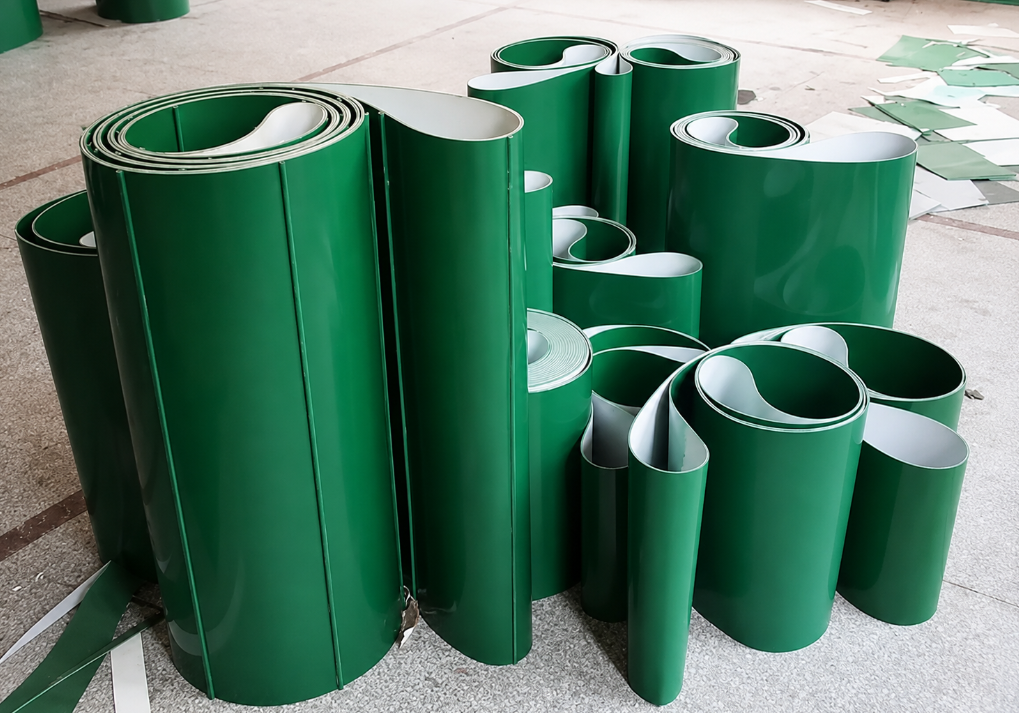
An endless conveyor belt forms a continuous loop around a conveyor’s pulleys or sprockets. The loop may be manufactured without a seam, permanently joined by vulcanization or welding, or mechanically closed with lacing, pins, rods, or fasteners.
These constructions aren’t equivalent. A truly endless belt has no splice, while a joined belt has a closure affecting strength, thickness, flexibility, tracking, hygiene, or product marking. This guide explains the main types, materials, applications, and selection details.
Key Takeaways
- “Endless” describes a closed loop, but it doesn’t always mean seamless.
- Truly endless belts provide uniform thickness and uninterrupted reinforcement in selected constructions.
- Vulcanized, welded, pinned, and modular closures simplify different installation and repair tasks.
- Dimensions, pulley size, load, tracking, environment, joint design, and machine access determine suitability.
What Is an Endless Conveyor Belt?
An endless conveyor belt is a belt configured as a closed loop so it can circulate continuously through the carrying and return paths. The term covers light fabric belts, heavy rubber conveyors, timing belts, plastic modular belts, wire mesh, filter belts, and specialty process belts.
Some belts leave the factory in their final loop form. Others are supplied open and joined on the machine. A supplier may call both products endless because both operate as loops. Buyers should therefore specify whether they need truly endless, factory-spliced endless, field-spliced, or mechanically joined construction.
Habasit defines seamless belts as truly endless belts with no splice or seam (Habasit, Seamless Belts). Their uninterrupted construction can support uniform running, tight tolerances, and consistent surface behavior in high-speed feeding and process applications.
A joined belt can also provide reliable service. Finger splices, stepped vulcanized splices, welded thermoplastic joints, metal lacing, hinge pins, and modular rods suit different belt bodies. The best closure depends on tension, pulley diameter, product contact, cleaning, installation access, and acceptable downtime.
Running direction can matter. Some splices, covers, profiles, scrapers, and fabric constructions are directional. Belt markings and supplier instructions should be followed during installation. A reversible conveyor requires a belt and joint approved for both directions.
What Is the Difference Between Truly Endless and Spliced Endless Belts?
A truly endless belt is manufactured as a continuous loop without a transverse splice. A spliced endless belt begins as open material and has its ends permanently or mechanically joined. Both circulate continuously, but their reinforcement and surface continuity differ.
Truly endless belts may be woven in loop form, molded as a ring, cast over continuous cords, or produced from a sleeve that is slit to width. Their lack of a transverse joint eliminates splice thickness variation and prevents a closure from repeatedly crossing pulleys, scrapers, vacuum zones, or product-contact areas.
Habasit’s seamless HabaSYNC timing belts use helically wound cords without interruption (Habasit, HabaSYNC Flex Timing Belts). This construction supports synchronized conveying and accurate positioning, but available lengths, widths, pitches, and fabrication options remain product-specific.
Spliced endless belts offer greater length flexibility and easier field installation. Thermoplastic belts can use finger or overlap welding. Rubber belts may use hot or cold vulcanization. Heavy textile and steel-cord conveyors require engineered splice patterns. Mechanical fasteners allow rapid opening and closing.
Splice efficiency depends on belt construction, geometry, materials, pressure, temperature, workmanship, curing, and inspection. Continental notes that joining method is fundamental because many conveyor failures occur at splices (Continental, Belt Splicing).
What Are the Main Types of Endless Conveyor Belts?
The main types are seamless woven belts, vulcanized rubber belts, endless timing and positive-drive belts, modular plastic belts, metal mesh belts, and specialty vacuum or filter belts. The closing method must match the belt’s material and operating function.
Truly Endless Fabric Belts
Truly endless fabric belts are woven as loops or cut from endless sleeves. They have no transverse seam. Rubber, silicone, polyurethane, or other coatings may be applied to create grip, release, wear resistance, cushioning, or food-contact surfaces.
These belts serve paper feeding, folder-gluers, packaging, tube and cable pulling, rotary molding, coil wrapping, weighing, and high-speed conveying. Uniform thickness helps reduce vibration and repeated product marks. A continuous woven body can also resist cover peeling at a joint.
Vulcanized Endless Rubber Belts
Vulcanized endless belts are created by joining rubber belt ends with heat, pressure, and compatible uncured materials. The process bonds covers and reinforcement into a continuous loop. Hot vulcanization is common for heavy textile and steel-reinforced conveyor belts.
Textile belts may use finger, bias, or stepped-ply splice patterns. Steel-cord belts require defined cord preparation, spacing, overlap, and rubber bonding. The splice dimensions must follow the exact belt construction and manufacturer procedure.
Cold-bonded joints use chemical adhesives without a heated press. They can suit selected repairs or belts, but are not equivalent to every hot-vulcanized splice. Product temperature, chemicals, belt tension, and safety requirements determine whether cold bonding is permitted.
Endless Timing and Positive-Drive Belts
Endless timing belts use teeth that engage matching pulleys for synchronized conveying or power transmission. Molded rubber belts are commonly produced in fixed endless lengths. Thermoplastic polyurethane timing belts may be welded from open-ended material or manufactured truly endless over continuous cords.
Flights, profiles, coatings, perforations, and vacuum holes can be added for positioning, lifting, indexing, and feeding. Tooth pitch and profile must match the pulley. TranBelt’s guide to timing belt pitch explains the core measurement.
Positive-drive monolithic conveyor belts use molded drive bars or lugs under a continuous thermoplastic body. Their ends may be welded, mechanically laced, or supplied in specialized connectable sections. The joint should preserve pitch and tracking.
Plastic Modular Endless Belts
Plastic modular belts consist of interlocking module rows connected by transverse rods. Installing the final rod closes the belt into a loop. This is mechanically endless but not seamless; the closure row remains serviceable and generally resembles the other hinges.
Rods let technicians open the belt, replace damaged modules, change width, or remove it for maintenance. Intralox describes rods as connectors that support installation and sectional repair without replacing the full belt (Intralox, Conveyor Belt Joining and Maintenance Tools).
Flat-top, grid, friction-top, roller-top, flighted, and side-flexing modules serve different products. TranBelt’s plastic modular belt conveyor guide explains these options.
Endless Metal and Wire Mesh Belts
Metal conveyor belts use woven wire, linked spirals, rods, chains, flat wire, eye links, or solid steel. The loop may be welded, pinned, laced, hooked, or connected through a repeating link pattern. Some joints are nearly indistinguishable from the belt body.
Joint design affects strength, flexibility, tracking, and product contact. A removable pin simplifies installation, while a welded closure can create a smoother or more permanent loop. Conveyor sprockets and support rails must suit the mesh pitch and edge style.
Specialty Perforated, Vacuum and Filter Belts
Vacuum belts use perforations and an air chamber to hold products against the surface. A joint crossing the vacuum zone can leak or change holding force. Truly endless or carefully prepared splices improve thickness and airflow consistency where precise positioning matters.
Filter belts pass liquid while retaining solids. Woven cloths may use clipper, pin, spiral, welded, or endless seams. Some vacuum filter suppliers offer endless constructions to reduce closure leakage, while removable seams simplify installation.
TranBelt’s filter belt guide explains woven, spiral, perforated, and rubber drainage constructions. The vacuum belting guide covers hole patterns, support, and vacuum conveyor uses.
What Materials and Reinforcements Are Available?
Endless belts use rubber, PVC, TPU, silicone, woven textiles, aramid, fiberglass, steel, plastic modules, and metal mesh. Material controls friction, flexibility, temperature, chemicals, wear, hygiene, load, and joining method. Reinforcement controls tensile capacity and elongation.
Rubber and Elastomeric Compounds
Rubber compounds include natural rubber, SBR, chloroprene, EPDM, NBR, silicone, and proprietary blends. Covers can provide grip, abrasion resistance, oil resistance, heat performance, weathering, cushioning, or release.
PVC, TPU and Silicone
PVC and TPU conveyor belts can be finger-spliced, overlap-welded, or mechanically joined. TPU timing belts may also be manufactured truly endless. Material compatibility, weld preparation, heat, pressure, and cooling determine splice quality.
Polyester, Polyamide, Aramid and Fiberglass
Polyester and polyamide fabrics form carcasses for light conveyor and seamless woven belts. Fabric weave and coating adhesion affect tracking, flexibility, edge stability, and splice behavior.
Plastic Modules and Metal Mesh
Polypropylene, polyethylene, acetal, and engineering plastics are used in modular belts. Rod material may differ from modules. Temperature, chemicals, impact, abrasion, food contact, expansion, and wearstrip interaction guide selection.
Where Are Endless Conveyor Belts Used?
Endless conveyor belts are used in food, packaging, printing, paper, logistics, mining, agriculture, metalworking, textiles, electronics, woodworking, and general manufacturing. The required construction depends on whether uniformity, field installation, hygiene, high tension, heat, drainage, or fast repair has priority.
Packaging and printing machines use truly endless feeder and grabber belts for paperboard, film, cartons, tubes, and labels. Uniform thickness supports smooth high-speed feeding. Holes, slots, grooves, and high-friction covers can be added for vacuum or pulling functions.
Mining, aggregates, cement, and bulk handling use field-vulcanized rubber belts because conveyors may be too large for a preformed loop. Splice engineering is part of belt design. Mechanical fasteners may support emergency repair or selected duties.
Automation and assembly machines use truly endless timing belts for synchronized parallel conveying, indexing, and positioning. Welded timing belts suit custom lengths when their lower splice rating is acceptable. Profiles and fixtures can carry products at repeatable spacing.
Endless Conveyor Belt Type Comparison
The table distinguishes construction and closure. “Endless” alone doesn’t indicate whether a belt has a joint. Suppliers should state the exact manufacturing and joining method on drawings and quotations.
| Belt Type | Loop Construction | Joint Type | Main Feature | Typical Application | Main Limitation |
|---|---|---|---|---|---|
| Truly endless woven belt | Woven as a loop or cut from a sleeve | None | Uniform thickness and surface | Feeding, packaging, rotary molding | Requires machine access for installation |
| Vulcanized rubber belt | Open belt permanently bonded | Hot or cold splice | Long custom lengths and high load options | Bulk conveying and heavy industry | Splice quality depends on procedure |
| Truly endless timing belt | Molded or cast over continuous cords | None | Uninterrupted reinforcement and pitch | Indexing, positioning, power transmission | Fixed manufacturing length range |
| Welded timing belt | Open-end TPU belt joined into loop | Finger or overlap weld | Custom long lengths | Synchronized conveying | Lower joint capacity than continuous cords |
| Plastic modular belt | Interlocked module rows | Removable connecting rod | Sectional repair and positive drive | Food, packaging, curves | Hinges and expansion need attention |
| Metal mesh belt | Wire, link, or chain construction | Pin, hook, lace, or weld | Heat, airflow, drainage, and heavy duty | Ovens, fryers, washers | Joint and thermal fatigue vary by design |
| Vacuum or filter belt | Porous fabric or perforated body | Seamless, welded, clipper, or pin | Controlled airflow or liquid passage | Vacuum conveying and filtration | Joint can affect leakage and process uniformity |
Truly endless construction is most valuable when a splice would disturb product contact, pitch, vacuum, scraping, or high-speed running. A removable or field-made joint is preferable when installation access and downtime dominate.
How Do You Select the Correct Endless Conveyor Belt?
Select an endless belt by defining its function, exact length convention, pulley geometry, load, speed, environment, joint requirement, and installation route. A supplier should receive a machine drawing and a sample or full description of the conveyed product.
Belt Dimensions and Length Definition
Provide endless length, width, thickness, profile, tooth pitch, hole pattern, and tolerances. State how length is measured and under what tension. If replacing a stretched belt, use the machine geometry or original specification rather than copying the worn loop.
Pulley Diameter and Conveyor Layout
Record drive and tail pulley diameters, nosebars, reverse bends, wrap, center distance, take-up travel, return supports, and tracking system. Splice thickness and stiffness must pass every bend without lifting, cracking, or striking the frame.
Review how a preformed loop will be installed. Shafts, bearings, cantilever frames, removable sides, and sanitation stands can simplify replacement. If dismantling is impractical, choose an approved field splice or removable closure.
Load, Speed and Tracking
Provide belt pull, product load, speed, acceleration, incline, duty cycle, and shock. Truly endless does not mean unlimited strength. Belt body, reinforcement, width, and pulley engagement still determine capacity.
Uneven loading, side transfers, worn pulleys, frame misalignment, and poor tension can make any belt mistrack. Seam uniformity helps, but it cannot correct an unsuitable conveyor.
Temperature, Chemicals and Cleaning
List operating and cleaning temperatures, water, oils, chemicals, abrasion, ultraviolet exposure, and food-contact requirements. Check the belt, coating, reinforcement, joint, profiles, and edge treatment as one construction.
Cleaning tools and scrapers must pass the closure safely. A raised mechanical joint can catch a scraper, while a smooth permanent splice may be harder to open for sanitation. Product risk and cleaning validation should guide the choice.
Installation and Replacement Access
Estimate replacement time, required labor, press or welding equipment, cure time, and spare-belt storage. Truly endless belts can reduce joint maintenance but increase machine disassembly. Mechanical or modular closures can restore production faster.
Ask whether the belt can be repaired locally and whether the joint requires certified technicians. Critical lines may stock a premeasured belt, splice kit, rods, fasteners, and installation tools.
Frequently Asked Questions
Does endless conveyor belt mean there is no splice?
Not always. Endless means the belt operates as a closed loop. A truly endless or seamless belt has no transverse splice. A joined endless belt contains a vulcanized, welded, pinned, laced, or modular closure. The supplier should state the exact construction.
Is a truly endless belt stronger than a spliced belt?
It can provide uninterrupted reinforcement and uniform thickness, but finished strength depends on belt design. Some truly endless timing belts exceed joined versions, while engineered vulcanized conveyor splices can carry demanding loads. Use the manufacturer’s rating for the exact belt and joint.
Can an endless belt be installed without removing conveyor parts?
A preformed seamless loop normally requires a clear path around shafts and frame components. A field-spliced or mechanically joined belt can be installed open and closed on the conveyor. Cantilevered frames and removable bearing assemblies can simplify endless-belt replacement.
Can a damaged endless belt be repaired?
Sometimes. Modular belts allow individual module replacement. Rubber and thermoplastic belts may accept approved patches or resplicing. Truly endless woven or timing belts can be difficult to restore without changing uniformity or strength. Repair feasibility depends on damage location and construction.
How do you measure an endless conveyor belt?
Use the manufacturer’s specified inside, outside, neutral-axis, effective, or pitch-length method under the stated tension. For installed conveyors, pulley diameters, center distance, take-up position, and routing can establish required length. Do not copy a stretched belt without correction.
Conclusion
Endless conveyor belts include seamless loops, vulcanized rubber, welded timing, modular, metal mesh, vacuum, and filter constructions. Their joints differ in strength, thickness, flexibility, hygiene, installation, and repair.
Specify whether the belt must be truly endless or joined into a loop. Match dimensions, pulleys, load, tracking, environment, cleaning, and access. The best construction balances uniformity with installation and maintenance.
Sources
- Habasit, Seamless Belts, retrieved 2026-07-23.
- Habasit, HabaSYNC Flex Timing Belts, retrieved 2026-07-23.
- Habasit, HabaSYNC Flex Timing Belt Overview, retrieved 2026-07-23.
- Habasit, HabaSYNC Timing Belts, retrieved 2026-07-23.
- Continental, Belt Splicing, retrieved 2026-07-23.
- Intralox, Conveyor Belt Joining and Maintenance Tools, retrieved 2026-07-23.
- Intralox, ThermoDrive Belt Joining Options, retrieved 2026-07-23.
- Intralox, ZeroSplice Technology, retrieved 2026-07-23.