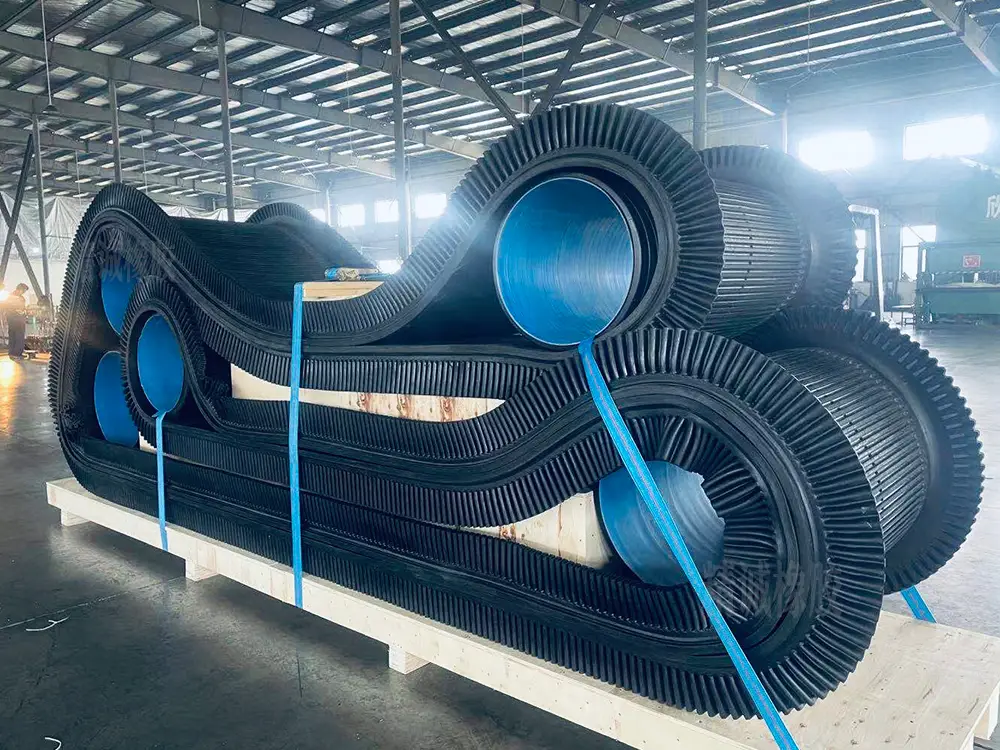
A filter belt separates solids from liquids or gases. Its openings pass filtrate while retaining particles or supporting a filter cake. Filter belts serve vacuum filters, belt presses, gravity thickeners, dryers, and coolant systems.
The term can describe woven media, spiral meshes, perforated belts, or the grooved rubber drainage belt beneath a separate cloth. These components don’t perform the same job. Selection depends on filtration, retention, permeability, chemistry, temperature, load, seam, tracking, cleaning, and cake release.
Key Takeaways
- Filter belts provide continuous filtration, dewatering, washing, pressing, or drainage.
- Woven cloth usually performs separation; a rubber drainage belt may support the cloth and carry vacuum.
- Polyester, polypropylene, polyamide, PTFE, rubber, and metal serve different process conditions.
- Aperture, permeability, strength, seam, tracking, cleaning, and cake release must be evaluated together.
What Is a Filter Belt?
A filter belt is an endless or joined process belt designed to let fluid pass through controlled openings. Solid particles remain on the surface or within a growing cake. The moving belt carries retained solids through filtration, washing, pressing, drying, discharge, and cloth-cleaning zones.
GKD defines filter belts as endless belts used in continuous processing, particularly for solid-liquid separation in vacuum belt filters and belt presses (GKD, Filter Belt). Common constructions include monofilament woven fabric and plastic spiral mesh made from polyester, polypropylene, or polyamide.
The belt also acts as a mechanical component. It must resist operating tension, transverse distortion, roller flexing, scraper contact, wash pressure, and abrasive solids. Dimensional stability helps the belt track consistently and keeps the seam from moving unevenly through the machine.
Some horizontal vacuum filters use two belts. A porous cloth contacts the slurry and performs filtration. A thick grooved rubber drainage belt supports the cloth, carries filtrate toward vacuum holes, and transmits motion. Calling both components “the filter belt” can cause an incorrect replacement order.
How Does a Filter Belt Work?
A filter belt works by carrying a slurry, sludge, suspension, or contaminated fluid across a permeable surface. A pressure difference moves liquid through the openings. Retained solids form a cake that can improve particle capture but also increases resistance as it becomes thicker.
In a gravity belt or thickener, liquid drains under gravity. In a vacuum belt filter, vacuum below the cloth draws filtrate through the cake and medium. In a belt filter press, two belts progressively compress sludge between rollers, combining gravity drainage, wedge pressure, and mechanical pressing.
Micronics describes a horizontal belt vacuum filter in which a continuous rubber drainage belt supports a continuous filter fabric while both travel through vacuum zones (Micronics, Horizontal Belt Vacuum Filters). Separate zones can form, wash, dewater, and discharge the cake.
Washing sprays remove residual solids and reopen the belt after cake discharge. Nozzle arrangement, water quality, pressure, and spray angle matter. Excess pressure can drive particles deeper into the mesh, stretch the belt, damage seams, or create mist without improving cleaning.
Filtration quality and capacity are linked but not identical. A more open belt can increase flow while allowing greater initial solids passage. A tighter medium can improve retention but blind faster. Pilot testing with representative process slurry is usually more reliable than choosing from micron rating alone.
What Are the Main Types of Filter Belts?
The main filter belt types are vacuum filter cloths, belt press fabrics, woven mesh belts, spiral-link belts, perforated process belts, rubber drainage belts, and seamless constructions. Machine design determines whether the belt filters directly, supports another medium, or combines filtration with conveying.
Vacuum Filter Belts
Vacuum filter belts are porous fabrics used in horizontal vacuum belt filters, rotary vacuum filters, and selected gravity systems. Vacuum pulls liquid through the cloth while solids form a cake on top. The belt moves continuously through cake formation, washing, dewatering, discharge, and cleaning stages.
Single-layer polyester monofilament fabrics are common because they can combine permeability, dimensional stability, cleaning, and cake release. GKD’s VACUBELT range uses single-layer polyester meshes with flat clipper seams and publishes aperture options from 50 to 500 micrometers for that product family (GKD, Filter Belts).
Belt Filter Press Belts
Belt filter press belts dewater sludge between two circulating porous fabrics. The feed first drains on a gravity section. The belts then converge through a wedge before passing around rollers that apply progressively changing pressure and shear.
ANDRITZ supplies dewatering belts in polyester, polyamide, or combined constructions for belt presses, double-wire presses, belt filters, and gravity tables (ANDRITZ, Technoflex Dewatering Belts). Available joining concepts include woven endless seams and flat pin seams.
Woven Mesh Filter Belts
Woven filter belts are produced from monofilament, multifilament, spun, or mixed yarns. Plain, twill, and specialized weave patterns balance particle retention, permeability, strength, surface smoothness, and cleaning. Monofilaments generally create defined openings and smoother cake-release surfaces.
Heat setting stabilizes dimensions after weaving. Calendering compresses and smooths the surface, changing permeability and release behavior. Edge treatments, coatings, reinforced seams, and tracking guides adapt the belt to its machine. Every finish can affect flow or chemical behavior and should be tested with the process fluid.
Spiral-Link Filter Belts
Spiral-link belts consist of intermeshing plastic spirals connected by pintle wires. The open structure supports drainage, airflow, drying, pressing, and sludge dewatering. Filler yarns may be inserted into the spirals to reduce permeability or alter particle retention.
Spiral belts flex readily around rollers and can be joined with a pin-style seam that resembles the body construction. They are used in pulp and paper, wastewater treatment, food processing, dryers, and forming applications. Surface marking and seam behavior should be checked when product appearance matters.
Perforated and Grooved Drainage Belts
Perforated belts use machined or molded holes to let liquid or air pass through while transporting product. They appear in vacuum conveying, food processing, drying, washing, and forming. Hole diameter, spacing, open area, belt thickness, and support determine flow and product marking.
Grooved rubber drainage belts are heavy support belts used in horizontal vacuum filters. Transverse grooves collect filtrate beneath a separate filter cloth and route it toward central drainage holes. The rubber belt also carries machine tension and protects vacuum components from the slurry.
Seamless Filter Belts
Seamless filter belts have no mechanical closure across the working width. They can improve thickness uniformity, reduce seam marks, and avoid leakage where a closure passes through a vacuum zone. Some are woven endless, while others use specialized fabrication methods.
Seamless belts suit processes sensitive to marks, vacuum leakage, or seam disturbance. Joined belts remain widely used because they simplify installation. The correct choice balances process quality, machine access, replacement time, and total operating cost.
What Materials Are Filter Belts Made From?
Filter belts are made from polyester, polypropylene, polyamide, PTFE-containing materials, elastomers, and metals. Material selection determines chemical compatibility, temperature range, moisture response, abrasion resistance, flexibility, dimensional stability, and cleanability. The exact fiber grade and construction matter as much as the polymer family.
Polyester
Polyester, often identified as PET or PES, is widely used for woven and spiral filter belts. It offers useful strength, dimensional stability, abrasion resistance, and weave precision. Smooth monofilament polyester surfaces can support cleaning and filter-cake release in vacuum and belt-press service.
Polypropylene
Polypropylene provides low density and broad resistance to many acids and alkalis. It is used in filter fabrics where chemical exposure makes polyester unsuitable. Its low moisture absorption can also help maintain predictable behavior in wet processes.
Polyamide
Polyamide, commonly called nylon, provides toughness, flex-fatigue resistance, and abrasion performance. It appears in woven belts, spiral components, and combined polyester-polyamide fabrics for demanding mechanical duties.
Polyamide absorbs more moisture than polyester or polypropylene, which can affect dimensions and mechanical properties. Acid resistance can also be limiting. The belt supplier should evaluate pH, water exposure, operating tension, and dimensional requirements before selection.
PTFE-Coated Materials
PTFE-coated glass or aramid fabrics and PTFE-containing yarn systems serve processes needing release, chemical resistance, or elevated-temperature performance. They are often associated with drying, baking, curing, and air filtration rather than high-tension sludge presses.
Coating thickness and base fabric determine permeability and strength. An open mesh can pass air, while a coated closed fabric may function as a release conveyor rather than a filter. Buyers should define whether filtration, drainage, or nonstick transport is the primary requirement.
Rubber and Elastomeric Compounds
Rubber and elastomeric belts are used mainly as vacuum drainage or support belts. Their covers may be formulated for abrasion, chemicals, heat, oil, or weather. Textile or steel reinforcement carries tension, while molded grooves and holes transport filtrate.
Compound selection must match the slurry, wash liquid, temperature, vacuum-box friction, and cleaning chemicals. Cover swelling, hardening, cracking, or delamination can alter sealing and tracking. The splice needs equivalent chemical and mechanical compatibility.
Where Are Filter Belts Used?
Filter belts are used wherever continuous solid-liquid separation, sludge dewatering, cake washing, drainage, or process-air flow is required. Major sectors include municipal wastewater, mining, minerals, chemicals, pulp and paper, food, pharmaceuticals, metalworking, and power generation.
Wastewater plants use belt filter presses and gravity belts to thicken or dewater municipal and industrial sludge. Polymer conditioning helps solids form a drainable floc before the belt. Belt permeability, press loading, wash effectiveness, and cake release affect dryness and operating stability.
Mining and mineral processing uses horizontal vacuum belt filters for tailings, concentrates, coal fines, phosphate, gypsum, lithium, and leached products. ANDRITZ lists dewatering and washing applications across these materials for its horizontal vacuum belt filters (ANDRITZ, Horizontal Vacuum Belt Filter).
Food processors use filter belts for fruit pulp, starch, sugar, oils, proteins, brewing residues, and other separations. The complete belt and seam require appropriate food-contact documentation and hygienic design. TranBelt’s food conveyor belt material guide explains related material and compliance considerations.
Filter Belt Type and Material Comparison
Filter belt categories overlap because one machine may contain both a filter cloth and a support belt. The table provides starting points only. Temperature and chemical limits must be taken from the exact yarn, coating, compound, seam, and machine design.
| Belt Type | Common Material | Filtration or Drainage Method | Main Strength | Typical Application | Main Limitation |
|---|---|---|---|---|---|
| Vacuum filter cloth | Polyester or polypropylene monofilament | Vacuum through woven pores | Continuous cake forming and washing | Minerals, chemicals, gypsum | Seam and vacuum-zone behavior |
| Belt press fabric | Polyester, polyamide, or blend | Gravity plus mechanical pressure | Strength and repeated flexing | Wastewater and pulp dewatering | Edge wear and cleaning demand |
| Spiral-link belt | Polyester or other thermoplastic | Open spiral channels | Drainage and easy pin joining | Sludge, drying, forming | Less suitable for very fine direct capture |
| Perforated process belt | PU, PVC, silicone, or metal | Molded or machined holes | Controlled transport with airflow or drainage | Food, forming, vacuum conveying | Hole pattern can mark products |
| Rubber drainage belt | Reinforced elastomer | Grooves and vacuum holes beneath cloth | Supports cloth and carries filtrate | Horizontal vacuum belt filters | Not the fine filtration medium |
| PTFE-coated mesh | Coated glass or aramid | Open mesh airflow | Release and elevated-temperature options | Drying, curing, food processing | Construction-specific load and pore limits |
Material compatibility can narrow the choice before weave is considered. After that, laboratory or pilot testing should compare filtrate clarity, throughput, cake moisture, wash efficiency, blinding, release, and cleaning recovery under representative conditions.
How Do You Select the Correct Filter Belt?
Select a filter belt from process data, machine geometry, and performance targets. Send the supplier a slurry sample when possible. A trial can reveal cake formation, pore blinding, release, and filtrate quality that cannot be predicted from a catalog aperture alone.
Particle Size and Filtration Accuracy
Provide particle-size distribution, solids concentration, viscosity, density, cake compressibility, and desired filtrate clarity. State whether a precoat or filter aid is used. The smallest particle isn’t automatically the correct aperture because the cake often becomes the effective filter layer.
Compare aperture, weave, open area, permeability, and surface finish. ANDRITZ notes that filter-cloth selection considers the product, pH, temperature, feed pressure, solids concentration, residual moisture, and filtration time (ANDRITZ, Filter Cloths).
Chemical and Temperature Exposure
List every process liquid, cleaning chemical, concentration, pH, temperature, and exposure duration. Include startup, shutdown, steam, oxidation, and abnormal conditions. Compatibility should cover yarns, coatings, edges, seam loops, joining pins, and any rubber components.
Belt Strength, Tracking and Joint Design
Provide belt width, length, operating tension, speed, roller diameters, wrap, tracking system, and edge-loading conditions. Wide belts need transverse stability to remain flat. Uneven cake, blocked sprays, worn rollers, and feed imbalance can create tracking forces even with a dimensionally stable fabric.
Cleaning and Product Release
Describe cake stickiness, discharge method, scraper arrangement, spray pressure, nozzle spacing, water quality, and permitted cleaning agents. A smooth surface may release cake well, while an open structure may clean more easily. These advantages don’t always occur in the same weave.
Inspect used belts for blinding, seam wear, edge damage, elongation, abrasion, chemical attack, and deposits. Replacing a belt without correcting feed distribution, wash coverage, roller alignment, or scraper pressure can repeat the same failure.
Frequently Asked Questions
Is a filter belt the same as a conveyor belt?
No. A filter belt is designed to pass fluid through controlled openings while retaining solids. It also conveys the cake through the process. A standard conveyor belt primarily transports material and may be impermeable. Some vacuum systems use a conveyor-like rubber drainage belt beneath a separate filter cloth.
What micron rating should a filter belt have?
There is no universal rating. Required retention depends on particle distribution, cake formation, solids concentration, viscosity, weave, pressure difference, and acceptable filtrate clarity. Aperture data should be combined with permeability and representative slurry testing.
Which material is best for filter belts?
Polyester is a common balanced choice, polypropylene suits many acid and alkali duties, and polyamide offers toughness and abrasion resistance. PTFE and metal serve specialized conditions. The best material depends on chemistry, temperature, load, cleaning, dimensional stability, and food or process requirements.
Why does a filter belt keep tracking to one side?
Likely causes include uneven feed or cake thickness, contaminated rollers, worn guides, incorrect tension, distorted seams, damaged edges, misaligned shafts, or uneven spray pressure. Correct the process and mechanical cause before increasing guide force, which can accelerate edge damage.
How often should a filter belt be replaced?
Replacement is condition-based rather than calendar-based. Change the belt when lost permeability, permanent blinding, seam damage, elongation, edge wear, poor tracking, reduced cake release, or chemical deterioration prevents reliable operation. Trend throughput, cake moisture, wash demand, and inspection findings.
Conclusion
Filter belts combine filtration and movement in vacuum filters, belt presses, gravity systems, and dryers. Woven, spiral, perforated, seamless, and rubber drainage constructions perform different roles, so identify the machine and process before selecting a replacement.
Match retention, permeability, chemistry, temperature, strength, seam, tracking, cleaning, and cake release. Process testing and accurate machine data provide a stronger basis than polymer name or micron rating alone.
Sources
- GKD, Filter Belt, retrieved 2026-07-23.
- GKD, Filter Belts, retrieved 2026-07-23.
- GKD, Process Belts, retrieved 2026-07-23.
- ANDRITZ, Technoflex Dewatering Belts, retrieved 2026-07-23.
- ANDRITZ, Horizontal Vacuum Belt Filter, retrieved 2026-07-23.
- ANDRITZ, Filter Cloths, retrieved 2026-07-23.
- ANDRITZ, Belt Presses, retrieved 2026-07-23.
- Micronics, Horizontal Belt Vacuum Filters, retrieved 2026-07-23.