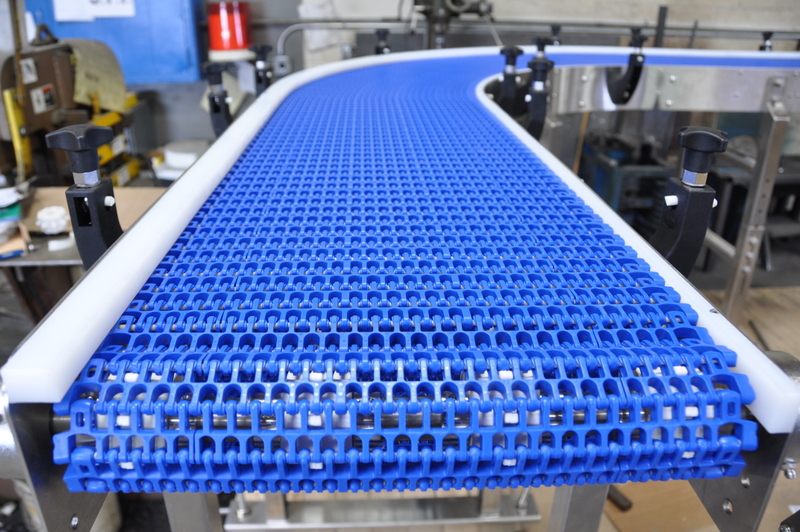
A plastic modular belt conveyor uses molded modules connected by rods. Sprockets engage the belt underside, creating a positive-drive system that can run straight, curve, incline, decline, accumulate, drain, cool, or position products.
Modular construction offers many surfaces, materials, pitches, flights, side guards, and transfer options. Damaged sections can be replaced without discarding the entire belt. Successful operation still depends on correct sprockets, wearstrips, catenary sag, thermal allowance, alignment, and loading.
Key Takeaways
- Plastic modules connect with rods and engage sprockets for positive belt drive.
- Flat, grid, raised-rib, friction-top, radius, and roller-top designs serve different product flows.
- Replaceable sections, drainage, and configurable accessories are major practical benefits.
- Material, pitch, transfer geometry, belt pull, support, and cleaning requirements must be engineered together.
What Is a Plastic Modular Belt Conveyor?
A plastic modular belt conveyor is a conveying system whose carrying surface consists of rows of injection-molded plastic modules. Full-width or sectional rods join the rows into a continuous belt. The modules form hinges, allowing the belt to articulate around sprockets and return rollers.
Habasit describes a modular belt as individual molded modules connected by lateral rods in a bricklay pattern (Habasit, Meat and Poultry Processing Belts). Modules can be combined across the belt width, so many systems can be built in nonstandard widths without cutting a continuous sheet.
Drive sprockets mesh with openings or drive bars on the belt underside. This engagement reduces the risk of drive slip and eliminates the high installation tension associated with many friction-driven belts. It doesn’t remove the need for correct belt pull, sprocket spacing, take-up arrangement, shaft stiffness, or return-strand control.
The conveyor includes more than the belt. Its structure normally contains a drive shaft, idle shaft, sprockets, bearings, motor and gearbox, wearstrips, side guides, return supports, guards, and transfer components. Curved systems may add hold-down features and inside-radius guides.
Common module materials include polypropylene, polyethylene, and acetal. Engineered grades can add wear, impact, heat, chemical, flame, conductive, detectable, or food-contact properties. Rod material may differ from the modules, so both components must suit the environment.
Plastic modular belt conveyors differ from hinged steel belts and table-top chains. They also differ from fabric belts, which use a continuous carcass and usually transfer drive force through pulley friction. For a broader system overview, see TranBelt’s guide to conveyor system types and uses.
What Are the Main Types of Plastic Modular Belt Conveyors?
Plastic modular conveyors are commonly classified by belt surface and route. Flat-top, flush-grid, raised-rib, friction-top, radius, and roller-top belts control product support, drainage, grip, turning, and accumulation differently. Pitch and accessory options create further variations within each category.
Flat-Top Modular Belt Conveyors
Flat-top belts create a closed or nearly closed conveying surface for cartons, trays, containers, food products, components, and packages. Their continuous support prevents small items from dropping through the belt. A smooth top can also allow products to slide during accumulation or side transfer.
Flat-top belts are available in multiple pitches. Small-pitch constructions can reduce chordal action and the transfer gap at a nosebar. Larger pitches may support greater loads or more durable hinge geometry, but the selected series determines actual capacity and minimum sprocket size.
Flush-Grid and Perforated Belt Conveyors
Flush-grid belts contain openings through the conveying surface. They allow water, cleaning solution, crumbs, air, or process fluid to pass through. These belts are common in washing, cooling, freezing, blanching, draining, seafood, produce, and packaging operations.
Open area varies by product design. Intralox publishes 17% open area for its Series 400 Flush Grid belt, together with 2-inch pitch and material options including acetal, polyethylene, and polypropylene (Intralox, Series 400 Flush Grid). Those figures apply to that series, not every grid belt.
Larger openings improve flow but reduce support for small or soft products. Hinge design also affects debris release and cleaning access. Buyers should specify minimum product size, allowable marking, drainage rate, airflow, and whether loose pieces could enter the hinges or sprockets.
Raised-Rib Modular Belt Conveyors
Raised-rib belts support products on narrow longitudinal ribs above the hinge plane. Spaces between the ribs improve airflow and drainage. Finger transfer plates can extend between the ribs at the conveyor end, creating a supported transition for cans, bottles, and other stable containers.
These conveyors are widely used in beverage lines, pasteurizers, container handling, cooling, and accumulation. The rib-and-finger arrangement can reduce product tipping at transfers, but the fingers must match the belt series and remain correctly aligned. Damaged or incorrectly positioned fingers can catch products or contact the belt.
Friction-Top and Cleated Belt Conveyors
Friction-top modular belts use molded textures or elastomer inserts to increase product grip. Cleated versions add transverse flights, buckets, scoops, or cones. These features control cartons, bags, produce, loose food, and bulk material on incline or decline sections.
Positive sprocket drive controls the belt, while the top surface controls the product. These are separate functions. A modular belt can remain fully engaged with its sprockets while products slide on its surface. Angle, speed, moisture, package material, center of gravity, and flight geometry determine product stability.
For elevation changes, compare these constructions with the options in TranBelt’s incline and decline conveyor belt guide. Cleat height and spacing should follow actual product behavior instead of a generic slope rule.
Side-Flexing and Curved Modular Conveyors
Side-flexing belts negotiate horizontal curves while articulating around vertical sprockets. Radius modules are shaped to collapse on the inside of a curve and open toward the outside. This allows one belt to connect straight sections and turns with fewer transfer points.
Curve design is controlled by the belt’s minimum inside-radius ratio, width, tension, product load, speed, and hold-down method. The outer edge travels farther than the inner edge, creating different forces across the belt. A straight-running modular belt cannot be assumed to side-flex safely.
Roller-Top Modular Belt Conveyors
Roller-top belts contain small rollers within the modules. Roller orientation can support low-pressure accumulation, side transfer, sorting, merging, centering, or product movement faster or slower than the belt itself. The rollers may be passive or actuated by contact with support surfaces beneath the belt.
These conveyors handle cartons, totes, tires, pallets, and packaged goods. A roller-top system can reduce sliding friction during accumulation and control product flow without adding a separate conveyor at every movement. Actual behavior depends on roller direction, support-rail layout, product base, load, and belt speed.
Where Are Plastic Modular Belt Conveyors Used?
Plastic modular belt conveyors are used in food processing, beverage production, packaging, logistics, automotive manufacturing, tire handling, and general industry. Their configurable surfaces and routes make them useful where a simple straight fabric belt cannot provide the required drainage, curve, transfer, grip, or accumulation behavior.
Food processors use flat-top, grid, and flighted belts for meat, poultry, seafood, produce, bakery products, snacks, frozen foods, and ready meals. Open hinges and grid surfaces can improve cleaning access, but hygienic performance depends on the entire conveyor. Shafts, sprockets, wearstrips, supports, and guards must also be accessible.
Material selection is application-specific. Polypropylene often provides useful chemical resistance, polyethylene can suit cold or impact-sensitive duties, and acetal offers strength, stiffness, and low friction in many demanding applications. Food-contact status, temperature, water absorption, cleaners, lubricants, and wear partners must be checked for the exact grade.
Packaging and logistics systems use modular belts for cartons, totes, polybags, mail, and unit loads. Roller tops enable sorting and accumulation. Friction tops support incline sections. Radius belts route products through limited floor space while reducing the number of separate conveyor-to-conveyor transfers.
What Are the Benefits and Limitations of Plastic Modular Belt Conveyors?
The main benefits are positive drive, configurable surfaces, replaceable modules, corrosion-resistant materials, and the ability to combine straights, curves, inclines, drainage, and product-control accessories. The main limitations involve hinge wear, thermal expansion, transfer gaps, cleaning complexity, noise, and application-specific material restrictions.
Sprocket engagement reduces drive slip and avoids the high pretension used by many friction-driven belts. This can lower shaft loading in a properly designed conveyor. Modular construction also allows a damaged area to be opened and repaired with compatible modules and rods instead of replacing a complete continuous belt.
Plastic doesn’t rust like carbon steel, but it isn’t immune to damage. Chemical exposure, temperature, impact, abrasion, ultraviolet light, hydrolysis, and stress can affect modules and rods. For abrasive duties, review TranBelt’s abrasion-resistant plastic modular belt guide.
Hinges can collect soil or abrasive particles, depending on their openness and the product. Rod and module wear can increase pitch, causing poor sprocket engagement. Regular inspection should include hinges, rods, edges, sprockets, wearstrips, flights, and catenary sag.
Transfers can be wider than those of thin fabric belts because modular belts articulate around sprockets. Small-pitch products, nosebars, dead plates, roller transfers, or finger plates can reduce the unsupported gap. The chosen solution must suit product size, belt pull, speed, and cleaning needs.
Plastic Modular Belt vs Fabric Belt vs Roller Conveyor
Plastic modular, fabric-belt, and roller conveyors can all transport unit loads, but their drive and support methods differ. Modular belts provide a continuous configurable surface with sprocket engagement. Fabric belts offer thin, flexible surfaces. Roller conveyors support products at separate contact lines and may allow accumulation with minimal surface coverage.
| Feature | Plastic Modular Belt | Fabric Conveyor Belt | Roller Conveyor |
|---|---|---|---|
| Construction | Connected molded modules and rods | Continuous coated fabric carcass | Multiple rollers in a frame |
| Drive method | Positive sprocket engagement | Usually pulley friction | Powered rollers, chain, belt, or gravity |
| Product support | Closed, grid, ribbed, or roller-top surface | Continuous thin surface | Separate roller contact points |
| Cleaning | Configurable open or closed design | Smooth surface, construction dependent | Access around many rollers is required |
| Repair | Replace affected modules and rods | Repair or replace belt section | Replace individual rollers or drive parts |
| Best fit | Wet process, curves, drainage, configurable handling | Tight transfers, light products, simple runs | Rigid flat-base packages and pallets |
| Main limitation | Hinges, expansion, and transfer geometry | Tracking, splice, and traction requirements | Poor support for small or flexible products |
No type is universally better. A fabric belt may handle a very small transfer more simply. Rollers may be efficient for rigid cartons or pallets. A modular belt becomes attractive when positive drive, drainage, curved routing, rapid sectional repair, or integrated product-control features justify its added design requirements.
How Do You Select a Plastic Modular Belt Conveyor?
Selection begins with the product and process, then works through belt surface, material, pitch, route, drive, and support. A supplier needs enough detail to calculate belt pull and verify sprockets, shafts, wearstrips, thermal clearance, transfers, and accessories.
Product and Load
Record product dimensions, individual weight, total live load, throughput, contact area, temperature, and orientation. Note whether items are rigid, soft, sharp, oily, unstable, abrasive, or easily marked. Bulk products also require density, lump size, moisture, and flow information.
Belt Surface and Open Area
Choose a closed top for small products and stable support. Select grid or perforated surfaces for drainage, cooling, airflow, or cleaning access. Raised ribs suit finger transfers and selected container lines. Friction tops and flights control products on slopes, while roller tops support accumulation or directional movement.
Material and Operating Environment
Specify minimum and maximum temperatures, chemicals, cleaning agents, water exposure, abrasion, impact, flame requirements, and food-contact needs. Module, rod, sprocket, and wearstrip materials interact, so choosing the strongest module alone can move wear elsewhere.
Habasit’s modular range includes special material properties such as low friction, chemical resistance, conductive behavior, detectability, impact resistance, and high-temperature capability (Habasit, Plastic Modular Belts). Availability and limits depend on the exact belt family.
Pitch, Transfers and Pulley Size
Pitch influences articulation, chordal action, sprocket diameter, hinge size, and transfer geometry. Small pitches often support tighter transfers, while larger series may support heavier duty. Product size and stability should set the allowable transfer gap.
Check the manufacturer’s minimum sprocket, back-flex, and nosebar requirements. Transfer plates need correct clearance through temperature changes and belt motion. A plate that is too close can contact the belt; one that is too far away can trap or tip products.
Drive, Tracking and Conveyor Layout
Calculate belt pull from product load, belt mass, friction, elevation, accumulation, curves, and startup conditions. Select sprockets, shafts, bearings, motor, and gearbox from the manufacturer’s engineering data. Avoid estimating capacity from width alone.
Sprockets provide tracking, but their alignment and restraint still matter. The conveyor must accommodate catenary sag and temperature-driven length changes. Curves require approved radius geometry, edge guidance, and hold-down arrangements. Wearstrips need suitable spacing, joints, material, and thermal gaps.
Provide the supplier with a layout drawing, belt width, center distance, elevation, speed, drive position, transfers, supports, product data, environment, and sanitation method. Final approval should be based on the selected belt series and operating conditions, not a generic modular-belt rating.
Frequently Asked Questions
How is a plastic modular conveyor belt driven?
Sprockets on the drive shaft engage molded openings or drive bars beneath the belt. This positive engagement reduces traction slip. Correct sprocket type, quantity, spacing, alignment, shaft stiffness, wrap, catenary sag, and belt pull remain necessary for reliable operation.
Can individual modular belt sections be replaced?
Yes. A technician can normally remove a connecting rod, replace damaged modules, and reinstall a compatible rod. The repair must use the correct series, width pattern, material, color, flight configuration, and rod retention method. The cause of damage should also be corrected.
Are plastic modular belts suitable for food contact?
Many belt families offer food-contact materials, but suitability isn’t automatic. Verify the exact module, rod, accessory, and regulatory declaration for the food type, temperature, and market. Hygienic performance also depends on conveyor access, drainage, soil retention, cleaning procedure, and sanitation validation.
Do plastic modular belts need tensioning?
They generally don’t use the high pretension required by friction-driven belts. However, they still need controlled belt length and catenary sag for sprocket engagement and thermal expansion. The conveyor manufacturer’s take-up or return design must follow the selected belt’s engineering guidance.
What causes a modular belt to jump sprockets?
Common causes include excessive belt pull, worn sprockets, elongated hinges, incorrect sag, debris, poor sprocket alignment, insufficient engagement, or the wrong sprocket series. Inspect the belt, rods, drive shaft, wearstrips, loading, and return path before replacing parts.
Conclusion
Plastic modular belt conveyors combine molded modules, rods, and positive sprocket drive. Flat, grid, raised-rib, friction-top, radius, and roller-top surfaces support drainage, curves, inclines, accumulation, and positioning.
Their advantages depend on correct engineering. Match the product, load, surface, material, pitch, transfers, belt pull, sprockets, supports, and cleaning method. A suitable modular conveyor can simplify repair and handling, while a poor match creates wear, transfer problems, or unstable operation.
Sources
- Habasit, Plastic Modular Belts, retrieved 2026-07-23.
- Habasit, HabasitLINK Plastic Modular Belt Product Guide, retrieved 2026-07-23.
- Habasit, Meat and Poultry Processing Belts, retrieved 2026-07-23.
- Habasit, Belts for Tire Manufacturing, retrieved 2026-07-23.
- Intralox, Straight-Running Modular Belts, retrieved 2026-07-23.
- Intralox, Series 400 Flush Grid, retrieved 2026-07-23.
- Intralox, Series 900 Accessories, retrieved 2026-07-23.
- Intralox, Series 800 Flush Grid, retrieved 2026-07-23.