The best slat conveyor manufacturer depends on what the conveyor must carry. A bottling line needs smooth transfers, curves, and washdown-compatible components. An automotive assembly line may need steel slats, fixtures, operator work zones, and support for heavy products. One supplier rarely leads every category.
This 2026 guide compares ten established manufacturers with verifiable slat, flat-top chain, or overlapping-slat conveyor products. The reviews focus on published capabilities, practical fit, and visible limitations. The order is an editorial shortlist, not a claim about global revenue, market share, or universally superior quality.
Key Takeaways
- FlexLink and Bosch Rexroth offer broad modular chain platforms for complex production layouts.
- Titan, LEWCO, and OCC are stronger candidates for heavy products and assembly work.
- Ryson specializes in compact elevation changes using overlapping slat technology.
- Buyers should compare the complete system, regional support, controls, and lifecycle requirements.
Top 10 Slat Conveyor Manufacturers in 2026
1. FlexLink — Best for Modular Production Lines
FlexLink is a strong candidate for manufacturers that need plastic flat-top chain conveyors across packaging, food, personal care, pharmaceuticals, electronics, or automotive production. Its portfolio covers narrow and wide chain systems, aluminum and stainless platforms, cleated chains, steel-top chains, and components for horizontal or vertical routing.
The main advantage is platform breadth. Standard chain widths across the portfolio extend from compact product handling to wider packaged goods, while curves and elevation changes support dense layouts. FlexLink states that its chain systems handle products ranging from a few grams to 30 kg, depending on the selected line (FlexLink, Conveyor Belts and Conveyor Chains).
FlexLink is less compelling when the application requires a rugged steel-slat work platform for very heavy castings or vehicle assemblies. Its value also depends on access to local engineering and integration support. Buyers should identify the exact system series because capacity, speed, hygiene, and chain options vary considerably.
2. Bosch Rexroth — Best for Configurable Automation Systems
Bosch Rexroth’s VarioFlow plus system suits machine interlinking, packaged product transport, healthcare, food, and automated production. The modular platform supports aluminum and stainless steel structures, horizontal and vertical layouts, workpiece pallets, curves, and a large range of functional components.
Published technical data lists chain widths from 65 to 320 mm and speeds up to 120 m/min for selected configurations. Bosch Rexroth also provides MTpro planning software, product documentation, and standardized components. These resources make VarioFlow plus attractive to engineering teams that want a configurable system with formal design support (Bosch Rexroth, VarioFlow Plus Chain Conveyor System).
The system is designed primarily for controlled product transport rather than every heavy-duty slat application. Published load ratings use specific product-weight and chain-width conditions, so they shouldn’t be treated as one conveyor-wide capacity. Buyers may also need a qualified integrator for controls, guarding, installation, and process interfaces.
3. mk Technology Group — Best for European Modular Engineering
mk Technology Group offers the Versaflex modular flat-top chain platform for bottles, cans, cartons, packaged goods, and workpiece carriers. The system supports three-dimensional layouts, curves, different elevations, multiple chain widths, cleats, rollers, magnetic links, stoppers, switches, and product-guiding components.
Versaflex’s modular construction is useful when a production route may need later changes. mk says one drive can move products through curves and level changes under suitable design conditions. Positive chain drive also supports wet-area applications where a friction-driven conveyor belt may be less predictable (mk Technology Group, Versaflex Flat Top Chain Conveyor).
The published portfolio is strongest for light and medium unit loads, packaging, and machine links. A buyer seeking thick steel slats for hot components should consider another mk product or a heavy-duty specialist. Regional availability and project responsibility should also be confirmed outside mk’s core European markets.
4. Dorner — Best for Packaging and Precision Handling
Dorner is a practical choice for packaged products, containers, food-related handling, and automation requiring compact curves or flexible routing. Its FlexMove platform uses flexible chain technology with configurable supports, guides, transfers, and layouts. Dorner also offers other conveyor families that can complete a mixed production line.
The advantage is application integration rather than a single heavy slat model. A buyer can combine flexible-chain transport with belt conveyors, pallet systems, lift modules, or sanitary conveyors through one supplier network. This can simplify interfaces in packaging and automation projects (Dorner, FlexMove Conveyors).
Dorner should not automatically be shortlisted for severe-impact or extremely heavy steel-slat service. FlexMove capabilities depend on the chain, width, route, speed, accumulation, and product center of gravity. Ask for a layout-specific rating and clarify whether Dorner or a regional partner will handle controls and commissioning.
5. Span Tech — Best for Flexible Plastic Chain Systems
Span Tech manufactures custom plastic chain conveyors for food, beverage, packaging, manufacturing, and related product-handling lines. Its systems are known for horizontal curves, elevation changes, compact transfers, and layouts configured from proprietary chain and frame components.
The company is worth considering when products must move around machinery without repeated transfers between straight conveyors. A continuous configured path may reduce transfer points and product instability. Span Tech also publishes conveyor types for accumulation, merging, inclines, declines, and sanitary applications (Span Tech, Conveyor Systems).
The tradeoff is dependence on a proprietary platform and its available components. Replacement parts, local service, and modification procedures should be examined before purchase. Like other plastic-chain systems, it isn’t a direct alternative to a steel slat conveyor carrying hot castings, large fixtures, or concentrated impact loads.
6. Ryson International — Best for Space-Saving Slat Conveyors
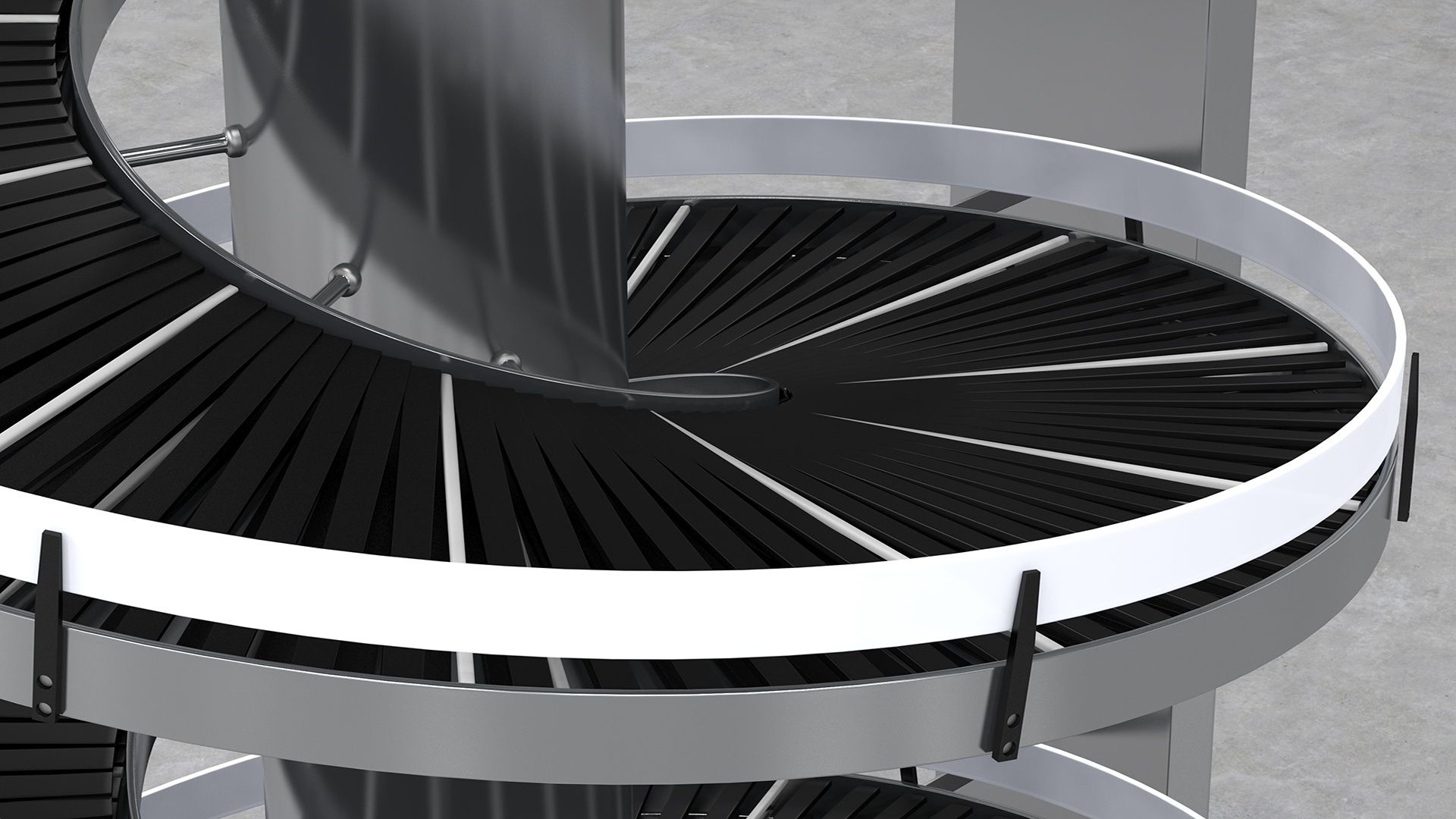
Ryson specializes in vertical conveying and uses overlapping slat-style chain technology in spiral and related conveyor systems. Its slat conveyors are particularly relevant when a plant needs elevation change, accumulation, or product flow within limited floor space rather than a conventional straight transport line.
The company’s current slat conveyor range targets industrial manufacturing, consumer packaged goods, and food and beverage applications. Flexible routing and overlapping slats can support stable product movement through curves and elevation transitions (Ryson International, Slat Conveyors).
Ryson is a specialist choice, not the default for every horizontal conveyor. Buyers should verify infeed and discharge elevations, available footprint, product dimensions, load, speed, accumulation behavior, and transfer interfaces. A simple straight conveyor may be more economical from another supplier if vertical movement provides no operational benefit.
7. Titan Conveyors — Best for Heavy-Duty Industrial Loads
Titan Conveyors’ Model 696 is designed for heavy industrial transportation, accumulation, assembly, side loading, unloading, and frequent starts. Standard information lists a 7-gauge frame and slats, with 4-inch or 6-inch pitch heavy-duty chain options. Slats can use formed, flat-plate, wood, or application-specific designs.
This construction makes Titan a strong candidate for large components, fixtures, stop-start work, and demanding factory environments. The company can modify its standard model or design a custom unit. Its published options include wider slats, special drives, controls, work surfaces, fixtures, and support configurations (Titan Conveyors, Model 696 Slat Conveyor).
The limitation is that heavy construction isn’t ideal for every application. Lightweight packages, tight curves, hygienic washdown, and high-speed container handling may be better served by plastic flat-top chain. Buyers outside Titan’s main service region should also confirm installation and parts support.
8. LEWCO — Best for Configurable Steel Slat Conveyors
LEWCO’s SL6 slat conveyor is another candidate for heavy or awkward products that need continuous support. Published literature shows steel slats attached to conveyor chain, standard and optional widths, different slat constructions, and configurable drive arrangements. This provides a defined starting model instead of a completely blank custom design.
LEWCO is attractive when buyers want an industrial conveyor manufacturer with adjacent roller, chain, and transfer equipment. A mixed system can be engineered around a common supplier. The SL6 literature also documents physical options clearly enough to support an informed request for quotation (LEWCO, SL6 Slat Conveyor Product Literature).
Detailed suitability still requires direct engineering review. Public brochures cannot resolve load distribution, slat deflection, fixture forces, guarding, or duty cycle. Buyers should obtain a signed layout and specification with rated load, speed, environment, controls, and acceptance criteria.
9. OCC Systems — Best for Automotive Assembly Lines
OCC Systems designs slat conveyor systems for final assembly areas and employee-intensive workstations. Its stated focus on heavy or unusually shaped products makes the company relevant to automotive, appliance, and industrial assembly projects where operators work directly beside the moving platform.
The strongest reason to consider OCC is systems-level experience. Assembly conveyors often require tooling, ergonomic access, stops, transfers, lifts, controls, guarding, and coordination with multiple production stations. OCC presents slat systems as part of a broader material-handling and automation capability (OCC Systems, Slat Conveyor Systems).
This project-led approach may be more extensive than a buyer needs for a standalone transport conveyor. It can also mean longer engineering and approval cycles than ordering a catalog model. Procurement teams should define scope boundaries carefully and compare commissioning, documentation, training, and service terms.
10. SPG Conveyor Systems — Best for UK Food and Beverage Projects
SPG Conveyor Systems manufactures standalone slat conveyors and complete systems in the United Kingdom. Its published range includes straight, bend, and incline modules with plastic or stainless steel slats, variable-speed controls, stainless frames, installation, and maintenance services.
SPG is particularly relevant to UK food, beverage, bottling, labeling, drying, and packing projects. The company states that equipment is supplied with UKCA or CE marking and operation manuals. It also presents modular integration with other conveying and packing equipment (SPG Conveyor Systems, Slat Conveyors).
The clearest limitation is geographic. A regional manufacturer can provide responsive support near its home market but may be less economical for distant installations. International buyers should confirm export engineering, electrical standards, local installation, spare parts, and response times before including SPG in a final bid.
Slat Conveyor Manufacturer Comparison
The comparison below identifies each manufacturer’s strongest visible fit. “Plastic chain” refers to modular flat-top or flexible-chain systems commonly called slat-chain conveyors. “Steel slat” refers to rigid plates attached across one or more chains. These categories overlap, but they solve different load and routing problems.
| Manufacturer | Best For | Primary Slat or Chain Style | Main Market Strength | Customization Level |
|---|---|---|---|---|
| FlexLink | Modular production lines | Plastic flat-top and specialty chains | Global automation and packaging | High |
| Bosch Rexroth | Configurable automation | Modular plastic flat-top chain | Global industrial automation | High |
| mk Technology Group | Flexible European systems | Plastic flat-top chain | Europe and machine building | High |
| Dorner | Packaging and precision handling | Flexible plastic chain | North American automation | High |
| Span Tech | Curved product routing | Proprietary plastic chain | North American product handling | High |
| Ryson International | Elevation and compact layouts | Overlapping slat-style chain | Spiral and vertical conveying | Specialized |
| Titan Conveyors | Heavy industrial loads | Rigid steel or custom slats | North American heavy industry | High |
| LEWCO | Configurable steel slat units | Chain-driven steel slats | North American manufacturing | Medium to high |
| OCC Systems | Automotive assembly | Heavy-duty slat platforms | Integrated assembly systems | Project-specific |
| SPG Conveyor Systems | UK food and beverage lines | Plastic or stainless slats | United Kingdom | High |
How Were These Slat Conveyor Manufacturers Evaluated?
The shortlist was created from manufacturers with an active official website and a verifiable slat, flat-top chain, flexible-chain, or overlapping-slat conveyor offering in 2026. It excludes directory listings that don’t show an identifiable manufacturer, technical product page, or complete conveyor capability.
This isn’t a laboratory test, customer satisfaction survey, or audited market-share ranking. Pricing, delivery, final engineering quality, and after-sales performance can’t be judged reliably from public pages. “Best for” therefore means the manufacturer’s published offering appears particularly well aligned with that application, subject to quotation and technical verification.
How Do You Choose the Right Slat Conveyor Manufacturer?
Start with the load and process, not the manufacturer name. Provide product dimensions, weight, contact area, center of gravity, orientation, temperature, contamination, and required throughput. Explain whether operators assemble on the conveyor, products accumulate under back pressure, or fixtures introduce concentrated forces.
Next, define the route. Include straight lengths, horizontal curves, inclines, declines, elevation changes, transfers, working height, available footprint, and maintenance access. Plastic flat-top chains handle complex paths efficiently, while dual-chain steel slats better support large or heavy loads. A specialist spiral may solve elevation more compactly than an inclined conveyor.
Specify the environment and product-contact requirements. Food and beverage systems may require stainless frames, suitable chain materials, documented food-contact components, drainage, cleanable joints, and washdown-compatible bearings or drives. Hot, sharp, oily, or abrasive parts may require steel slats, replaceable wear strips, protected bearings, and accessible chain lubrication.
Compare quotations line by line. Confirm rated load, speed, duty cycle, slat material, chain, wear strip, motor, gearbox, controls, guarding, supports, installation, commissioning, documentation, warranty, and spare parts. Ask which performance assumptions can invalidate the rating. A lower equipment price can become expensive if integration and safety scope are missing.
Frequently Asked Questions
Who makes heavy-duty slat conveyors?
Titan Conveyors, LEWCO, and OCC Systems are strong starting points for heavy-duty projects in North America. Titan and LEWCO publish dedicated steel slat models, while OCC focuses on assembly systems. Final selection must account for total load, load concentration, impact, slat span, chain rating, speed, and duty cycle.
Which manufacturers offer modular plastic slat conveyors?
FlexLink, Bosch Rexroth, mk Technology Group, Dorner, and Span Tech offer modular plastic chain platforms. Their product ranges support different widths, curves, inclines, guides, cleats, accumulation methods, and sanitary options. The components aren’t automatically interchangeable, so replacement availability and platform ownership should be considered.
What information should you provide before requesting a quote?
Provide product drawings, minimum and maximum weight, rate, speed, accumulation, route, elevation, environment, utilities, controls, guarding standard, and installation location. Include photographs or layout files where possible. For assembly lines, add operator tasks, fixture loads, cycle time, stops, tools, and ergonomic requirements.
Should you choose a local or international manufacturer?
Choose based on project risk and support needs. International suppliers may offer mature modular platforms, while local manufacturers can provide faster site visits, fabrication, installation, and repairs. Many projects combine a global component platform with an experienced regional integrator.
Conclusion
There is no universal number-one slat conveyor manufacturer. FlexLink, Bosch Rexroth, and mk stand out for modular production routing. Ryson offers a focused answer to elevation and space constraints. Titan, LEWCO, and OCC are more relevant when heavy products, fixtures, or assembly work drive the design.
Build a shortlist around the actual load class, route, environment, controls, and service location. Then compare written technical proposals instead of brand claims alone. The most honest test is whether a supplier can document how its conveyor will perform in your operating conditions.
Sources
- FlexLink, Conveyor Belts and Conveyor Chains, retrieved 2026-07-21.
- Bosch Rexroth, VarioFlow Plus Chain Conveyor System, retrieved 2026-07-21.
- mk Technology Group, Versaflex Flat Top Chain Conveyor, retrieved 2026-07-21.
- Dorner, FlexMove Conveyors, retrieved 2026-07-21.
- Span Tech, Conveyor Systems, retrieved 2026-07-21.
- Ryson International, Slat Conveyors, retrieved 2026-07-21.
- Titan Conveyors, Model 696 Slat Conveyor, retrieved 2026-07-21.
- LEWCO, SL6 Slat Conveyor Product Literature, retrieved 2026-07-21.
- OCC Systems, Slat Conveyor Systems, retrieved 2026-07-21.
- SPG Conveyor Systems, Slat Conveyors, retrieved 2026-07-21.