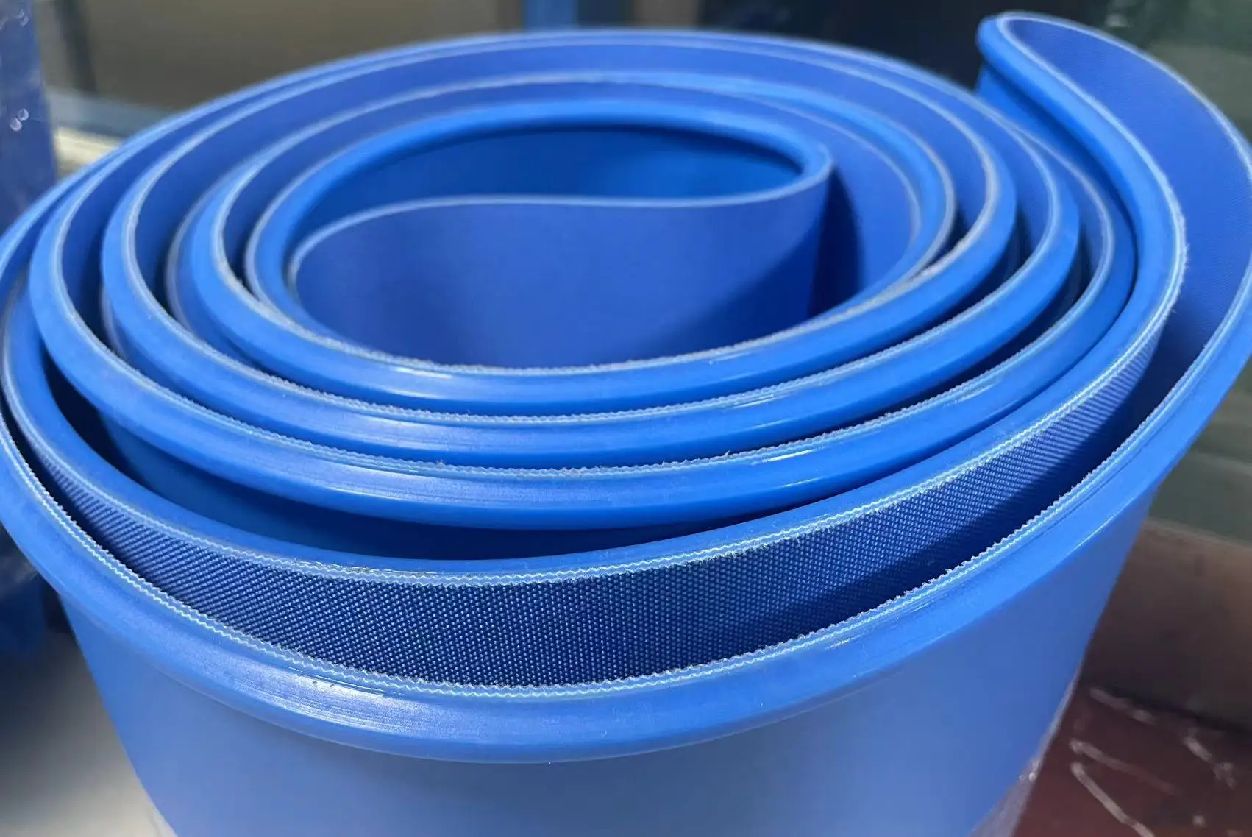
A polyurethane conveyor belt uses polyurethane as its conveying surface, belt body, or both. Available constructions include fabric-reinforced belts, homogeneous monolithic belts, sprocket-driven positive-drive belts, cleated belts, perforated vacuum belts, and polyurethane timing belts.
Polyurethane does not define one fixed performance level. Thermoplastic polyurethane grade, reinforcement, thickness, hardness, surface pattern, splice, profiles, and drive system all affect wear, flexibility, oil resistance, hygiene, temperature, load, and pulley requirements. This guide explains the main types and how to select the correct construction.
Key Takeaways
- PU and TPU belts include fabric, monolithic, positive-drive, and synchronous constructions.
- Polyurethane commonly offers wear, oil, grease, and fabrication advantages, but performance is grade-specific.
- Monolithic belts remove exposed fabric, while reinforced belts support greater dimensional stability.
- Product, load, surface, environment, pulley, splice, and drive method must be specified together.
What Is a Polyurethane Conveyor Belt?
A polyurethane conveyor belt is a flexible belt that contains polyurethane on its product-contact surface or throughout its body. In conveyor terminology, PU often refers to thermoplastic polyurethane, or TPU, which can be extruded, coated, welded, molded, and fabricated into profiles.
Fabric-reinforced PU belts contain one or more textile plies beneath polyurethane covers. The fabric carries tension and controls elongation. Monolithic belts use a homogeneous TPU body without fabric. Reinforced monolithic belts embed tensile cords inside a solid TPU structure.
Habasit describes monolithic elastic belts as single-layer elastic conveyor belts usually made from TPU, without fabric reinforcement or layered construction (Habasit, Monolithic Elastic Belts). Their smooth structure reduces places where liquid can wick into exposed textile.
Drive method also varies. Friction-driven PU belts rely on contact with a pulley. Positive-drive belts use molded bars, teeth, or lugs that engage sprockets. PU timing belts use precise tooth profiles for synchronized conveying and positioning.
The phrase “polyurethane conveyor belt” is therefore incomplete for ordering. A useful specification includes construction, reinforcement, width, endless length, thickness, surface, hardness, drive geometry, splice, profiles, temperature, chemicals, cleaning, product, load, and required compliance.
What Are the Main Types of Polyurethane Conveyor Belts?
The main types are fabric-reinforced PU belts, monolithic elastic belts, reinforced positive-drive belts, cleated and sidewall belts, perforated vacuum belts, and PU timing belts. Each combines polyurethane with a different load-carrying and driving method.
Fabric-Reinforced PU Conveyor Belts
Fabric-reinforced PU belts use woven polyester, polyamide, or another textile carcass beneath a polyurethane top cover. Some constructions also have PU on the pulley side. The carcass provides tensile strength, dimensional control, lateral stiffness, and splice support.
These belts are common in food processing, packaging, electronics, checkweighing, logistics, metal detection, paper handling, and light industrial conveying. Thin constructions can run over small pulleys and knife edges, subject to the manufacturer’s limits.
Fabric edges can fray or wick liquid if damaged or left unsealed. Sealed edges, capped edges, and compatible finger splices may be required in wet or food-contact applications. The finished splice and edge treatment should be included in compliance review.
Monolithic Polyurethane Belts
Monolithic PU belts have a homogeneous thermoplastic body without textile plies. Elastic versions stretch during installation and can operate with simple tensioning. Their continuous structure avoids exposed fabric and reduces the risk of layer separation or liquid wicking.
Habasit’s monolithic elastic belt literature identifies TPU constructions without fabric reinforcement and highlights abrasion, chemical, and hydrolysis-resistant options (Habasit, Monolithic Elastic Belts Flyer).
Monolithic does not always mean unreinforced. Some homogeneous-looking PU belts contain fully enclosed aramid cords for dimensional stability. Buyers should distinguish elastic monolithic, reinforced monolithic, friction-drive, and positive-drive constructions.
Positive-Drive PU Belts
Positive-drive PU belts have molded drive bars, teeth, or lugs beneath a solid thermoplastic body. Sprockets engage these features, reducing dependence on friction and installation tension. The top surface can remain continuous for product contact and scraping.
Habasit Cleandrive includes aramid-reinforced monolithic TPU belts in sprocket-driven and pulley-driven versions (Habasit, Cleandrive Conveyor Belts). Embedded cords control belt length while the closed body avoids modular hinge cavities.
Intralox ThermoDrive combines a homogeneous thermoplastic structure with tensionless positive drive for hygienic food processing (Intralox, ThermoDrive Hygienic Conveyor Belts). Available drive styles, materials, surfaces, flights, and joining options vary by series.
Cleated and Sidewall PU Belts
Cleated PU belts use welded or molded transverse profiles to support products on inclines, maintain spacing, or form pockets. Straight, T-shaped, scoop, finger, and custom profiles serve different product shapes and release requirements.
Corrugated or straight sidewalls contain loose products near the belt edges. Cleats and sidewalls can combine for snacks, produce, meat, bakery products, powders, components, and packaged goods. Their material should be compatible with the base belt and welding process.
Intralox offers polyurethane positive-drive belts with flights and synchronized sidewalls for incline containment (Intralox, ThermoDrive A23 for Snack Inclines). For a broader profile comparison, see TranBelt’s cleated conveyor belt guide.
Perforated and Vacuum PU Belts
Perforated PU belts contain punched, drilled, molded, or machined holes that let air or liquid pass. A vacuum chamber beneath the belt creates holding force for paper, film, labels, packaging, lightweight components, and unstable products.
Hole diameter, pitch, pattern, open area, belt thickness, and chamber layout determine airflow. The splice should preserve hole alignment and avoid leakage or thickness changes that disturb product position. Support beneath the belt must prevent excessive deformation around vacuum slots.
TranBelt’s vacuum belting guide explains vacuum force, perforation, support, and tracking factors in more detail.
Polyurethane Timing Conveyor Belts
PU timing belts use molded teeth that engage matching pulleys. They provide synchronized conveying, indexing, positioning, and repeatable spacing. Open-ended belts can be clamped for linear motion or welded into loops, while truly endless products use continuous tension members.
Continental describes Synchromotion as a truly endless PU timing belt for transport, synchronous conveyor systems, positioning, and reversing drives (Continental, Synchromotion).
Pitch, tooth profile, width, pulley count, engagement, pretension, and cord construction must match the application. A welded timing belt normally has a different allowable load from a truly endless belt with uninterrupted cords.
What Are the Main Features of Polyurethane Conveyor Belts?
Polyurethane belts are selected for combinations of abrasion resistance, oil and grease resistance, flexibility, cleanability, fabrication, grip, and release. Actual performance depends on TPU chemistry, hardness, reinforcement, thickness, surface, temperature, and exposure time.
Abrasion and Wear Resistance
PU can provide strong abrasion and cut resistance in light and medium conveying. It is used for sharp packaging edges, food products, small parts, and repeated scraper contact. A harder surface may resist wear but provide less grip or cushioning.
Oil, Grease and Chemical Resistance
Many PU compounds resist animal fats, vegetable oils, mineral oils, and cleaning chemicals better than general-purpose PVC or rubber constructions. Resistance varies by formulation, concentration, temperature, and exposure duration.
Hydrolysis is a key distinction. Warm water, steam, humidity, and acidic or alkaline cleaning can degrade unsuitable polyester-based TPU. Polyether-based or hydrolysis-resistant grades may be preferred, but the exact supplier rating should govern selection.
Flexibility and Small-Pulley Performance
Thin PU covers and monolithic bodies can flex over small pulleys, supporting compact transfers and checkweighing. Minimum pulley diameter still depends on belt thickness, fabric plies, reinforcement, splice, profiles, temperature, and reverse bending.
Cold conditions can increase stiffness. Intralox publishes a continuous range of minus 7 to 60 degrees Celsius for one Series 8026 polyurethane belt and notes increased stiffness below 5 degrees Celsius (Intralox, S8026 Nub Top Polyurethane). Those limits apply only to that product.
Food-Contact and Hygienic Options
PU is widely used in food processing because selected grades offer food-contact documentation, wear resistance, oil resistance, and weldable fabrication. Monolithic designs remove exposed fabric, while positive-drive systems can reduce high operating tension.
Compliance is product-specific. The base belt, profiles, sidewalls, splice, colors, additives, and later modifications must remain within the declaration’s intended foods and conditions. Hygienic performance also depends on conveyor drainage, access, scraper design, and cleaning validation.
Grip, Release and Surface Customization
PU surfaces range from glossy and low-friction to matte, textured, soft, and high-grip. Nub, diamond, fabric, and rough patterns change air release, product contact, incline performance, and discharge.
Where Are Polyurethane Conveyor Belts Used?
Polyurethane conveyor belts are used in food processing, packaging, logistics, electronics, pharmaceuticals, textiles, paper, metal detection, checkweighing, and light manufacturing. Their construction is selected around hygiene, oil, wear, small transfers, positioning, and product control.
Food applications include meat, poultry, fish, cheese, bakery products, confectionery, snacks, produce, frozen food, and ready meals. Monolithic and positive-drive belts are common where washdown, scraping, and exposed-fabric control matter.
Food-safe does not mean suitable for every food or cleaning process. TranBelt’s food conveyor belt guide covers material declarations, fats, temperature, and sanitation considerations.
Packaging systems use thin fabric PU belts, vacuum belts, timing belts, and cleated belts for cartons, labels, film, pouches, and product spacing. Small-pulley designs support transfers, while textured surfaces control acceleration and incline movement.
Checkweighers and inspection machines use light, stable, low-vibration belts. Endless length, splice thickness, tracking, static behavior, and surface cleanliness affect measurement and product flow. Monolithic elastic belts can simplify compact installations.
General industry uses PU belts for paper, textiles, small metal parts, plastics, wood components, and machine integration. Abrasive or sharp products require correct cover thickness and support. Heavy impact or bulk handling may favor rubber, modular plastic, or metal alternatives.
Polyurethane vs PVC vs Rubber Conveyor Belts
PU, PVC, and rubber belts overlap in many applications, but their typical strengths differ. The table provides relative guidance only. Exact compound, carcass, cover, splice, and manufacturer rating determine performance.
| Feature | Polyurethane Belt | PVC Belt | Rubber Belt |
|---|---|---|---|
| Common construction | Fabric-coated, monolithic, positive-drive, or timing | Mainly fabric-coated | Textile or steel reinforced |
| Wear resistance | Often high in thin and hygienic duties | Good for general light conveying | Strong options for heavy abrasion and impact |
| Oil and grease resistance | Often strong, grade-specific | Compound-dependent | Requires oil-resistant compounds |
| Cleaning | Monolithic and smooth options available | Smooth but fabric edges need review | Construction-dependent; often heavier |
| Flexibility | Thin and small-pulley options available | Broad light-duty range | Varies from flexible light belts to heavy bulk belts |
| Typical use | Food, packaging, precision, checkweighing | Logistics, packaging, general industry | Mining, agriculture, heavy conveying |
| Main limitation | Hydrolysis, heat, and cost vary by grade | Plasticizer, temperature, and oil limits | Weight, hygiene, and pulley size can limit use |
PU is not automatically superior. PVC may be economical for dry general handling, while rubber is better suited to heavy impact, hot bulk material, or thick abrasion-resistant covers. Select from the operating conditions instead of material name alone.
How Do You Select the Correct Polyurethane Conveyor Belt?
Select a PU belt by documenting the product, load, conveyor, drive method, surface behavior, environment, and cleaning. Send suppliers a layout drawing and representative product sample when grip, release, marking, or transfer stability matters.
Product and Load
Record product dimensions, weight, contact area, temperature, oil, moisture, sharp edges, and allowable marking. State total belt load, throughput, impact, accumulation, incline, and startup conditions.
Soft food may need gentle release, while cartons require acceleration and stable transfers. A small dense component can create greater local wear than a larger light product. Test the worst-case product and contamination condition.
Belt Construction and Reinforcement
Choose fabric reinforcement for dimensional control and broad light-conveyor options. Select elastic monolithic belts for compact, easy-install duties. Use cord-reinforced monolithic or positive-drive belts where controlled length and sprocket engagement are required.
Timing belts suit synchronized positioning. Their cord type and splice determine load. For general material differences beyond conveying, see TranBelt’s urethane belt guide.
Surface, Profiles and Tracking Guides
Specify smooth, matte, textured, high-grip, low-release, or fabric-impression surfaces from actual product behavior. Define cleat shape, height, spacing, indent, sidewalls, perforations, edge seals, and longitudinal guides.
Guides do not replace conveyor alignment. Excess side force can wear the guide and belt edge. Pulley crown, frame squareness, loading, tension, and support remain part of tracking design.
Temperature, Chemicals and Cleaning
List continuous and peak temperatures, humidity, water, steam, oils, fats, acids, alkalis, sanitizers, and cleaning duration. Ask for compatibility of the exact TPU grade, splice, profiles, and reinforcement.
Intralox lists a standard polyurethane material for selected ThermoDrive belts and separate grades for harsher temperature, humidity, impact, or chemical conditions (Intralox, ThermoDrive Belt Materials). Do not transfer one grade’s limit to another.
Pulley Diameter, Splice and Drive System
Provide every pulley, nosebar, reverse bend, center distance, wrap, speed, and take-up position. Check minimum diameters for the belt, splice, guide, cleat, and sidewall at operating temperature.
Choose finger splice, overlap weld, endless fabrication, mechanical lace, or specialized closure from tension, hygiene, access, and downtime requirements. Positive-drive systems require approved sprockets and joining methods. Friction-drive belts require adequate wrap and tension without overloading bearings.
Frequently Asked Questions
Is a polyurethane conveyor belt the same as a TPU belt?
In most conveyor catalogs, PU commonly refers to thermoplastic polyurethane, or TPU. However, polyurethane is a broad polymer family. Buyers should confirm the exact grade, base chemistry, hardness, construction, reinforcement, and supplier designation instead of relying only on PU or TPU.
Are polyurethane conveyor belts food safe?
Selected PU belts are documented for food contact, but not every polyurethane belt is compliant. Verify the finished belt, color, profiles, sidewalls, splice, additives, food type, temperature, and market requirements. Conveyor hygiene and cleaning validation remain separate responsibilities.
Can PU belts resist oil and grease?
Many PU grades provide useful resistance to fats and oils, but performance depends on fluid type, temperature, concentration, and exposure. Hot animal fat, mineral oil, solvents, and cleaning chemicals can behave differently. Use the exact manufacturer’s compatibility data.
What is the difference between monolithic and fabric PU belts?
A monolithic belt has a homogeneous TPU body without textile plies, although some versions contain enclosed cords. A fabric PU belt uses a textile carcass beneath its cover. Monolithic construction reduces exposed fabric, while fabric reinforcement provides dimensional control and broad splice options.
Can polyurethane conveyor belts run on small pulleys?
Many thin PU belts can use small pulleys, but the allowable diameter depends on construction, thickness, plies, reinforcement, splice, profiles, reverse bending, load, and temperature. Use the minimum diameter published for the exact fabricated belt.
Conclusion
Polyurethane conveyor belts include fabric-reinforced, monolithic, positive-drive, cleated, vacuum, and timing constructions. PU can provide wear resistance, flexibility, oil resistance, hygienic options, and extensive fabrication, but each benefit depends on the exact grade and belt design.
Match the product, load, surface, reinforcement, temperature, chemicals, cleaning, pulley geometry, splice, and drive system. Product testing and manufacturer ratings provide a stronger selection basis than choosing polyurethane by name alone.
Sources
- Habasit, Monolithic Elastic Belts, retrieved 2026-07-24.
- Habasit, Monolithic Elastic Belts Flyer, retrieved 2026-07-24.
- Habasit, Cleandrive Conveyor Belts, retrieved 2026-07-24.
- Habasit, Cleandrive Monolithic Belts, retrieved 2026-07-24.
- Intralox, ThermoDrive Hygienic Conveyor Belts, retrieved 2026-07-24.
- Intralox, ThermoDrive Belt Materials, retrieved 2026-07-24.
- Intralox, S8026 Nub Top Polyurethane, retrieved 2026-07-24.
- Continental, Synchromotion, retrieved 2026-07-24.