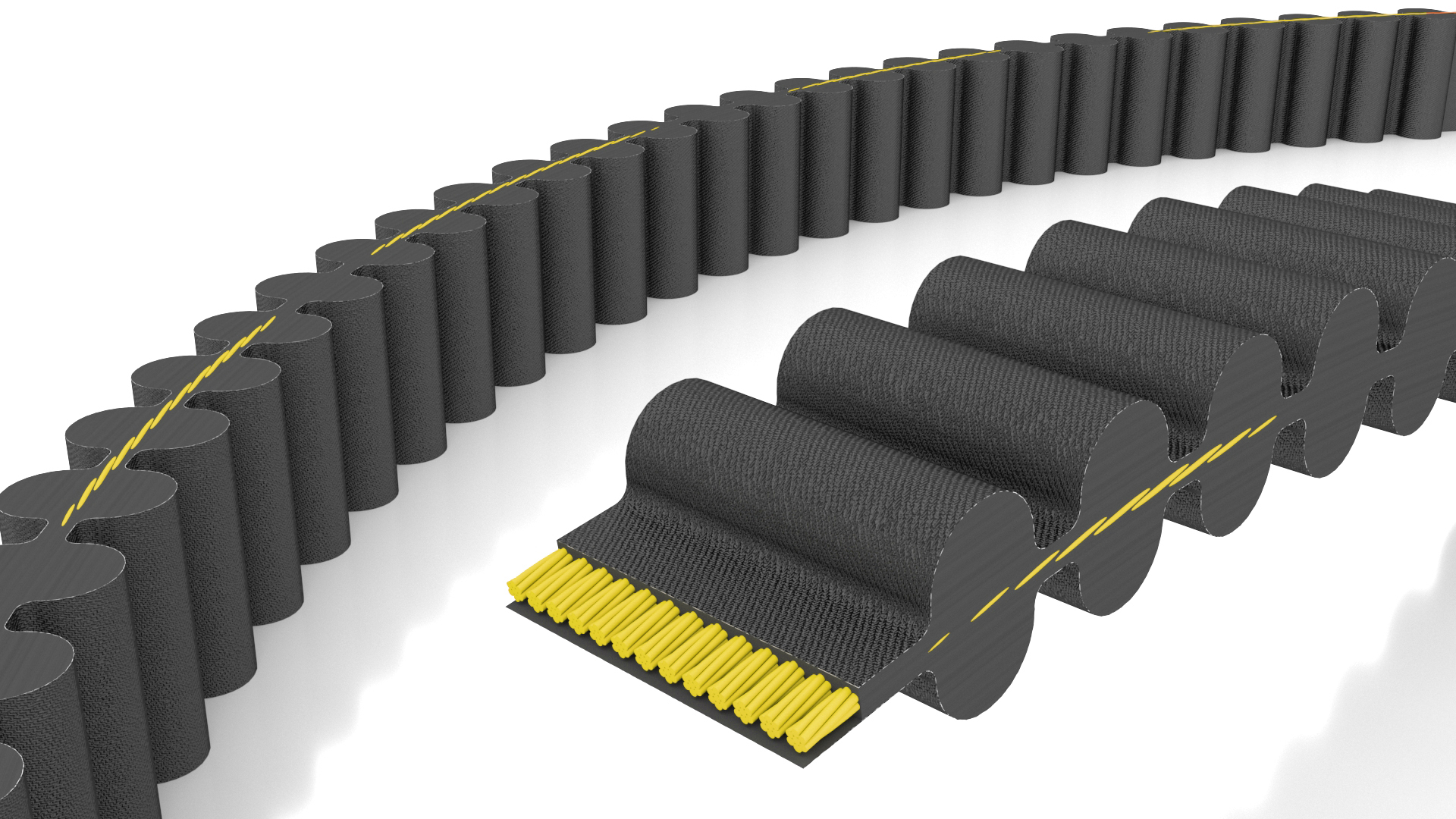
A Kevlar belt is an industrial belt reinforced with DuPont Kevlar aramid fiber, usually in its tensile cords or fabric. The reinforcement carries working tension and controls stretch, while rubber, polyurethane, or another polymer forms the belt body, teeth, ribs, or conveying surface.
The term is often used loosely for any aramid-reinforced belt. However, Kevlar is a registered DuPont brand, and not every aramid fiber is Kevlar. This guide explains the main belt types that use aramid reinforcement, where they are applied, how the reinforcement changes performance, and what limitations buyers must consider.
Key Takeaways
- Kevlar is a branded para-aramid fiber, not a generic name for every aramid cord.
- Timing, V, ribbed, flat, lifting, and conveyor belts can use aramid reinforcement.
- Aramid tensile members provide high strength at low weight with limited elongation.
- The belt body, cord treatment, pulley geometry, tension, and environment still control performance.
What Is a Kevlar Belt?
A Kevlar belt is a composite power transmission or conveyor belt containing DuPont Kevlar fiber as a reinforcing element. In most designs, the visible belt surface is not Kevlar. The fiber is embedded inside the belt as longitudinal cords, woven fabric, reinforcement plies, or a tension layer.
Kevlar belongs to the aromatic polyamide, or aramid, family. DuPont describes it as an organic fiber combining high strength, high modulus, toughness, and thermal stability (DuPont, Kevlar Properties, 2019). Different Kevlar yarn grades and constructions are produced for different end uses, so one published fiber property cannot represent every finished belt.
The reinforcement performs a structural role. Tensile cords carry the circumferential force in a V-belt or timing belt and limit length change under load. In a flat or conveyor belt, aramid fabric or cords can reduce weight, control elongation, and carry longitudinal tension across a wide belt.
The surrounding polymer determines many other characteristics. Rubber compounds affect flexibility, damping, temperature, oil resistance, and pulley grip. Polyurethane forms precise teeth, resists abrasion, and can support profiles or machining. Adhesion systems transfer force between the cords and belt body.
“Kevlar belt” should therefore not be treated as a complete specification. A buyer still needs the belt profile, pitch, width, length, cord construction, body material, temperature range, chemical limits, pulley requirements, and rated load. If a product only states “aramid,” the fiber may be another para-aramid brand rather than Kevlar.
What Are the Main Types of Kevlar-Reinforced Belts?
Kevlar or other aramid reinforcement appears in timing belts, V-belts, banded belts, ribbed belts, flat belts, lifting belts, and conveyor or process belts. Manufacturers choose aramid when high tensile capability, limited stretch, low mass, or shock-load performance provides an advantage over standard reinforcement.
Kevlar Timing Belts
Aramid-reinforced timing belts use longitudinal cords beneath the tooth surface. The cords control pitch elongation while the teeth engage matching pulley grooves. Rubber timing belts may combine aramid cords with elastomer teeth and a wear-resistant facing. Polyurethane belts can use parallel aramid cords for conveying or linear motion.
These belts serve positioning, high-speed transmission, packaging, robotics, printing, and high-performance engine drives. Gates uses aramid cord in its RPM timing-belt range for forced-induction and high-output engines (Gates Corporation, RPM Timing Belts). Industrial and automotive products must not be interchanged without matching pitch, profile, width, and rating.
Aramid can reduce stretch and rotating mass, but timing accuracy depends on the entire system. Tooth clearance, pulley runout, belt tension, cord layout, frame stiffness, and control settings all matter. Aramid cords also need suitable pulley diameters and clamping arrangements in open-end linear belts.
Kevlar V-Belts and Banded V-Belts
Aramid V-belts place high-modulus cords near the belt’s neutral axis. The V-shaped body wedges into pulley grooves and transfers torque through friction. Aramid reinforcement is common in heavy-duty drives exposed to shock, pulsation, high torque, or severe operating conditions.
Banded versions join several V-belt ribs under a common tie band. This controls rib spacing and helps prevent turnover, whip, or separation. Gates Predator PowerBand belts use aramid tensile cords and a joined construction for mining, agriculture, wood processing, construction, and other shock-loaded applications (Gates Corporation, Predator PowerBand).
High-strength cords do not make every pulley suitable. Groove profile, alignment, wrap, belt speed, drive width, and tension must follow manufacturer ratings. A stiffer cord may require a different installation tension or tensioning procedure than a standard polyester-cord belt.
Kevlar Ribbed and Serpentine Belts
Ribbed belts use many longitudinal V-shaped ribs on a thin backing. Their flexibility supports small pulleys, high speed, and serpentine layouts. Aramid cords can improve dimensional stability and load capacity in selected industrial, automotive, supercharger, and accessory drives.
Gates also supplies automotive Micro-V products with aramid cord where the original drive requires that construction. The company warns through application specificity that an aramid belt is not automatically an upgrade for every vehicle or pulley system (Gates Corporation, Micro-V Aramid Belts).
Ribbed belts distribute load across their width, making pulley alignment important. Incorrect tension can overload accessories or allow rib slip. Oil, debris, worn grooves, and damaged tensioners may create noise or tracking problems even when the aramid cords remain intact.
Kevlar Flat and Lifting Belts
Flat belts use a rectangular cross-section and can contain parallel aramid cords, woven aramid fabric, or mixed reinforcement. They transmit power, drive live rollers, position machinery, or lift moving components. Low reinforcement mass can reduce inertia in equipment that starts, stops, or reverses frequently.
Aramid flat belts may offer corrosion resistance compared with steel-cord constructions and can bend around appropriate pulleys. However, steel often provides greater stiffness for demanding linear positioning or lifting. The correct choice depends on allowable elongation, load, fatigue cycle, clamp design, pulley diameter, and safety factor.
Lifting applications require special caution. A belt used to support a suspended load needs a manufacturer-approved construction, attachment method, redundancy strategy, inspection procedure, and applicable safety measures. A generic aramid-reinforced conveyor belt should never be assumed suitable for lifting people or critical loads.
Kevlar-Reinforced Conveyor and Process Belts
Conveyor belts can use aramid cords or fabric as a lightweight, high-strength carcass. Narrow polyurethane timing belts may contain parallel aramid cords, while broad process belts can use woven reinforcement. Applications include packaging, food processing, textile production, corrugating, high-speed conveying, and difficult long-center drives.
Gates offers wide TPU timing belts with parallel aramid cords for synchronous conveying and positioning. The parallel layout helps maintain uniform tension and prevents exposed cord at the edges in that product family (Gates Corporation, Synchro-Power Wide).
Conveyor performance also depends on tracking, splice design, edge sealing, product contact, coatings, and cleaning. Aramid reinforcement can reduce elongation, but it does not make the belt surface resistant to every cut, chemical, temperature, or sanitation method.
Where Are Kevlar Belts Used?
Kevlar and other aramid-reinforced belts are used where standard polyester or fiberglass reinforcement cannot provide the desired combination of strength, limited stretch, low mass, or shock resistance. The application must justify the cord properties because aramid constructions usually cost more and may need different drive settings.
Mining, quarrying, and aggregate equipment use heavy-duty aramid V-belts on crushers, screens, pumps, and other shock-loaded drives. Sudden load changes and airborne debris demand robust covers, stable banded constructions, and carefully maintained pulleys. The cord alone cannot compensate for poor alignment or chronic jamming.
Agricultural machinery uses aramid V-belts and banded belts on combines, mowers, planters, harvesters, and outdoor power equipment. These drives experience dust, shock, clutching, backside idlers, weather, and irregular loading. Gates uses aramid tensile cords in selected PoweRated belts intended for demanding outdoor equipment (Gates Corporation, PoweRated V-Belts).
Wood processing, construction, oil-field, and crushing equipment can use aramid-cord banded V-belts where individual belts may turn over or jump from pulleys. The combination of high-strength cords and lateral band stability is useful under pulsation, impact, and vibration.
High-performance timing drives use aramid to control pitch elongation at speed. Applications include superchargers, racing engines, test systems, machine tools, and other high-load synchronous drives. A belt designed for racing is not automatically suitable for continuous industrial duty, despite using the same reinforcement family.
Packaging and automation systems use aramid-cord timing belts for indexing, product transport, robotic motion, printing, and machine interconnection. Low cord mass supports dynamic motion, while limited stretch helps repeatability. Positioning accuracy still depends on tooth profile, tension, pulley quality, frame rigidity, and control resolution.
Conveyors and material-handling systems use aramid-reinforced flat, timing, V, and ribbed belts for live rollers, accumulation, lifting, and product transport. Gates describes a live-roller belt using aramid tensile members to maintain tension in a high-speed zero-pressure accumulation conveyor (Gates Corporation, Thermoplastic Polyurethane Belts).
How Does Aramid Reinforcement Affect Belt Performance?
Aramid reinforcement carries high tensile force at relatively low weight. DuPont’s technical guide reports fiber properties for specific Kevlar grades and test conditions, but those values should not be used directly as finished-belt ratings (DuPont, Kevlar Aramid Fiber Technical Guide). Cord twist, treatment, adhesion, quantity, and belt geometry change practical capacity.
High modulus limits elastic elongation under load. In a timing belt, this helps maintain tooth pitch and positioning. In a V-belt, it can reduce stretch and re-tensioning. In a conveyor belt, it can reduce take-up travel. Limited elongation also transfers load changes more directly to other components.
Low density reduces reinforcement mass compared with steel. This can lower inertia in high-speed or reversing drives. Aramid is also nonmetallic and does not corrode like untreated steel. These benefits can matter in wide belts, dynamic axes, or environments where belt weight affects system response.
Aramid cords behave differently under compression, bending, clamping, and repeated flexing. Tight pulley diameters, incorrect cord positioning, sharp clamps, and twisting can shorten life. The belt manufacturer controls these factors through cord construction, treatment, body material, and minimum pulley recommendations.
Heat resistance must be interpreted carefully. Kevlar fiber has useful thermal stability, but a belt’s continuous temperature rating may be much lower because the elastomer, polyurethane, adhesive, fabric, or splice limits the assembly. Chemical resistance also belongs to the complete construction rather than the reinforcement name.
What Are the Benefits and Limitations of Kevlar Belts?
The primary benefits are high tensile strength, low reinforcement weight, limited stretch, and strong shock-load capability in suitable constructions. These properties can increase power density, reduce belt count, improve positioning stability, or control elongation when compared with a standard belt designed around lower-modulus cords.
Aramid is nonmetallic, so it avoids steel corrosion and may reduce rotating mass. Selected V-belts can handle demanding pulsating loads, while timing belts can maintain pitch under dynamic force. Wide conveying belts may benefit from high strength without the mass of steel reinforcement.
Aramid does not make a belt universally stronger. Steel cord usually provides greater stiffness and may suit high-force linear positioning. Fiberglass offers stable timing performance and broad availability. Polyester can provide useful elasticity, fatigue behavior, and economical service in general V-belt drives.
Higher modulus can also change drive behavior. A belt may transmit shock more directly, require precise tension, or tolerate less installation error. Replacing a polyester-cord belt with aramid without recalculating tension and shaft load can overload bearings or alter clutching behavior.
Cord adhesion and flex fatigue are critical. The fiber must bond to the belt body through compatible treatments and compounds. Very small pulleys, reverse bending, poor alignment, or damaged grooves can concentrate fatigue. Visible surface condition may not reveal internal cord damage.
Aramid absorbs some moisture, and environmental effects depend on fiber grade, cord treatment, and belt encapsulation. Chemicals may attack the surrounding polymer or adhesion system before the fiber. A Kevlar label does not prove resistance to oil, acids, alkalis, steam, washdown, or UV exposure.
Cost and availability can be higher than standard reinforced belts. Product claims also require scrutiny because “Kevlar,” “aramid,” and “aramid fiber” are not interchangeable sourcing statements. Buyers needing the DuPont product should request explicit manufacturer documentation instead of relying on a distributor’s generic description.
Kevlar vs Polyester vs Fiberglass vs Steel Reinforcement
No reinforcement is best for every belt. The comparison below describes common engineering tendencies. Actual performance depends on cord grade, twist, treatment, quantity, belt body, pulley diameter, operating speed, and manufacturer design.
| Reinforcement | Main Strength | Typical Belt Types | Main Limitation | Best Use |
|---|---|---|---|---|
| Kevlar or para-aramid | High strength at low weight with limited stretch | Timing, V, banded, ribbed, flat, conveyor | Cost, bending, and clamping sensitivity | Shock-loaded or lightweight high-strength drives |
| Polyester | Balanced strength, elasticity, and fatigue performance | V, ribbed, conveyor | More elongation than high-modulus aramid | General industrial power transmission |
| Fiberglass | Dimensional stability and flexibility | Rubber timing belts | Can be damaged by crimping or mishandling | Synchronous drives with stable pitch |
| Steel | Very high stiffness and tensile capacity | Polyurethane timing and flat belts | Weight, corrosion, and pulley constraints | Precision linear motion and heavy lifting |
Choose from the finished-belt rating, not a fiber comparison alone. A well-designed polyester belt can outperform an unsuitable aramid belt on a specific drive. Similarly, one manufacturer’s aramid construction cannot inherit the ratings of another product with the same nominal cross-section.
Frequently Asked Questions
Is every aramid belt made with Kevlar?
No. Kevlar is DuPont’s registered brand of para-aramid fiber. Other manufacturers produce aramid fibers with different trademarks and specifications. If the source matters, request documentation identifying the actual fiber rather than assuming every belt labeled “aramid” contains Kevlar.
Is a Kevlar belt stronger than a steel-reinforced belt?
Not in every sense. Kevlar offers high strength relative to its weight and useful shock performance. Steel typically provides greater stiffness and can carry high tensile loads in suitable constructions. The stronger finished belt depends on width, cord arrangement, body material, pulley geometry, and rated application.
Do Kevlar belts stretch?
Yes, but aramid cords generally limit elastic elongation compared with many polyester constructions. The finished belt still changes length through cord loading, polymer deformation, temperature, seating, and wear. Use the manufacturer’s tensioning and take-up recommendations rather than assuming zero stretch.
Can a Kevlar belt replace a standard belt directly?
Only when the manufacturer approves the substitution. Matching length and cross-section is not enough. Aramid construction can change power rating, tension, shaft load, pulley requirements, clutching behavior, and shock response. Recalculate the drive or use an approved cross-reference.
Conclusion
Kevlar belts use branded para-aramid fiber as cords or fabric inside timing, V, ribbed, flat, lifting, and conveyor constructions. The reinforcement offers high strength at low weight, limited elongation, and useful shock performance, but it does not define the complete belt.
Select from the finished product’s rated load, pulley, tension, temperature, chemical, and fatigue limits. Confirm whether the fiber is genuine Kevlar or another aramid when sourcing matters. The best reinforcement is the one engineered for the complete drive, not the material with the strongest headline.
Sources
- DuPont, Kevlar Properties, 2019, retrieved 2026-07-22.
- DuPont, Kevlar Aramid Fiber Technical Guide, retrieved 2026-07-22.
- Gates Corporation, Industrial Power Transmission Catalogue, 2025, retrieved 2026-07-22.
- Gates Corporation, Predator PowerBand, retrieved 2026-07-22.
- Gates Corporation, RPM Timing Belts, retrieved 2026-07-22.
- Gates Corporation, Synchro-Power Wide, retrieved 2026-07-22.
- Gates Corporation, Thermoplastic Polyurethane Belts, retrieved 2026-07-22.
- Gates Corporation, PoweRated V-Belts, retrieved 2026-07-22.