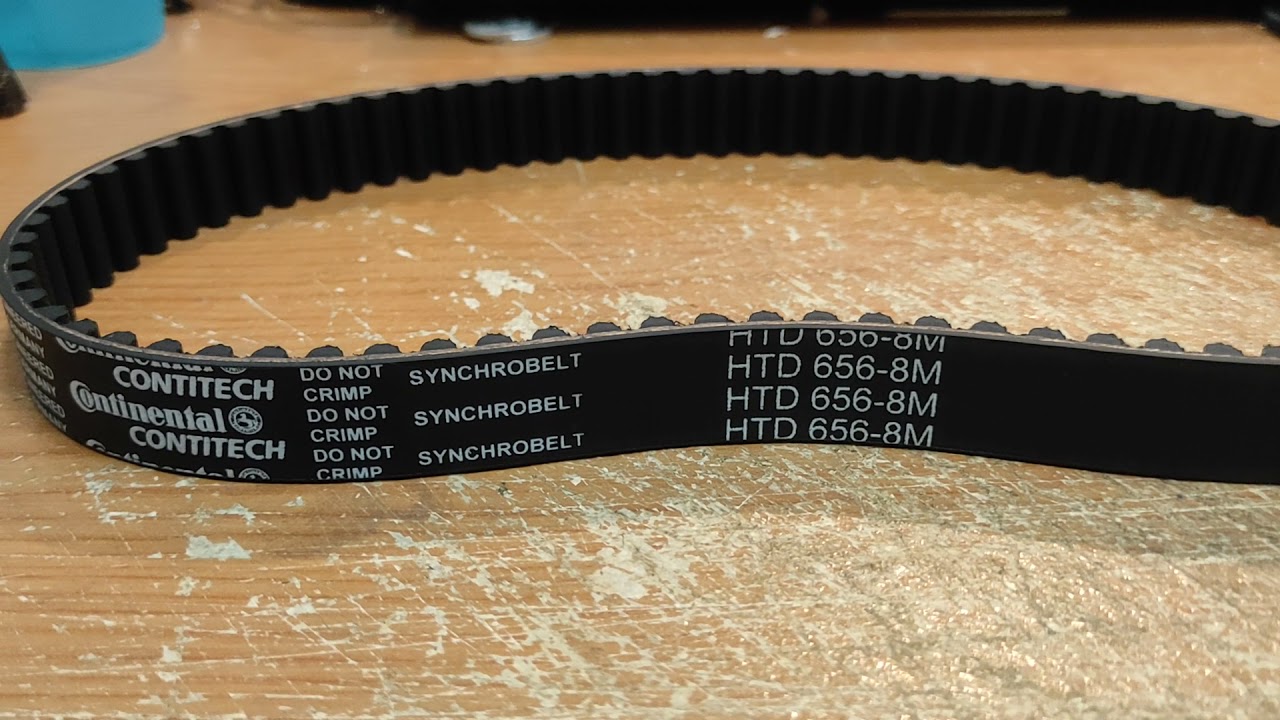
Is your machine losing power or skipping steps? A worn timing belt that doesn’t grip right can ruin your cycle time and scrap parts. That noise under the cover isn’t normal either. The fix is probably simpler than you think.
The good news: switching to an HTD timing belt can solve that. This guide explains what an HTD timing belt is, breaks down the 4 common HTD belt profiles, compares HTD vs STD timing belts, helps you choose the right belt, shows common applications, and shares maintenance and replacement tips. No guesswork, just what you need to get your drive running smooth again.
1. What Is an HTD Timing Belt?
An HTD timing belt is a synchronous power transmission belt with a rounded tooth profile designed for high-torque applications where slip-free operation is critical.
HTD stands for High Torque Drive. Unlike standard timing belts with trapezoidal teeth, HTD belts use a curved, full-arc tooth shape. This design spreads the load more evenly across the tooth surface, which means the belt can handle higher torque without jumping teeth. The rounded profile also reduces stress concentration at the tooth root, giving the belt a longer service life under heavy loads. Gates Corporation introduced the HTD tooth profile in the 1970s for high-torque industrial drives, and it has since become a standard across multiple industries.
2. 4 Common HTD Belt Profiles
HTD belts come in four standard pitch sizes. The pitch is the distance from one tooth center to the next, and it determines how much power the belt can carry. A quick look at each profile.
| Profile | Pitch | Tooth Depth | Common Widths | Typical Application |
|---|---|---|---|---|
| 3M | 3 mm | 1.2 mm | 6, 9, 15 mm | 3D printers, small CNC |
| 5M | 5 mm | 2.1 mm | 9, 15, 25 mm | Robotics, CNC mills |
| 8M | 8 mm | 3.4 mm | 20, 30, 50, 85 mm | Industrial automation |
| 14M | 14 mm | 6.0 mm | 40, 55, 85, 115 mm | Heavy machinery |
Choose a larger pitch when you need more power. Choose a smaller pitch when space is tight and precision matters more than torque.
3M Profile
What it is
The 3M profile has a 3 mm pitch and is the smallest standard HTD profile. It is designed for light-duty applications where space is limited and positional accuracy matters more than raw power.
Key features
Tooth depth of about 1.2 mm. Common belt widths include 6 mm, 9 mm, and 15 mm. Low torque capacity but excellent repeatability.
- 3 mm pitch, 1.2 mm tooth depth
- Common widths: 6 mm, 9 mm, 15 mm
- Low torque, high positional accuracy
Best for
Best for 3D printers, small CNC routers, and light-duty automation where the belt mainly positions rather than drives heavy loads. Choose 3M when precision is more important than power.
5M Profile
What it is
The 5M profile has a 5 mm pitch and is the most popular HTD size. It strikes the best balance between power capacity and compact size, making it the go-to choice for many machinery.
Key features
Tooth depth of about 2.1 mm. Available in 9 mm, 15 mm, and 25 mm widths. Medium torque capacity suitable for most industrial applications.
- 5 mm pitch, 2.1 mm tooth depth
- Common widths: 9 mm, 15 mm, 25 mm
- Best all-round balance of power and size
Best for
Best for robotics, CNC milling machines, packaging equipment, and general industrial drives. If you’re unsure which profile to start with, 5M is the safest bet.
8M Profile
What it is
The 8M profile has an 8 mm pitch and is built for high-power transmission. It handles heavier loads than 3M or 5M and is common in continuous-duty industrial applications.
Key features
Tooth depth of about 3.4 mm. Available in 20 mm, 30 mm, 50 mm, and 85 mm widths. High torque capacity with excellent resistance to tooth shear.
- 8 mm pitch, 3.4 mm tooth depth
- Common widths: 20 mm, 30 mm, 50 mm, 85 mm
- High torque, continuous-duty rated
Best for
Best for industrial automation, conveyor systems, heavy CNC machinery, and any drive that runs for long hours under load. Step up from 5M to 8M when your application needs more power.
14M Profile
What it is
The 14M profile has a 14 mm pitch and is the largest standard HTD belt. It is designed for the highest torque applications and heaviest industrial loads.
Key features
Tooth depth of about 6.0 mm. Available in 40 mm, 55 mm, 85 mm, and 115 mm widths. Very high torque capacity with the strongest tooth design of any HTD profile.
- 14 mm pitch, 6.0 mm tooth depth
- Common widths: 40 mm, 55 mm, 85 mm, 115 mm
- Highest torque capacity
Best for
Best for heavy machinery, main spindle drives, large conveyors, and high-power industrial equipment. Note that 14M belts require larger pulleys and cost more than smaller profiles.
3. HTD vs STD Timing Belt: What’s the Difference?
STD belts (also called standard timing belts) have trapezoidal teeth with a flat top. HTD belts have full-arc rounded teeth. This difference in tooth shape changes everything about how they perform.
| Feature | HTD Belt | STD Belt |
|---|---|---|
| Tooth shape | Full-arc rounded | Flat-top trapezoidal |
| Load capacity | Higher (better load distribution) | Lower (stress concentrated at tooth base) |
| Backlash | Minimal | Can develop over time |
| Common applications | High-torque drives, precision positioning | General synchronization, light loads |
| Interchangeability | Requires HTD pulleys | Requires STD pulleys |
Per RMA (Rubber Manufacturers Association) belt drive standards, HTD profiles are rated for higher torque transmission than equivalent-width STD belts. The takeaway: use HTD belts when you need higher torque, lower backlash, or longer life under load. Use STD belts for light-duty synchronization where cost is the main concern.
4. How to Choose an HTD Timing Belt
Picking the right HTD belt comes down to four factors: pitch, width, length, and load. Work through them in order.
Identify Pitch and Profile
Start by measuring the pitch of your existing belt or pulley. The pitch is the center-to-center distance between two teeth. Match this to the nearest standard HTD profile — 3M, 5M, 8M, or 14M. Using the wrong pitch is the most common mistake and will cause immediate slippage or noise.
Check Belt Width and Length
Once you know the pitch, choose the width. Wider belts handle more load. For example, a 25 mm wide 5M belt can transmit roughly 2.5 times more power than a 9 mm wide belt of the same pitch. For length, measure the belt path around the pulleys. Many suppliers offer belt length calculators on their websites.
Match Load and Speed Requirements
Each profile has a torque and speed limit. 3M and 5M profiles work best at moderate speeds under 3000 RPM. 8M and 14M profiles handle lower speeds with higher torque. Always leave a safety factor of at least 1.5x between your expected load and the belt’s rated capacity.
5. Common Applications of HTD Timing Belts
HTD belts are the go-to choice for any application that needs slip-free power transfer at high torque, from robotic arms to CNC spindles. In industrial automation, they drive robotic arms, pick-and-place machines, and conveyor indexing systems. In CNC machining, they connect servo motors to ball screws and spindles. The automotive industry uses them in engine timing systems and accessory drives. You will also find HTD belts in 3D printers, packaging lines, and textile machinery. Any application that needs precise, slip-free power transfer at high torque is a good fit for an HTD belt.
6. HTD Timing Belt Maintenance and Replacement Tips
Check your HTD belts every few months. Look for cracked backings, frayed edges, or missing teeth. These are signs the belt needs replacement. Keep the belt clean — dust and oil both accelerate wear.
Replace an HTD belt when you see visible damage or when it has been in service for 5 years, whichever comes first. When installing a new belt, set the tension so the belt deflects about 1/64 inch per inch of span length under moderate finger pressure. Gates Corporation recommends checking belt tension after the first 24 hours of operation on new installations. Too loose and it will skip. Too tight and it will wear out the bearings.
7. How Does Tranbelt Help You Source HTD Timing Belts from China?
If you need HTD timing belts for your operation, working with the right supplier makes all the difference. You need someone who stocks the right profiles, cuts to length accurately, and ships on time.
- Official Distributor for Top Global Brands – We work directly with leading manufacturers like Bando, Continental, Gates, Megadyne, Mitsuboshi, and Optibelt. As their official distributor in China, we secure lower agent prices and maintain stable stock for fast, consistent supply.
- In-House Factory Production – Beyond branded products, we operate our own factory. This allows us to manufacture custom timing belts and kits for specialized machinery, with superior quality control and more competitive pricing than standard agents.
- Optimized Global Logistics – We partner with long-term shipping specialists for both air and sea freight. Our team helps you choose the best shipping plan to minimize costs while ensuring your goods arrive safely and on time.
If you’re looking for quality HTD timing belts, we can help. Tell us your pitch, width, and quantity, and we will find the right solution.
8. Frequently Asked Questions
1) What is the difference between HTD and STD timing belts?
HTD belts have full-arc rounded teeth while STD belts have flat-top semi-arc teeth. This makes HTD belts better for high-torque applications because the curved tooth distributes load more evenly. STD belts work fine for light-duty synchronization where cost is the main factor. The two aren’t interchangeable because they require different pulley profiles.
2) How long does an HTD timing belt last?
5 to 8 years in normal industrial use. Factors like misalignment, over-tensioning, exposure to heat above 200°F, and contact with oil or chemicals can shorten this significantly. Regular inspection every 3 to 6 months helps catch problems early.
3) What does 8M mean on an HTD belt?
8M means the belt has an 8 mm pitch — the distance from the center of one tooth to the center of the next. This pitch size is one of four standard HTD profiles (3M, 5M, 8M, 14M). The pitch must match the pulley exactly. An 8M belt won’t work on a 5M or 14M pulley.
4) Can I use an HTD belt with a standard pulley?
No. HTD belts require pulleys with the matching HTD tooth profile. Using an HTD belt on a standard trapezoidal pulley causes slippage, noise, and rapid tooth wear. Always match the belt profile to the pulley profile.
9. Conclusion
HTD timing belts solve real problems. They handle higher torque, reduce backlash, and last longer under load than standard timing belts. Whether you’re fixing a noisy drive or upgrading a new machine, choosing the right HTD profile is the first step.
Start by identifying your pitch and width. Match the profile to your load and speed. And when you’re ready to buy, work with a supplier who stocks all four HTD profiles and understands the difference between them. A HTD belt that fits right will run smoother and last longer.