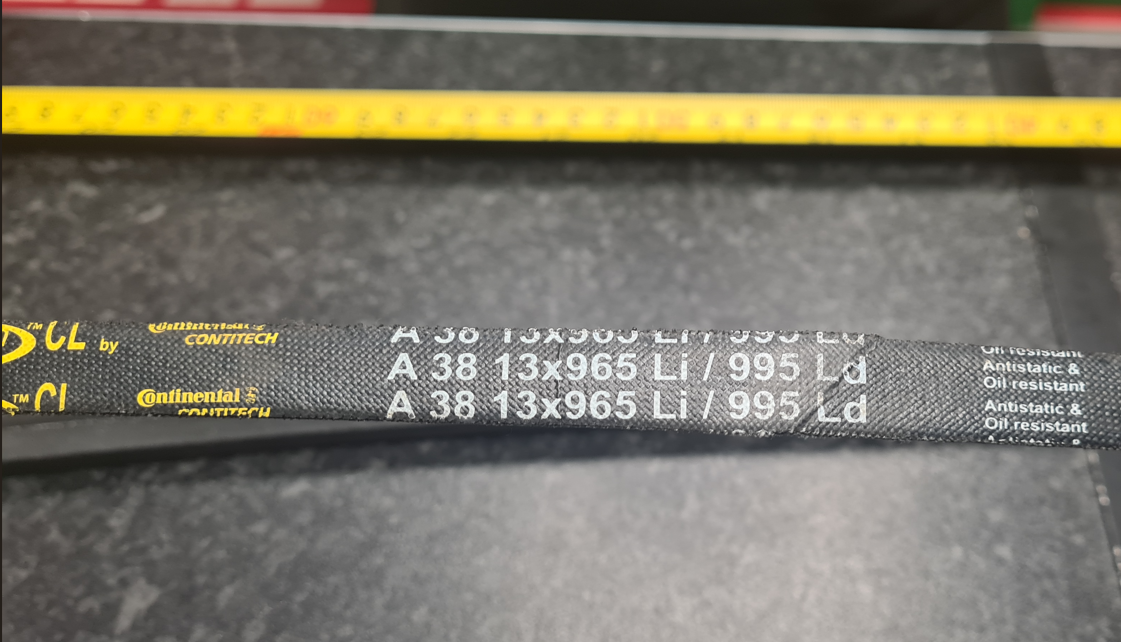
To measure a V-belt, record its top width, height, profile, and circumference. Check the printed belt code first because it may identify the exact section and nominal length. If the marking is unreadable, use calipers for the cross-section and a belt gauge or flexible tape for length.
The difficult part is interpreting the result. V-belts may be cataloged by inside length, outside length, datum length, or effective length. A measured 50-inch outside circumference is not automatically a belt with “50” in its part number. This guide shows how to take each measurement and compare it with the correct manufacturer convention.
Key Takeaways
- Read the original belt code before relying on physical measurements.
- Measure top width and height without compressing the belt.
- A flexible tape around the back gives outside circumference, not effective length.
- Match the measured profile and length convention to a manufacturer catalog.
Which V-Belt Measurements Do You Need?
A replacement V-belt needs more than one length. The minimum identification set is top width, belt height, cross-section family, and a clearly labeled circumference. Also record whether the belt is wrapped, raw-edge cogged, banded, double-V, or another special construction.
Top width is measured across the broad outer face. Height is measured from the top surface to the narrow inner face. The sidewall angle and exact datum-width geometry are normally confirmed from a standard or supplier drawing rather than measured accurately with ordinary workshop tools.
Length needs a reference. Inside length follows the narrow inner surface. Outside length follows the belt back. Datum or effective length follows a theoretical reference line within the belt where it operates in the pulley groove. These circumferences differ because they lie at different distances from the belt’s center.
Record units exactly. Industrial V-belts mix millimeter and inch systems, and the number in a part code may not represent the same reference length across product families. Gates product data, for example, can list inside, effective, and outside circumferences separately for one belt (Gates Corporation, Metric Power V-Belt Product Data, 2026).
Check the Existing V-Belt Code First
Clean the belt back gently and inspect the entire circumference under good light. Record every letter, number, suffix, brand name, and logo before measuring. A partial marking such as A, B, 3V, 5VX, SPA, or SPB can identify the section family even when the length characters have disappeared.
Do not interpret the code from one character alone. A classical A belt, an AX cogged belt, and an automotive belt with a similar top width may use different constructions or length conventions. Metric labels may include Li, La, Ld, or Le to identify inside, outside, datum, or effective length.
Photograph the marking and note the machine model, pulley groove count, and number of matched belts. If several belts run together, replace them with a manufacturer-approved matched set. Mixing a new belt with stretched or differently toleranced belts produces unequal load sharing.
TranBelt’s guide to all V-belt types explains the differences between classical, narrow, cogged, wrapped, banded, and double-V constructions. Identify the construction before converting any measured circumference into a catalog size.
What Tools Do You Need to Measure a V-Belt?
Use a clean flexible tape, vernier caliper, straight ruler, fine marker, and a flat surface. A dedicated two-pulley belt measuring gauge is preferable when available because it controls the measuring path and can show a corresponding product size for supported belt families.
Dayco’s Factfinder gauges display top width and replacement length for several FHP, classical, 3VX, and 5VX families. Its listed tools cover V-belts up to 100 inches, with an extension for larger sizes (Dayco, Belt Measuring Gauges, 2026).
Calipers should contact the rubber lightly. Excessive jaw pressure can compress a soft belt and reduce the reading. Avoid rigid steel tape around a small belt because it may bridge curved surfaces and distort the circumference.
How Do You Measure V-Belt Width and Height?
Place the belt in its natural shape without twisting it. Select a straight, undamaged section away from cracks, glazing, chunks, and the most polished sidewalls. Use the outside jaws of the caliper to measure across the top face. Keep the jaws square to the belt and apply only enough pressure to make contact.
Take top-width readings at three or more positions. If the values differ, record the largest credible dimension and the amount of variation. A belt that has worn deeply in a pulley can become narrower than its original nominal section, so a single reading from the most worn location may suggest the wrong profile.
Measure height from the top face to the inner surface. For a cogged belt, measure the overall section height defined by the supplier, not the depth of an individual molded notch. Do not mistake bottom width for top width; the narrow inner face is not normally the dimension used to name a V-belt section.
Compare the measurements with a section table. Nominal dimensions are identification values, while actual tolerances and measuring methods belong to the relevant standard or manufacturer. A measured width close to two families requires additional confirmation from pulley groove geometry, remaining markings, and product drawings.
The belt should ride on its sidewalls, not bottom in the pulley groove. If a known section sits too low, the pulley may be worn. Replacing the belt without inspecting the grooves can shorten the new belt’s life and make physical identification misleading.
How Do You Measure V-Belt Length?
The best method depends on available tools and the length definition you need. A belt gauge provides the most repeatable workshop result. A flexible tape or mark-and-roll method can measure outside circumference. A cut belt can be measured along a chosen surface, but the result still needs a stated reference.
Belt Measuring Gauge
Place the belt around the gauge pulleys with the V profile facing inward. Move the adjustable pulley until both spans are straight and the belt is seated consistently. Apply only the tension specified by the gauge instructions, then read the indicated length or replacement code.
Do not pull the belt as hard as possible. Measuring tension changes circumference, especially on a small, flexible, or badly worn belt. Gates’ industrial preventive-maintenance manual states that its length finder measures inside length with the profile inward and that the result is an indication, not a precision tolerance measurement (Gates Corporation, Industrial Power Transmission Preventive Maintenance Manual, 2024).
Flexible Tape Method
Wrap a flexible cloth or fiberglass tape around the outside surface of the belt. Keep the tape centered on the back, remove slack, and avoid stretching either the tape or belt. Read the point where the tape completes one full circumference. This value is the outside length, usually written La or Lₐ.
Repeat the measurement at least twice. If the tape wanders toward one edge, reposition it and start again. Do not place the tape through the inside V and call that effective length. A hand tape follows a physical surface, while effective length is defined by a standardized measuring system.
Mark-and-Roll Method
Draw one fine reference mark across the belt back and place that mark against a starting line on a flat surface. Roll the belt through one complete revolution without sliding it. Mark the surface when the belt reference returns to the contact point, then measure between the two surface marks.
Keep the belt vertical and apply light, consistent pressure. A leaning belt follows a longer diagonal path, while sliding shortens or lengthens the result. The mark-and-roll method also produces outside circumference because the back surface contacts the measuring plane.
Measuring a Cut Belt
If the belt is already cut, lay it straight without stretching it. Measure along the inner surface for inside length or along the back for outside length. Follow the curve around any retained end shape rather than measuring a diagonal chord. Label the result Li or La so it cannot be confused later.
Do not cut a serviceable endless belt merely to measure it. Cutting prevents reinstallation and removes the opportunity to check fit on a proper gauge. For a laminated or banded construction, cutting can also disturb the section and make the measured length unreliable.
Inside Length vs Outside Length vs Effective Length
Inside length, outside length, datum length, and effective length describe different paths around the same V-belt. They are not alternate names for one measurement. The difference may be small relative to total circumference, but it can be large enough to select the wrong catalog size or exceed machine adjustment.
| Length Term | Common Symbol | Reference Path | Typical Measurement Method |
|---|---|---|---|
| Inside length | Li | Narrow inner surface | Inside-length gauge or measured cut belt |
| Outside length | La or Lₒ | Belt back | Flexible tape or mark-and-roll method |
| Datum length | Ld | Standardized datum line within the belt | Standard measuring pulley system |
| Effective length | Le or EL | Effective working reference defined for the belt family | Standardized gauge and specified pulley geometry |
Optibelt defines La as outside length, Li as inside length, and Ld as datum length in its current V-belt technical manual. The same manual shows that length designation varies by profile: selected classical belts use inside length, narrow sections may use datum length, and 3V, 5V, and 8V products may use outside length (Optibelt, Technical Manual for V-Belt Drives, 2026).
Conversion offsets are not universal. They depend on section geometry and the definitions used by the manufacturer or standard. Do not apply one fixed addition to every A, B, 3V, 5V, SPA, or SPB belt. Use the conversion table for the exact profile and brand family.
This issue also appears in ribbed belts. A manufacturer may list effective and outside lengths separately because the operating reference lies inside the belt. TranBelt’s Poly-V belt guide explains how profile codes and length designations work for that related but different belt type.
How Do You Identify the V-Belt Section?
Identify the section by combining top width, height, printed code, and pulley fit. Cross-section families can overlap in apparent size, especially after wear. A caliper reading should therefore narrow the options, not serve as the only proof.
| V-Belt Family | Common Sections | Approximate Nominal Top Width | Usual Length Reference |
|---|---|---|---|
| Classical | Z, A, B, C, D | 10, 13, 17, 22, 32 mm | Often inside or datum length |
| Cogged classical | ZX, AX, BX, CX | Similar to matching classical section | Family-specific |
| Narrow imperial | 3V, 5V, 8V | 3/8, 5/8, 1 in | Commonly outside or effective length |
| Cogged narrow | 3VX, 5VX | Similar to 3V and 5V | Family-specific |
| Fractional horsepower | 2L, 3L, 4L, 5L | 1/4, 3/8, 1/2, 21/32 in | Often outside length |
| Metric wedge | SPZ, SPA, SPB, SPC | 9.7, 12.7, 16.3, 22 mm | Commonly datum length |
Classical sections use familiar letter codes, but the nominal top widths are not exact permission to substitute any belt with a similar caliper result. A B-section industrial belt and a 5L utility belt can appear close in width while differing in geometry, construction, power rating, and pulley compatibility.
Narrow or wedge belts use deeper profiles to transmit more power in compact drives. Imperial 3V, 5V, and 8V sections should be matched to their pulley grooves. Metric SPZ, SPA, SPB, and SPC sections use metric datum conventions and should not be selected by converting only the width to inches.
Fractional-horsepower belts are common on light machinery, appliances, and outdoor equipment. Their part numbers often combine a section code with an outside-length convention, but brand practices vary. Confirm the supplier’s catalog rather than assuming every final number means the same circumference.
A cogged suffix changes flexibility and construction, not merely appearance. AX, BX, 3VX, and 5VX belts usually match specified pulley families, but replacement still requires the correct section and catalog length. A raw-edge cogged belt should not be ordered from the dimensions of one molded notch.
Frequently Asked Questions
Is V-belt length measured on the inside or outside?
It can be either, depending on the belt family. Classical belts may use inside or datum length, while some narrow and FHP belts use outside or effective length. State whether your measurement is Li, La, Ld, or Le, then use the exact manufacturer’s conversion table.
Can I measure a V-belt with a string?
A non-stretch string can estimate outside circumference when wrapped around the belt back, but a flexible tape is easier to control. Mark the overlap, lay the string straight, and label the result as outside length. Do not treat it as a precision effective-length measurement.
Does the number on a V-belt equal its length?
Often it represents a nominal length, but the reference and units depend on the coding system. The number may indicate inside, outside, datum, or effective length in inches or millimeters. Decode the complete prefix, number, and suffix using the correct brand catalog.
Should V-belt width be measured at the top or bottom?
Measure the broad top face for standard section identification. The narrow bottom face is affected more severely by wear and does not normally define the named top width. Also measure overall height and compare both dimensions with the relevant section drawing.
Can a new V-belt be selected from pulley center distance alone?
No. Center distance is only one input. Pulley pitch or datum diameters, groove section, adjustment range, and drive layout are also required to calculate a belt length. When replacing an existing belt, the machine manual or original belt code is more reliable than center distance alone.
Conclusion
Accurate V-belt identification combines the printed code, top width, height, section, construction, and a clearly defined circumference. A belt gauge is the best workshop tool, while a flexible tape or mark-and-roll method provides outside length.
Never convert a measured circumference into a part number without checking its reference. Inside, outside, datum, and effective lengths are different. Match the measured section and length convention to the supplier’s catalog, then confirm pulley fit and machine adjustment before ordering.
Sources
- Gates Corporation, Metric Power V-Belt Product Data, retrieved 2026-07-20.
- Gates Corporation, Industrial Power Transmission Preventive Maintenance Manual, retrieved 2026-07-20.
- Optibelt, Technical Manual for V-Belt Drives, retrieved 2026-07-20.
- Dayco, Belt Measuring Gauges, retrieved 2026-07-20.
- Dayco, Factfinder Belt Measuring Gauges, retrieved 2026-07-20.