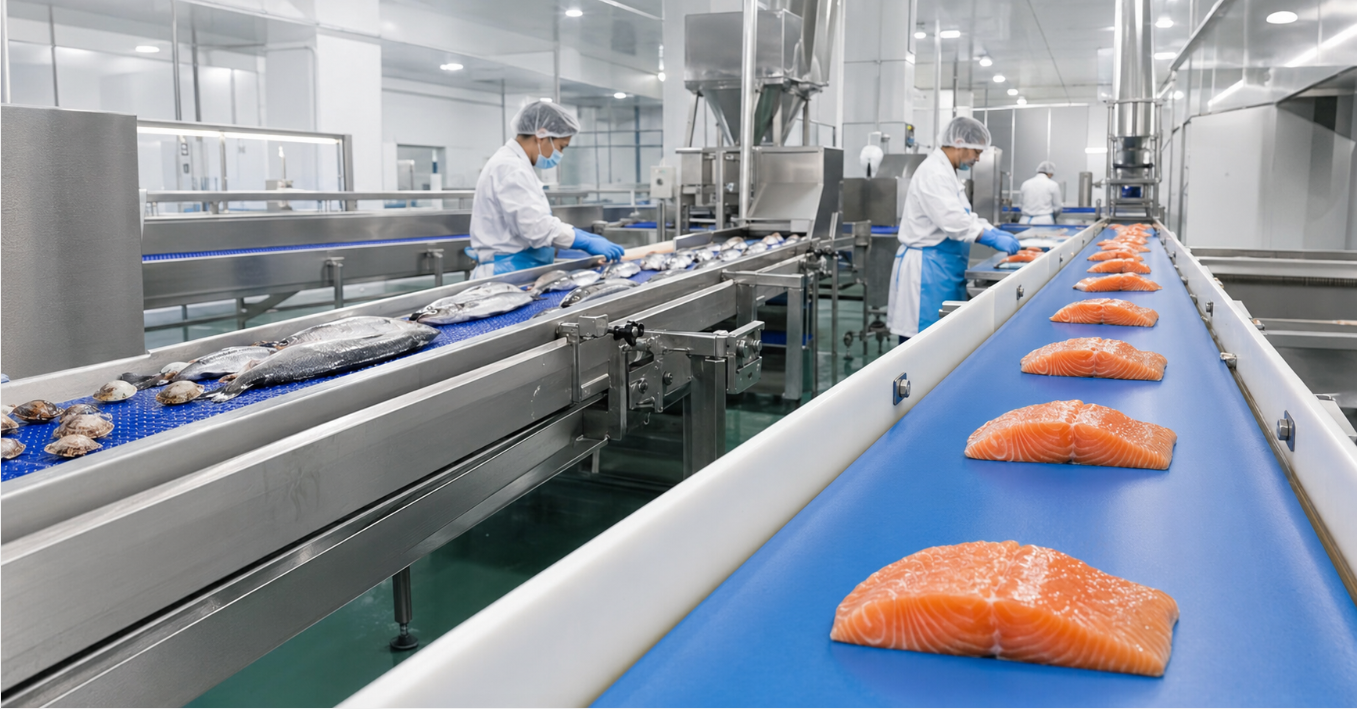
Food conveyor belts carry ingredients, unpackaged foods, and finished products through washing, cutting, cooking, cooling, freezing, inspection, and packaging. The correct belt must do more than move the product. Its material, surface, edges, joints, accessories, and supporting conveyor must suit sanitation, temperature, chemicals, product release, and food-contact requirements.
China has manufacturers serving nearly every food conveying category, including PU and PVC flat belts, monolithic belts, plastic modular belts, silicone belts, and stainless steel mesh belts. This review compares five manufacturers with identifiable food-industry products and Chinese operations. TranBelt publishes this comparison and is included as a full-range industrial belt manufacturer and supplier. Rankings reflect sourcing suitability based on available product information, not independent laboratory testing.
Key Takeaways
- TranBelt offers broad food conveyor belt sourcing and customization across several industrial belt categories.
- YONGLI has a large light-duty portfolio that includes coated, monolithic, modular, and silicone food belts.
- XINBEX is a strong option for fabricated PU and PVC belts used on conventional food-processing conveyors.
- HONG’S BELT specializes in modular plastic systems, while Jiangsu Huada focuses on high-temperature stainless steel mesh belts.
Food Conveyor Belt Manufacturer Comparison
Food belts solve different processing problems. Smooth PU belts suit many direct-contact applications, modular belts support positive drive and drainage, and metal mesh handles temperature ranges that polymers cannot. “Recommended for” describes the clearest application fit of each manufacturer’s range.
| Rank | Manufacturer | Location | Main Food Belt Categories | Typical Applications | Recommended For |
|---|---|---|---|---|---|
| 1 | TranBelt Transmission Solutions | Shenzhen, Guangdong | PU, PVC, silicone, modular, and customized food conveyor belts | Meat, seafood, bakery, produce, frozen food, and packaging | Full-range food belt sourcing and customization |
| 2 | Shanghai Yongli Belt Industry Co., Ltd. / YONGLI | Shanghai and Anhui | Coated, monolithic, modular, TPU, TPO, TPEE, and silicone belts | Meat, bakery, confectionery, produce, and packaging | Comprehensive hygienic conveyor belt solutions |
| 3 | Xiamen Hee Industrial Belt Co., Ltd. / XINBEX | Xiamen, Fujian | PU, PVC, fabricated, and specialty food belts | Bakery, meat, prepared food, confectionery, and packaging | PU and PVC food conveyor belts |
| 4 | Huanan Xinhai (Shenzhen) Technology Co., Ltd. / HONG’S BELT | Shenzhen, Guangdong | Plastic modular belts, chains, sprockets, and conveyor systems | Washing, drainage, cooling, beverage, and packaging | Modular food conveyor systems |
| 5 | Jiangsu Huada Metal Mesh Belt Co., Ltd. | Jiangsu | Stainless steel mesh and chain-driven metal belts | Baking, frying, cooking, cooling, drying, and freezing | High-temperature food processing |
Top 5 Food Conveyor Belt Manufacturers in China
The companies below serve different sections of the food industry. A ranking position should not be interpreted as proof that one construction is better than another. A smooth PU belt, open modular belt, and stainless steel mesh belt have different hygiene, drive, temperature, and product-support characteristics.
1. TranBelt Transmission Solutions
Company Background
TranBelt is a full-range industrial belt manufacturer and supplier based in Shenzhen, Guangdong. It serves food-equipment manufacturers, processing plants, distributors, maintenance companies, and OEM customers. The company provides standard products, imported industrial belt brands at distributor pricing, and TranBelt OEM belts for customized applications.
TranBelt is also the publisher of this article. Buyers should independently compare technical specifications, compliance documents, samples, and quotations. Its position is based on the breadth of food conveyor belt solutions it can supply and customize rather than a claim that one TranBelt construction suits every food process.
Product Line
TranBelt supplies PU and PVC conveyor belts for conventional straight-running lines, along with silicone and other specialty surfaces for release or temperature requirements. Available food conveying solutions also include plastic modular belts and components for positively driven, washable, or open-grid applications.
Customization can include belt width and length, sealed or prepared edges, splices, surface patterns, guides, sidewalls, and cleats. These features help match inclined conveyors, product spacing, drainage, transfer, and tracking requirements. Material and construction options can be selected for oily foods, wet processing, cutting exposure, cold rooms, and routine sanitation.
The range supports applications in bakery, meat and poultry, seafood, fruit and vegetables, frozen foods, confectionery, prepared foods, and packaging. TranBelt’s food conveyor belt guide explains how belt construction, sanitation, temperature, and documentation affect selection.
Why We Recommend It
TranBelt is recommended for buyers who want to compare several belt constructions through one supplier. A food machinery OEM may need a smooth PU belt for direct contact, a modular belt for washing, a silicone surface for release, and a general-purpose belt for packaged products. A broad range helps prevent the material choice from being decided before the process is understood.
Customization is another advantage. A nominally compliant belt can still fail hygienically or mechanically if its edge, splice, cleat, or guide traps residue or separates under cleaning. TranBelt can match fabrication to the conveyor layout and provide standard or OEM options. Food-contact status must be confirmed for the complete quoted belt under the intended conditions.
2. Shanghai Yongli Belt Industry Co., Ltd. / YONGLI Belting
Company Background
YONGLI is a Chinese light-duty conveyor belt manufacturer established in 1989 according to its official company information. The group lists manufacturing facilities in Shanghai’s Qingpu and Chongming districts and in Guangde, Anhui. Food processing is one of the industries specifically identified in its international product portfolio.
Its long operating history, visible manufacturing locations, and extensive product range make it one of the strongest independently verifiable companies on this list. Global reach and product breadth do not remove the need to review the actual belt declaration and fabrication details supplied for a project.
Product Line
YONGLI manufactures light conveyor belts coated with PVC, TPU, TPO, TPEE, and silicone. It also offers modular belts and chains, TPU products, fabrication services, and HygienePro monolithic belts. These categories cover conventional friction-driven conveyors and positively driven hygienic designs.
Food applications include meat processing, bakery, dough handling, confectionery, fruit and vegetable processing, and packaged products. Available surfaces and constructions address product release, oil resistance, washdown, cutting exposure, small transfers, and positive drive. Exact features vary by series.
Why We Recommend It
YONGLI is recommended for comprehensive hygienic belt projects because its portfolio covers coated fabric belts, monolithic products, and modular systems. This allows engineering teams to compare constructions within a single manufacturer’s range rather than assuming a familiar PVC or PU belt remains the best option.
Its Chinese manufacturing footprint is also clearly published. For regulated food-contact applications, buyers should request the declaration, migration or supporting test data, and traceability for the exact product code. Documentation should cover the color, coating, reinforcement, splice, profiles, and intended temperature and food type.
3. Xiamen Hee Industrial Belt Co., Ltd. / XINBEX
Company Background
XINBEX states that its industrial belt business began in 1998. Xiamen Hee Industrial Belt Co., Ltd. operates as its identified manufacturing company, with published production history in Xiamen and additional operations in Tianjin and Suzhou. The company focuses on light conveyor and transmission belt development, manufacturing, fabrication, and service.
Its website provides factory history and dedicated categories for PU, PVC, and food-processing belts. This is stronger evidence than generic marketplace listings, although capacity, certification, and output claims should still be verified during supplier qualification.
Product Line
XINBEX offers PU and PVC conveyor belts, food-processing belts, specialty belts, and custom fabrication. Available configurations include smooth and patterned surfaces, cleats, sidewalls, guides, and application-specific splices. The portfolio also includes other industrial belt categories and fabrication equipment.
The food range targets meat, bakery, confectionery, prepared food, dairy, sauces, and packaging. PU options are promoted for oil resistance, cleanability, wear resistance, and selected cutting applications. PVC may suit dry foods and packaged products when the compound and operating conditions are appropriate.
Why We Recommend It
XINBEX is a practical shortlist option for conventional PU and PVC food conveyors. These belts remain widely used because they support smooth product transfer, small pulley arrangements, and extensive fabrication. The company’s ability to add guides, cleats, and sidewalls can help match existing equipment.
Buyers should avoid accepting “FDA food-grade belt” as the complete specification. Request the product code, coating formulation, reinforcement, color, splice method, edge treatment, and intended use declaration. Verify whether the documents apply to direct contact, the relevant food type, operating temperature, and cleaning chemicals.
4. Huanan Xinhai (Shenzhen) Technology Co., Ltd. / HONG’S BELT
Company Background
Huanan Xinhai operates the HONG’S BELT brand from Shenzhen. The company focuses on modular conveyor belts, plastic chains, transmission components, and integrated conveyor systems. Its stated applications include food, beverage, pharmaceuticals, logistics, automotive, and other industrial sectors.
The company publishes information about production facilities, product development, and completed conveyor projects. Factory size, patent totals, and project counts are company-reported figures. Its clearly identified legal name and modular product range support inclusion as a Chinese manufacturer.
Product Line
HONG’S BELT supplies straight-running and side-flexing modular plastic belts, flat-top chains, sprockets, and related components. Food configurations include closed surfaces for product support and open-grid designs for drainage, airflow, washing, cooling, or freezing.
Flights, side guards, wear strips, and conveyor components can be combined into complete systems. Radius and spiral products can route food through turns or elevation changes without transferring between several straight conveyors. Resin options and available designs vary by belt series.
Why We Recommend It
HONG’S BELT is recommended for modular food conveyor systems. Sprocket drive reduces reliance on friction and helps the belt maintain repeatable movement in wet conditions. Damaged modules can often be replaced without changing the entire belt, reducing repair scope when the correct spares are available.
Modular construction is not automatically hygienic. Hinges, rods, flights, side guards, and return supports can retain residue if sanitation access is poor. Buyers should review the complete conveyor design and request food-contact documentation for the exact module resin, rod, color, and accessories.
5. Jiangsu Huada Metal Mesh Belt Co., Ltd.
Company Background
Jiangsu Huada specializes in metal mesh conveyor belts and chain-driven conveying systems. It states that its manufacturing history began in 1992 and publishes information about production facilities and quality control. Food processing is one of several industries served by its metal belt range.
Company claims regarding factory size, certification, exports, and operating history should be confirmed as part of commercial due diligence. Its legal company name, Jiangsu location, and identifiable metal belt portfolio nevertheless provide reasonable evidence of manufacturing activity.
Product Line
Huada supplies stainless steel wire mesh, balanced-weave, compound-weave, flat-wire, rod-reinforced, and chain-driven belts. Constructions can be customized by alloy, wire diameter, pitch, width, edge finish, chain, and product-support requirements.
Food applications include baking, frying, cooking, blanching, cooling, drying, and freezing. Open metal structures allow air, oil, water, or process gases to move around the food. Stainless steel also handles temperatures beyond the practical range of most coated or modular polymer belts.
Why We Recommend It
Huada is recommended for temperature-intensive food processing. A correctly specified stainless steel belt can move products through ovens, fryers, coolers, freezers, and dryers while maintaining dimensional stability. Open area can support heat transfer, drainage, and rapid cooling.
Metal belts require application-specific engineering. Mesh openings can mark soft products or allow small items to fall through. Transfers, tracking, lubrication, welds, edge treatment, and product release must be considered. Buyers should verify alloy grade, wire condition, surface finish, welding quality, and cleanability before approval.
How Were These Food Conveyor Belt Manufacturers Evaluated?
Each company had to show a Chinese manufacturing identity or clearly published Chinese production operation. It also needed an identifiable food conveyor belt category rather than a general statement that its products might be used in factories. The shortlist covers coated flat belts, monolithic products, modular plastic belts, and metal mesh belts.
We considered range, customization, application coverage, manufacturing transparency, technical detail, and food-contact documentation. Public references to FDA, EU, GB, ISO, CE, or SGS were not treated as proof that every product complies. The supplied declaration and test evidence must match the exact belt.
The ranking compares sourcing fit rather than declaring one construction universally superior. TranBelt is ranked for its full-range industrial belt offering and custom food conveyor solutions. YONGLI and XINBEX have strong coated belt ranges, HONG’S BELT specializes in modular systems, and Huada supplies metal belts. “Best for” labels remain editorial assessments rather than certifications.
How Do You Choose the Right Food Conveyor Belt Manufacturer?
-
Define the contact type. State whether the belt touches unpackaged food, packaged products, or only secondary components. Direct contact generally requires more detailed material and use-condition documentation than handling sealed cartons.
-
Match the belt construction to the process. PU and PVC flat belts offer smooth transport and extensive fabrication. Monolithic belts reduce exposed fabric. Modular belts provide positive drive, drainage, and module-level repair. Stainless steel mesh handles high temperatures and open processing.
-
Describe the food accurately. Tell the manufacturer whether it is wet, dry, sticky, oily, fatty, frozen, hot, sharp, fragile, or granular. Product size, shape, and surface also affect release, support, transfer, and cleaning.
-
Confirm temperatures and sanitation chemicals. Provide product, ambient, and cleaning-water temperatures. List detergents, sanitizers, acids, alkalis, concentrations, and exposure times. A belt may tolerate production temperature but fail under repeated hot washdown or aggressive chemicals.
-
Review hygienic construction. Examine surface finish, exposed fabric, sealed edges, splice, weld, hinge, rod, cleat, sidewall, and guide design. The surrounding conveyor must allow access, drainage, inspection, and cleaning. A compliant material can still become unhygienic when poorly fabricated or installed.
-
Verify food-contact compliance. Request documentation for the finished belt, not just the base resin. Confirm that coatings, pigments, reinforcement, adhesive, splice, profiles, rods, and accessories are covered. Match the declaration to food type, contact duration, and temperature.
-
Check mechanical compatibility. Specify width, length, load, speed, incline, transfers, pulleys, sprockets, back flexing, and tracking. For modular belts, provide pitch, shaft, and sprocket details. For flat belts, confirm pulley diameter, tension, and splice.
-
Request samples and traceability. Inspect a material sample and, where relevant, an actual fabricated splice, edge, or cleat. Request batch identification, inspection records, packaging controls, and confirmation that production materials will match the approved sample.
Are Food Conveyor Belts from China Reliable?
Food conveyor belts from China can be reliable when the product is correctly specified, traceable, and supported by valid documentation for its intended use. China has established manufacturers across coated, modular, monolithic, and metal belt categories. Country of origin alone does not determine hygiene, durability, or compliance.
Color is not proof of food safety. Blue and white help inspection, but pigments, coatings, adhesives, cords, splices, and accessories still require evaluation. A declaration for a raw PU or PP resin may not cover the finished belt after fabric reinforcement, welding, edge sealing, or profile attachment.
Buyers should request documents that identify the exact product or material grade. Check whether the stated regulation, test method, food simulant, temperature, and contact duration match the application. Confirm that the report belongs to the quoted manufacturer and has not been copied from an unrelated material.
Factory control also affects reliability. Review raw-material segregation, recycled-material policies, fabrication cleanliness, batch traceability, storage, and packaging. For modular belts, verify modules, rods, sprockets, and attachments. For metal belts, confirm alloy grade, weld integrity, surface condition, and contamination controls.
Mechanical performance matters alongside food contact. Tracking, hydrolysis resistance, oil resistance, thermal expansion, dimensional stability, and cleanability determine whether the belt remains usable after repeated operation and sanitation. For critical projects, approve samples, audit the factory, and use third-party testing or inspection where justified.
Frequently Asked Questions
What Is the Best Material for a Food Conveyor Belt?
There is no universal best material. PU suits many wet, oily, and direct-contact applications. PVC can be economical for dry or packaged foods. PE and PP modular belts support washing, drainage, and freezing. Silicone and PTFE help with release and heat, while stainless steel suits ovens, fryers, and freezers.
Are Food Conveyor Belts FDA Approved?
The phrase “FDA approved belt” is often used imprecisely. Food-contact materials are generally evaluated against applicable requirements and intended conditions rather than every complete belt receiving an FDA approval certificate. Request a product-specific declaration and supporting evidence for the complete supplied construction.
What Is the Difference Between PU and PVC Food Conveyor Belts?
PU generally offers strong oil, abrasion, and low-temperature performance, while PVC is often more economical for dry foods and packaged products. Actual performance depends on the formulation, reinforcement, thickness, surface, and sanitation exposure. PU is not automatically the correct choice for every food conveyor.
When Should a Food Plant Use a Modular Plastic Belt?
Modular belts are useful for positive drive, washdown, drainage, cooling, curves, spirals, and applications where damaged sections should be replaced module by module. Their hinges and rods require proper sanitation access. Small products may also require a fine pitch or special transfer arrangement.
When Is a Stainless Steel Mesh Belt Better?
Stainless steel mesh is often preferred for baking, frying, cooking, blanching, drying, cooling, and freezing. It tolerates high or rapidly changing temperatures and permits airflow or drainage. Mesh size, alloy, surface finish, transfers, and product marking must be matched to the food.
What Information Should Be Included in an RFQ?
Provide the food, contact type, process, temperature, cleaning chemicals, belt construction, width, length, load, speed, and conveyor layout. Include pulleys or sprockets, transfers, incline, cleats, sidewalls, guides, surface requirements, documentation, samples, traceability, and inspection expectations.
Conclusion
The five manufacturers serve different food conveying needs. TranBelt offers full-range industrial belt sourcing and customized food conveyor solutions. YONGLI provides coated, monolithic, modular, and specialty belts, while XINBEX focuses strongly on fabricated PU and PVC products. HONG’S BELT specializes in modular systems, and Jiangsu Huada supplies metal mesh belts for temperature-intensive processing.
The application should determine the supplier, not the ranking alone. Compare materials, hygienic construction, mechanical compatibility, samples, declarations, and test evidence before ordering. A complete RFQ should identify the food, temperature, sanitation method, dimensions, load, speed, and conveyor layout so the manufacturer can recommend a product that is both mechanically suitable and properly documented.
Sources
- TranBelt Transmission Solutions, Food Conveyor Belt: Types, Materials and Applications Guide, retrieved 2026-07-28.
- Shanghai Yongli Belt Industry Co., Ltd., Company Profile and Chinese Manufacturing Facilities, retrieved 2026-07-28.
- YONGLI Belting, Product Range and Food Industry Applications, retrieved 2026-07-28.
- YONGLI Belting, HygienePro Monolithic Belt Product Information, retrieved 2026-07-28.
- Xiamen Hee Industrial Belt Co., Ltd., Company Profile, retrieved 2026-07-28.
- Xiamen Hee Industrial Belt Co., Ltd., Manufacturing History, retrieved 2026-07-28.
- Xiamen Hee Industrial Belt Co., Ltd., Food Processing Conveyor Belt, retrieved 2026-07-28.
- Huanan Xinhai (Shenzhen) Technology Co., Ltd., HONG’S BELT Company and Product Range, retrieved 2026-07-28.
- Jiangsu Huada Metal Mesh Belt Co., Ltd., Company Profile, retrieved 2026-07-28.