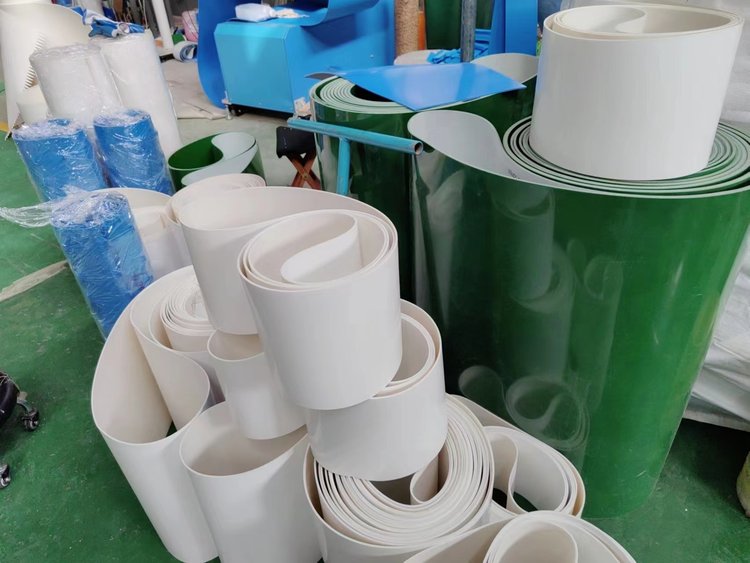
“FDA-approved conveyor belt” is a common purchasing term, but it can create the wrong expectation. The U.S. Food and Drug Administration regulates substances used in food-contact materials under defined authorizations and conditions. It does not normally issue a blanket approval for every finished conveyor belt carrying a familiar material name or color.
Buyers therefore need to verify the exact belt construction, supplier, food type, temperature, contact duration, and regulatory basis. This guide explains what FDA compliance means, compares common food-contact conveyor belt types, and identifies the documentation required before a belt is placed into food production.
Key Takeaways
- “FDA-compliant” is usually more accurate than “FDA-approved” for a finished conveyor belt.
- Compliance depends on the exact substances, supplier, intended use, and contact conditions.
- Polyurethane, PVC, silicone, rubber, plastic, and metal belts are not automatically food-safe.
- Regulatory documentation does not replace hygienic design, sanitation, or process validation.
What Is an FDA-Approved Conveyor Belt?
An FDA-approved conveyor belt is a market term for a belt intended to contact food while meeting applicable U.S. food-contact requirements. The more accurate description is usually an FDA-compliant conveyor belt or a belt made from substances authorized for the stated food-contact use.
FDA terminology distinguishes a food contact substance, a food contact material, and a food contact article. A substance may be a polymer, additive, pigment, antioxidant, or processing aid. Those substances form a material, and the material becomes a finished article such as a belt, tray, hose, or container (U.S. Food and Drug Administration, Food Ingredient and Packaging Terms).
The finished belt may contain several layers and components. A fabric-reinforced belt can include a top cover, carcass, skim layers, bottom cover, edge treatment, splice materials, pigments, and additives. A modular belt contains molded modules, hinge rods, and sometimes rubber inserts. Compliance cannot be established from the top-cover polymer alone.
FDA states that the overall regulatory status of a food-contact material is dictated by the status of each individual substance reasonably expected to migrate into food. That substance must have an appropriate regulatory basis, such as a Title 21 regulation, effective Food Contact Substance Notification, prior sanction, GRAS basis, or Threshold of Regulation exemption (U.S. Food and Drug Administration, Determining the Regulatory Status of Components of a Food Contact Material).
Authorization also has boundaries. It may apply only to a named substance, manufacturer, purity specification, food category, temperature, duration, or other condition. A supplier’s statement should connect the exact belt product to those conditions rather than offering a general claim that “polyurethane is FDA approved.”
What FDA Requirements Apply to Conveyor Belt Materials?
Food-contact conveyor belt compliance begins with the Federal Food, Drug, and Cosmetic Act and applicable FDA authorizations. Many indirect food additives appear in Title 21 of the Code of Federal Regulations, especially Parts 174 through 179. Part 177 covers polymers, while other parts address adhesives, coatings, paper, production aids, sanitizers, and irradiation.
The regulatory basis must cover the identity and intended use of each relevant substance. FDA advises reviewing authorizations as three connected elements: substance identity, specifications such as purity or physical properties, and limitations on conditions of use. Finding a similar polymer name in a regulation isn’t enough if the formulation or intended use falls outside those limitations.
Repeated-use rubber articles may be evaluated under 21 CFR 177.2600 when the formulation and use meet that section. The regulation identifies permitted ingredients, compositional requirements, and extractive limits for rubber articles intended for repeated use. It does not mean every rubber belt complies automatically (Electronic Code of Federal Regulations, 21 CFR 177.2600 Rubber Articles Intended for Repeated Use).
Polymer-based belts may rely on other sections in Part 177 or on an effective Food Contact Substance Notification. FDA’s inventory helps users locate substances listed in 21 CFR and their authorized uses. Separate inventories cover FCNs and Threshold of Regulation exemptions (U.S. Food and Drug Administration, Inventory of Food Contact Substances Listed in 21 CFR).
An FCN requires particular care. FDA explains that an effective notification applies to the identified manufacturer or supplier, substance, and conditions of use. It is not automatically available to an identical substance made by another supplier. A belt declaration relying on an FCN should therefore identify a traceable authorized supply chain.
Food type and operating condition are also part of compliance. FDA tables distinguish aqueous, acidic, fatty, dairy, alcoholic, bakery, and dry foods. Conditions range from high-temperature sterilization and hot filling to room-temperature, refrigerated, frozen, reheated, irradiated, or high-temperature cooking uses (U.S. Food and Drug Administration, Food Types and Conditions of Use for Food Contact Substances).
Migration or extractive testing may support compliance where the applicable authorization requires it. Test simulant, time, temperature, surface area, and analytical limits must represent the authorized condition. A passing result under cold, dry contact doesn’t establish suitability for hot, fatty food or repeated aggressive cleaning.
Finally, the belt must comply under good manufacturing practice. Unintended contaminants, formulation changes, incorrect curing, exposed carcass, unsuitable splice adhesive, or undocumented repair material can undermine the declared construction. The belt manufacturer is responsible for ensuring that its food-contact material meets applicable specifications and limitations.
What Are the Main Types of FDA-Compliant Conveyor Belts?
Common food-contact belt categories include polyurethane, PVC, silicone, rubber, modular plastic, and metal conveyor belts. Each category contains both compliant and noncompliant products. Buyers should treat the material name as a starting point and verify the exact grade, color, reinforcement, fabrication, and intended use.
Polyurethane Conveyor Belts
Polyurethane belts are widely used for bakery products, confectionery, meat, seafood, produce, packaging, and general food handling. Fabric-reinforced PU belts provide a thin flexible conveyor surface. Homogeneous thermoplastic polyurethane belts remove exposed fabric from the belt body and can use welded cleats or guides.
PU offers abrasion resistance, clean running, and useful resistance to fats, oils, and cleaning agents in selected formulations. Performance varies between polyester- and polyether-based grades and among hardness levels. Hydrolysis, microbial exposure, temperature, chemicals, splice materials, and food type must match the supplier’s declaration.
PVC Conveyor Belts
PVC conveyor belts are economical and available with smooth, rough, glossy, matte, or patterned surfaces. They are common in bakery, confectionery, dry food, packaged food, and general processing. Fabric plies provide strength while PVC covers create the product-contact surface.
Not every PVC formulation is suitable for direct food contact. Plasticizers, stabilizers, pigments, and other additives affect regulatory status. Temperature and fatty-food exposure can be especially important because the intended conditions influence migration. Buyers should verify whether the declared use covers direct contact, the relevant food type, and the actual operating temperature.
Silicone Conveyor Belts
Silicone belts and silicone-coated fabrics provide release, flexibility, and temperature capability for selected baking, confectionery, dough, cooling, sealing, and sticky-product applications. Their low surface energy can reduce product adhesion without applying release agents to the process.
Silicone is not automatically compliant because formulation, catalyst, pigment, filler, coating weight, curing, and substrate all matter. Thin coatings may wear and expose the reinforcing fabric. Silicone can also have lower tear and abrasion resistance than tougher thermoplastic surfaces, so sharp products and small pulleys require review.
Rubber Conveyor Belts
Rubber conveyor belts use elastomer covers over fabric or other reinforcement. Food-contact compounds may be developed for oily foods, wet processing, elevators, heavy products, or applications requiring grip and impact resistance. White or light-colored rubber is common, but color alone proves nothing about composition.
A supplier may cite 21 CFR 177.2600 for an appropriate repeated-use rubber construction. The finished compound must meet the section’s composition and extractive requirements under applicable conditions. Splices, exposed edges, repairs, and cleaning chemicals also need evaluation. General industrial rubber belting should never be assumed suitable for food contact.
Modular Plastic Conveyor Belts
Modular belts consist of interlocking molded plastic modules connected by hinge rods. Common resin families include acetal, polypropylene, polyethylene, and specialty polymers. Open-grid, flush-grid, perforated, raised-rib, and solid-top designs support drainage, cooling, inspection, washing, and package handling.
The resin, pigment, additive package, hinge rod, friction insert, edge module, and accessory must all suit the intended contact. Modular construction simplifies local module replacement but creates hinges and joints that require effective cleaning access. Some chemicals can attack hinge rods or cause environmental stress cracking in plastic modules.
Metal Conveyor Belts
Metal conveyor belts include wire mesh, balanced weave, eye-link, flat-wire, and plate constructions. Stainless steel is common in baking, frying, cooking, cooling, freezing, washing, and product transfer because it tolerates heat and provides an open structure for air or liquid flow.
Metal food-contact suitability depends on alloy, surface condition, fabrication, welds, lubricants, and process environment. A stainless label alone doesn’t establish resistance to every salt, acid, cleaner, or temperature. Metal belts also require hygienic equipment design so joints, supports, and inaccessible areas do not trap food residue.
Where Are Food-Contact Conveyor Belts Used?
Bakery and confectionery lines use PU, PVC, silicone, modular plastic, and metal belts for dough handling, proofing, baking, cooling, chocolate, candy, and packaging. Sticky products may need release surfaces, while ovens require metal or high-temperature constructions. Flour, sugar, fats, and cleaning methods influence surface and edge design.
Meat, poultry, and seafood processing commonly requires wet-cleaning capability, resistance to fats and proteins, accessible surfaces, and control of exposed fabric. Homogeneous PU and modular plastic belts are common candidates. Cutting, deboning, freezing, and portioning introduce different loads, temperatures, and sanitation risks.
Dairy processing uses belts for cheese, butter, curd, packaged products, and secondary handling. Fat contact, salt, moisture, refrigeration, and cleaning chemicals can affect polymers and joints. Product-contact declarations must cover the food type and temperature rather than only dry packaged goods.
FDA-Compliant Conveyor Belt Material Comparison
| Belt Material | Typical Food Uses | Main Strength | Main Limitation | Documentation Needed |
|---|---|---|---|---|
| Polyurethane | Meat, bakery, produce, confectionery | Abrasion resistance and fabrication options | Hydrolysis and chemical performance vary | Product declaration, regulatory basis, use conditions |
| PVC | Bakery, dry food, packaged products | Economical with many surfaces | Plasticizer, fat, and temperature limits | Formulation-specific declaration and contact limits |
| Silicone | Sticky, warm, bakery, and confectionery products | Release and temperature capability | Tear and coating wear | Coating and substrate compliance documentation |
| Rubber | Heavy food handling and oily products | Grip, impact resistance, and durability | Compound and extractive requirements | Applicable 21 CFR basis and test statement |
| Modular plastic | Meat, produce, dairy, drainage, packaging | Replaceable modules and positive drive | Hinges require effective cleaning | Resin, pigment, rod, and accessory declarations |
| Metal | Baking, frying, freezing, cooling, washing | Heat resistance and open-area options | Corrosion, joints, and product marking | Alloy, fabrication, lubricant, and sanitary-use records |
“Food grade” is not a complete specification. The phrase may describe regulatory status, physical design, cleanability, or simply marketing positioning. A useful declaration states the exact article, applicable authorization, food types, time and temperature limitations, and any restrictions on repeated use.
How Do You Verify FDA Compliance Before Buying?
Begin with the exact belt identification. Record the manufacturer, product family, cover compound, color, thickness, reinforcement, underside, profiles, guides, edge treatment, and splice. A declaration for a similar blue PU belt or resin family does not establish compliance for the ordered construction.
Ask the supplier to identify the regulatory basis. This may include specific sections of 21 CFR, an effective FCN, prior sanction, GRAS basis, or Threshold of Regulation exemption. If an FCN is cited, verify that the substance comes from the manufacturer or supplier covered by that notification.
Define the intended food and conditions of use. State whether contact is direct or incidental, repeated or single-use, and whether the food is aqueous, acidic, fatty, alcoholic, dairy, bakery, or dry. Include maximum product temperature, contact duration, refrigeration, freezing, heating, and cleaning cycles.
Request a current declaration of compliance or letter of guaranty for the exact belt. FDA specifically notes that customers may ask manufacturers for a letter of guaranty certifying that a product is acceptable for its intended food-contact use (U.S. Food and Drug Administration, Determining the Regulatory Status of Components of a Food Contact Material).
Review every food-contact component. A compliant cover can be undermined by an undocumented adhesive, mechanical fastener, repair material, exposed fabric edge, cleat, sidewall, or splice. For modular belts, include modules, rods, plugs, rubber inserts, and accessories. Confirm whether cutting or fabrication changes the declared article.
Check cleaning compatibility separately. Regulatory compliance does not guarantee resistance to alkaline foam, acid cleaner, chlorine, peracetic acid, steam, pressure washing, or repeated thermal cycling. Obtain chemical, concentration, temperature, and contact-time limits. Validate that the sanitation method reaches hinges, supports, undersides, and other product-residue zones.
Maintain traceability. Store the supplier declaration, belt part number, batch or lot where available, drawing, splice method, regulatory references, revision date, and approved use conditions. Reconfirm compliance after formulation, supplier, color, construction, or process changes. An old declaration should not be assumed to cover a redesigned product.
Frequently Asked Questions
Does the FDA approve conveyor belts?
FDA generally authorizes food-contact substances and their intended uses rather than issuing a universal approval for finished conveyor belt models. “FDA-compliant conveyor belt” is usually more accurate. The complete article must use appropriately authorized substances within their specifications and conditions of use.
Is every white or blue conveyor belt food-safe?
No. Color helps visibility or supports plant conventions, but it does not prove regulatory status. Pigments are themselves part of the formulation. Verify the exact belt product, supplier declaration, food type, contact temperature, splice, edges, and all other food-contact components.
Does FDA compliance mean a belt is hygienic?
No. Material compliance addresses whether substances are legally suitable for the intended food contact. Hygiene also depends on cleanable design, surface condition, joints, edges, drainage, access, sanitation procedures, and microbial control. A compliant material can still be installed in an unhygienic conveyor.
Are FDA-compliant belts also EU-compliant?
Not automatically. U.S. and European food-contact frameworks use different legal instruments, testing approaches, declarations, and national requirements. A supplier must provide separate documentation for applicable EU rules and intended conditions. One market’s declaration should not be treated as evidence for another.
Conclusion
“FDA-approved conveyor belt” is a useful search phrase but an incomplete compliance claim. The real question is whether every relevant substance in the exact belt construction is authorized for the intended food, temperature, duration, and repeated-use conditions.
Compare polyurethane, PVC, silicone, rubber, modular plastic, and metal belts by both process performance and documented regulatory status. Then verify splices, edges, accessories, cleaning compatibility, and traceability. A color or material name cannot replace a current, product-specific declaration.
Sources
- U.S. Food and Drug Administration, Determining the Regulatory Status of Components of a Food Contact Material, retrieved 2026-07-22.
- U.S. Food and Drug Administration, Understanding How FDA Regulates Substances that Come into Contact with Food, retrieved 2026-07-22.
- U.S. Food and Drug Administration, Food Ingredient and Packaging Terms, retrieved 2026-07-22.
- U.S. Food and Drug Administration, Food Types and Conditions of Use for Food Contact Substances, retrieved 2026-07-22.
- U.S. Food and Drug Administration, Inventory of Food Contact Substances Listed in 21 CFR, retrieved 2026-07-22.
- Electronic Code of Federal Regulations, 21 CFR Part 177 Indirect Food Additives: Polymers, retrieved 2026-07-22.
- Electronic Code of Federal Regulations, 21 CFR 177.2600 Rubber Articles Intended for Repeated Use, retrieved 2026-07-22.