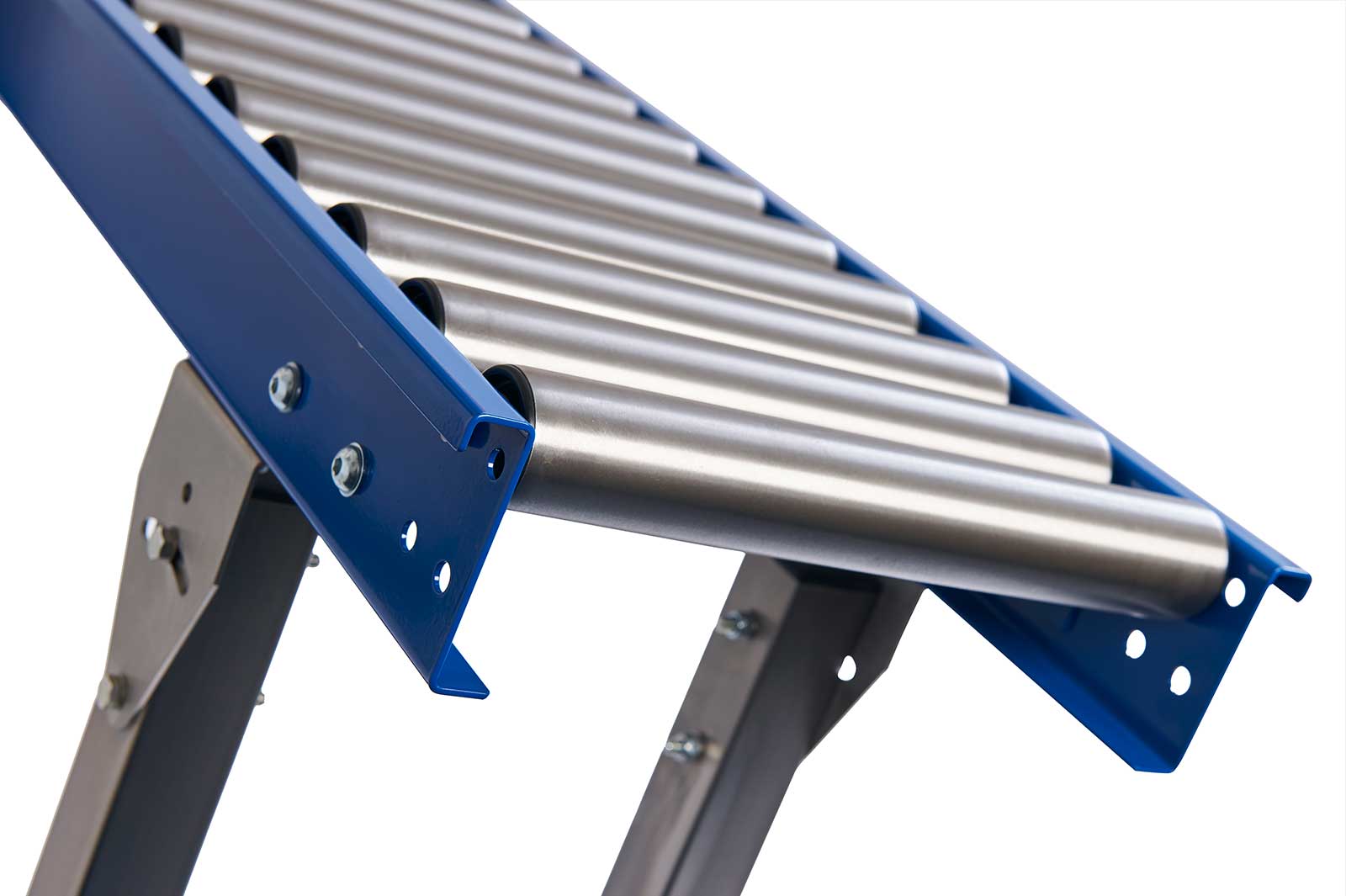
Conveyor rollers support and move cartons, totes, pallets, components, or a conveyor belt. They may rotate freely, receive power from a belt or chain, contain their own motor, guide products through curves, or absorb impact beneath a bulk-material loading zone.
The correct roller must fit the load, conveyor width, spacing, speed, drive method, and environment. Tube diameter alone is not enough. Shaft style, bearings, wall thickness, surface material, and mounting dimensions also affect performance. This guide compares the main conveyor roller types, materials, applications, and selection factors.
Key Takeaways
- Gravity, belt-driven, chain-driven, and motorized rollers serve different unit-handling duties.
- Tapered rollers guide products through curves, while idlers support bulk conveyor belts.
- Diameter, wall thickness, spacing, shaft, bearings, and material determine roller suitability.
- Replacement rollers must match installation dimensions and drive geometry, not only conveyor width.
What Is a Conveyor Roller?
A conveyor roller is a rotating cylindrical component that supports a product or moving conveyor belt. In a unit-handling conveyor, multiple rollers are mounted between parallel frames. Cartons, totes, pallets, drums, and components travel directly on the roller tubes. Movement may come from gravity, manual force, or a powered drive.
A typical roller contains a tube, shaft, bearings, and bearing housings. Powered versions add grooves, sprockets, pulleys, or internal motors. The tube carries the load and contacts the product. Bearings allow rotation around the shaft, while the shaft ends locate the roller in holes, slots, brackets, or mounting plates.
The term also covers idlers used beneath a conveyor belt. Carrying idlers support the loaded belt, return idlers support the empty return run, and impact rollers or impact idlers cushion loading zones. These components do not normally carry cartons directly, so their geometry and selection standards differ from unit-handling rollers.
Interroll distinguishes gravity rollers from driven rollers and offers tube materials including zinc-plated steel, stainless steel, and PVC. Its published roller range spans multiple diameters and constructions for straight conveyors, curves, and powered systems (Interroll, Rollers and Wheels).
What Are the Main Types of Conveyor Rollers?
The main conveyor roller types are gravity, belt-driven, chain-driven, motorized, tapered, impact, carrying and return idlers, and coated or grooved rollers. Some categories describe how the roller receives power, while others describe its shape, surface, or function. A roller can therefore belong to more than one category.
Gravity Rollers
Gravity rollers rotate freely without a mechanical drive. Products move because the conveyor slopes downward or because an operator pushes them. They are common in packing stations, temporary storage lanes, order-picking areas, truck loading, and connections between powered conveyor sections.
Low rolling resistance helps light products restart, but the slope must control heavier loads safely. Mixed product weights can travel at different speeds. Interroll’s Series 1100, for example, is designed for light to medium gravity and push conveyor duties, with product-specific limits for load, speed, temperature, and environment (Interroll, Series 1100 Gravity Conveyor Roller).
Belt-Driven Rollers
Belt-driven rollers receive power from a flat belt, round belt, timing belt, or multi-rib belt. The drive may contact the underside of each roller or connect adjacent rollers through grooves and individual belt loops. These systems move cartons and totes at controlled speeds with relatively quiet operation.
Round-belt drives are common in light-duty conveyors, while PolyVee or similar multi-rib drives transmit more force within compact spaces. Flat-belt systems can drive many rollers from one continuous belt. Belt tension, groove position, roller spacing, contamination, and product load determine whether the rollers transmit enough torque without excessive slip.
Chain-Driven Rollers
Chain-driven rollers use sprockets attached to one or both tube ends. Roller chain connects the rollers and transfers power from a geared motor. The positive mechanical drive suits pallets, drums, racks, steel containers, and heavy products that demand more torque than many light belt-driven systems provide.
Single- or double-sprocket arrangements support different drive layouts. Chains and sprockets tolerate demanding loads but add noise, weight, lubrication needs, guarding requirements, and wear points. Ashland Conveyor’s chain-driven live roller guidance shows how roller gauge, frame construction, centers, and drive arrangement are selected together for heavy unit handling (Ashland Conveyor, Chain-Driven Live Roller Selection Guide).
Motorized Rollers
A motorized roller contains an electric motor and gearbox inside its tube. It can drive one conveyor zone directly and transmit power to nearby carrying rollers through belts. Modern low-voltage systems use sensors and controls to run only occupied zones, supporting zero-pressure accumulation and decentralized conveyor layouts.
Motorized rollers reduce exposed drive components and simplify zone control, but each model has defined torque, speed, duty cycle, temperature, and cable requirements. Interroll offers 24 or 48 VDC RollerDrive components with matching rollers, PolyVee belts, controls, and power supplies (Interroll, RollerDrive EC5000).
Tapered Rollers
Tapered rollers have a changing outside diameter across their width. In a curve, the outer side of a product must travel farther than the inner side. The tapered shape creates different surface speeds across the roller, helping maintain product orientation and reduce side-guide pressure.
The taper must match conveyor radius, roller angle, frame width, and product position. Some designs use a genuinely tapered tube, while others add molded taper sleeves over a straight roller. Tapered rollers may be gravity-driven or powered through belts, chains, or other drive heads.
Impact Rollers
Impact rollers support a conveyor belt where bulk material falls onto the loading zone. Rubber rings or resilient discs around the roller tube absorb part of the impact and protect the belt carcass. They are used in mining, aggregates, recycling, ports, and other bulk-material systems.
Impact rollers do not eliminate the need for controlled loading. Drop height, material lump size, belt speed, skirt design, spacing, and support structure determine impact severity. Heavy loading may require impact beds or cradles rather than rollers alone. Ring material must also resist abrasion, oil, heat, and the surrounding environment.
Carrying and Return Idlers
Carrying idlers support the loaded side of a belt conveyor. Flat idlers support a flat belt, while three- or five-roll troughing sets shape a bulk-material belt into a trough. Training or tracking idlers may respond to belt movement, although correct alignment and loading remain the primary controls.
Return idlers support the empty belt on its path back to the tail pulley. They may use smooth tubes, rubber discs, or spiral forms intended to reduce material buildup. Idler diameter, bearing life, shell thickness, spacing, trough angle, belt width, speed, and load must follow the conveyor design.
Coated and Grooved Rollers
Coated rollers add rubber, polyurethane, PVC, or other surfaces to adjust grip, noise, marking, wear, or product protection. Soft covers can cushion delicate goods, while high-friction lagging improves drive. Conductive or static-dissipative surfaces may support electronics, film, or dry production environments when properly grounded.
Grooved rollers contain formed or machined channels for round belts, timing belts, or other drive elements. Groove diameter and position must match the conveyor’s belt path. A replacement with the wrong groove location can misalign the drive, interfere with the frame, or change belt tension.
Which Conveyor Roller Materials Are Available?
Roller tube material affects load capacity, inertia, corrosion, noise, cleanliness, surface friction, and cost. Common choices include zinc-plated steel, stainless steel, aluminum, PVC, and engineering plastics. Coatings or sleeves can modify a base tube without changing the complete roller construction.
Zinc-plated steel is widely used for general industrial conveyors because it combines strength, availability, and moderate cost. Tube diameter and wall thickness determine stiffness and resistance to denting. The zinc coating provides limited corrosion protection but is not equivalent to stainless steel in repeated washdown or corrosive service.
Stainless steel suits wet, hygienic, or corrosive environments. Food and pharmaceutical applications may require stainless tubes, shafts, and suitable bearing or seal materials. Stainless construction still needs a defined grade, surface finish, chemical compatibility, and cleaning method. Interroll identifies stainless rollers for moist and hygiene-critical applications within its range (Interroll, Rollers and Wheels).
PVC and engineering-plastic rollers are light, quiet, and corrosion-resistant in suitable environments. They are useful for light cartons, food-related handling, and non-marking applications. Temperature, chemical exposure, static behavior, tube deflection, and impact limit their use. PVC is not a default choice for heavy pallets.
| Roller Material | Main Strength | Typical Uses | Main Limitation |
|---|---|---|---|
| Zinc-plated steel | Strength and economical availability | General cartons, totes, and industrial handling | Limited corrosion resistance |
| Stainless steel | Moisture and chemical resistance | Food, washdown, pharmaceutical, and corrosive areas | Higher cost and rotating mass |
| Aluminum | Low weight and low inertia | Light products and rapid starts | Easier to dent or wear |
| PVC or plastic | Quiet, light, and non-corroding | Light cartons and moist environments | Lower stiffness and temperature limits |
| Rubber or PU coating | Grip, cushioning, and product protection | Inclines, delicate goods, and driven rollers | Coating wear and chemical limits |
Where Are Different Conveyor Rollers Used?
Warehouses and distribution centers use gravity, belt-driven, and motorized rollers for cartons, totes, and parcels. Gravity sections support packing and manual movement. Powered zones transport and accumulate products between scanners, labelers, sorters, and shipping areas. Low-voltage motorized rollers are especially useful where independent zone control is required.
Food and beverage plants use stainless steel or suitable plastic rollers in packaging, container handling, and washdown areas. The complete roller matters: tube, shaft, bearing housing, seal, lubricant, drive component, and coating must suit the environment. A stainless tube with unsuitable bearings may still fail during cleaning.
Mining and bulk-material conveyors use carrying, troughing, impact, and return idlers rather than product-contact unit-handling rollers. These idlers support the belt and material across long distances. Dust sealing, bearing life, shell wear, alignment, rotating resistance, and maintenance access strongly influence operating cost.
Curved conveyors use tapered rollers or tapered sleeves to control orientation. Accumulation conveyors may use friction-driven rollers or independently controlled motorized zones. The right design depends on whether products may touch, how easily they restart, and whether downstream equipment requires a defined gap.
Conveyor Roller Type Comparison
| Roller Type | Drive Method | Best Use | Main Advantage | Main Limitation |
|---|---|---|---|---|
| Gravity | Slope or manual push | Packing, storage, and simple transfer | Low complexity and no motor | Speed varies with load and slope |
| Belt-driven | Flat, round, timing, or ribbed belt | Cartons and totes | Quiet controlled transport | Belt slip and tension limits |
| Chain-driven | Roller chain and sprockets | Pallets and heavy unit loads | Positive high-torque drive | Noise, lubrication, and guarding |
| Motorized | Internal motor and gearbox | Zoned accumulation | Compact decentralized control | Model-specific torque and duty limits |
| Tapered | Gravity or powered | Curved conveyors | Maintains product orientation | Must match curve geometry |
| Impact | Rotates beneath conveyor belt | Bulk loading zones | Cushions belt impact | Not sufficient for every impact load |
| Carrying or return idler | Belt contact | Bulk belt support | Supports long conveyor runs | Requires alignment and sealing |
| Coated or grooved | Depends on base roller | Grip, protection, or belt connection | Tailored surface or drive interface | Cover and groove compatibility |
How Do You Select the Correct Conveyor Roller?
Begin with product dimensions and weight. Record the smallest and largest footprint, maximum individual weight, base material, rigidity, and any runners or feet. The roller must support concentrated contact without excessive tube deflection, shaft bending, bearing load, or product instability.
Choose roller spacing so the product remains supported throughout travel. A common design rule is to keep at least three rollers beneath a rigid unit load, but this is only a starting point. Flexible cartons, damaged pallets, narrow runners, transfers, and impact may require closer spacing or a continuous belt surface.
Roller diameter and wall thickness affect capacity and rolling behavior. Larger diameters generally provide greater stiffness, lower bearing speed for a given surface speed, and easier movement over small gaps. They also increase cost, weight, and conveyor height. Use the manufacturer’s load table at the actual between-frame width.
Confirm every ordering dimension. Between-frame width is the clear distance between side frames, but suppliers may distinguish installation length, tube length, shaft length, and reference length. Ashland notes that its rollers and conveyors are specified using between-frame dimensions, while material, gauge, shaft size, and bearings provide additional combinations (Ashland Conveyor, Roller Selection Guide).
Match the shaft and mounting style. Options include spring-loaded shafts, female-threaded ends, milled flats, hex shafts, and fixed axles. The shaft diameter and end geometry must fit the frame. Powered replacements must also match sprocket tooth count, groove position, pulley profile, and drive-side orientation.
Define speed, acceleration, duty cycle, and drive method. A roller that carries a static pallet may not suit frequent starts or high conveyor speed. Motorized rollers need adequate torque and thermal duty. Belt-driven systems need sufficient traction, while chain-driven systems require compatible chain pitch, alignment, lubrication, and guarding.
Finally, match the environment. Specify moisture, cleaning chemicals, food contact, dust, abrasion, temperature, static control, noise, and acceptable product marking. Select tube, shaft, bearings, seals, grease, coating, and drive components as one assembly. A single unsuitable component can determine the roller’s service life.
Frequently Asked Questions
How many conveyor rollers should support a product?
At least three rollers should commonly support a rigid unit load, including during entry and discharge. More may be needed for flexible cartons, damaged pallets, heavy loads, narrow runners, or impact. Divide the product’s shortest travel-direction length by the proposed roller pitch, then verify load distribution and transfers.
What roller diameter should you choose?
Choose diameter from the product weight, roller span, speed, impact, and required starting force. Larger rollers are generally stiffer and easier for products to roll across, but they add cost and mass. Use the supplier’s capacity data for the exact tube, shaft, bearing, and between-frame width.
Are PVC rollers suitable for heavy loads?
PVC rollers are generally selected for light or medium products where low weight, quiet running, or corrosion resistance matters. They can deflect or suffer impact damage under heavy loads. A rated steel or stainless roller is usually more appropriate for pallets and concentrated industrial loads.
What is the difference between a conveyor roller and an idler?
A conveyor roller often carries a carton, tote, pallet, or component directly. An idler usually supports and shapes a moving conveyor belt. The terms sometimes overlap, but bulk belt idlers use different frames, spacing, trough angles, sealing, and load calculations from unit-handling rollers.
Conclusion
Conveyor rollers differ by drive, shape, surface, material, and function. Gravity rollers simplify manual transport, belt-driven and motorized rollers handle cartons, chain-driven rollers move heavy units, tapered rollers guide curves, and idlers support bulk conveyor belts.
Select the roller as a complete assembly. Product size, load distribution, spacing, diameter, wall thickness, shaft, bearings, drive geometry, mounting dimensions, speed, and environment all matter. Matching only tube diameter and length can produce a roller that fits physically but fails operationally.
Sources
- Interroll, Rollers and Wheels, retrieved 2026-07-21.
- Interroll, Series 1100 Gravity Conveyor Roller, retrieved 2026-07-21.
- Interroll, Conveyor Roller Catalog, retrieved 2026-07-21.
- Interroll, RollerDrive EC5000, retrieved 2026-07-21.
- Ashland Conveyor, Roller Selection Guide, retrieved 2026-07-21.
- Ashland Conveyor, Chain-Driven Live Roller Selection Guide, retrieved 2026-07-21.
- Rexnord, Conveyor Glossary, retrieved 2026-07-21.