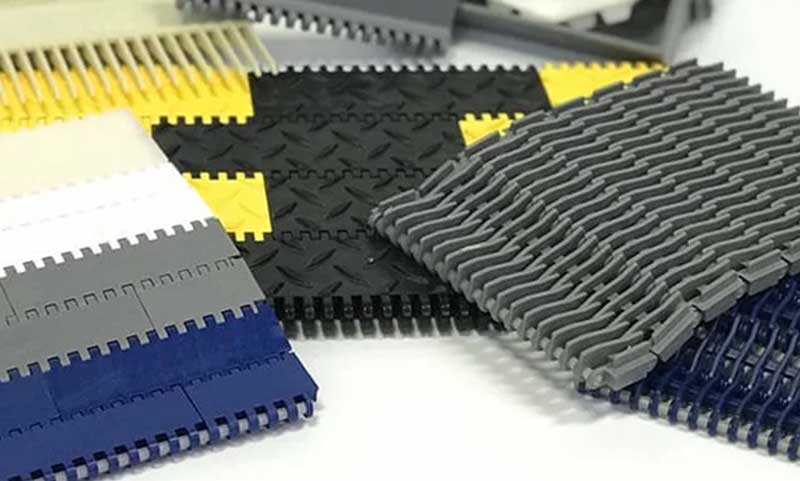
Abrasion-resistant plastic modular belts are assembled from molded polymer modules and hinge rods selected to reduce wear from products, debris, conveyor supports, and repeated articulation. They are used where ordinary modules lose thickness, develop elongated hinge holes, or shed material too quickly.
No plastic belt is wear-proof. Abrasive particles can attack the top, underside, hinges, rods, sprockets, edges, and wear strips through different mechanisms. This guide explains where wear occurs, compares common belt materials, and outlines the applications, benefits, limitations, and selection factors that determine service life.
Key Takeaways
- Abrasion resistance depends on the exact resin, module design, rods, sprockets, and wear strips.
- Acetal, polyketone, polyethylene, polypropylene, polyamide, and PBT serve different environments.
- Dry grit, wet slurry, product impact, and curve pressure create different wear mechanisms.
- The most durable solution minimizes contaminant entry and sliding force across the complete conveyor.
What Is an Abrasion-Resistant Plastic Modular Belt?
An abrasion-resistant plastic modular belt is a positively driven conveyor belt built from interlocking injection-molded modules. Hinge rods connect the rows, allowing the belt to articulate around sprockets. The belt can use flat, perforated, flush-grid, raised-rib, friction-top, flighted, or curved configurations.
The term “abrasion-resistant” describes a material and design intended to reduce wear under defined conditions. It does not mean the belt will resist every abrasive product, cleaner, temperature, or load. A material that performs well against dry cardboard dust may behave differently in wet sand, salt, bone fragments, or metal chips.
Wear resistance can be built into the resin, module geometry, or both. Hard and low-friction materials may resist scratching and sliding wear. Tougher polymers may prevent cracks and fragments after impact. Large hinge bearing areas, protected edges, robust rods, and accurate sprocket engagement can distribute load and slow dimensional change.
Modular construction allows individual rows or damaged modules to be replaced rather than discarding an entire endless belt. It also provides positive sprocket drive and configurable widths. Intralox notes that straight-running modular belts are available in hundreds of series, styles, materials, and accessories, including options developed for abrasion resistance (Intralox, Straight-Running Modular Belts).
The complete conveyor still governs life. Belt pull, speed, load, support arrangement, sprocket alignment, edge clearance, sanitation, and debris removal can matter as much as the polymer name. A premium module running over contaminated or unsuitable wear strips can fail faster than a standard material in a controlled design.
Where Does Abrasion Occur in a Modular Belt System?
Abrasion can occur on every surface where the belt rubs against products, trapped particles, or conveyor components. Intralox identifies the top and bottom surfaces, rods, sprockets, and hinges as vulnerable areas when abrasive particles enter a conveyor (Intralox, Straight-Running Modular Belts). Each location produces different symptoms and remedies.
The underside slides over wear strips, support rails, or beds. High belt pull increases contact pressure, and contaminated rails turn loose particles into grinding media. Misaligned or widely spaced supports can concentrate load. In curves, radial force pushes the belt against inner guides and raises pressure on sliding surfaces.
Hinge eyes and rods experience articulation plus bearing pressure. Fine particles can enter the joint and abrade both components during every sprocket cycle. Hinge holes become elongated, pitch increases, and the belt may no longer engage the sprocket correctly. Wet slurry can transport particles deep into joints instead of washing them away.
What Are the Main Types of Abrasion-Resistant Modular Belts?
The main material families used for abrasion-resistant modular belts include modified acetal, polyketone, polyethylene, polypropylene, polyamide, PBT, and proprietary impact-resistant blends. Their performance depends on formulation and module design, so generic resin comparisons should guide investigation rather than replace manufacturer test data.
Abrasion-Resistant Acetal Belts
Acetal, also called POM, combines stiffness, strength, dimensional stability, and low sliding friction. It is widely used in modular belts for container handling, packaging, industrial conveying, and selected food processes. Its rigidity supports accurate sprocket engagement and relatively low belt pull on suitable wear strips.
Manufacturers offer standard, low-friction, antistatic, electrically conductive, or abrasion-focused acetal grades. Acetal can perform well in dry sliding applications, but strong acids, oxidizing chemicals, chlorine exposure, impact, and prolonged hot-water or steam conditions may limit specific formulations.
Polyketone Modular Belts
Polyketone has emerged as a high-performance modular belt material for applications requiring a combination of abrasion, impact, chemical, and hydrolysis resistance. It is used in food processing and other demanding environments where conventional acetal can experience wear, chemical attack, or brittle damage.
Performance claims remain product-specific. Habasit reports that its WHI polyketone material showed 40% less wear and 70% lower scratch depth than its tested POM reference under controlled wet and dry tests (Habasit, Robust and Food-Safe WHI Material). Those figures should not be applied to every polyketone or operating condition.
Intralox similarly positions its PK material for direct food contact and states that it offers greater impact, chemical, and abrasion resistance than acetal within its product comparison (Intralox, Food-Safe Modular Plastic Belting). Buyers should compare supplier ratings, temperature, regulatory status, friction, and available belt series.
Polyethylene and Polypropylene Belts
Polyethylene modular belts offer low density, good release, impact resistance at suitable temperatures, and resistance to many acids and alkalis. They are common in food, frozen products, produce, and wet processing. Their softer surface can tolerate impact but may wear or deform under high sliding load and elevated temperature.
Polypropylene provides greater stiffness and higher temperature capability than many polyethylene grades. It also resists many chemicals and is used in food processing, packaging, and industrial washing. Low-temperature impact performance can be a limitation, and abrasive sliding behavior depends strongly on grade and support conditions.
Polyamide and PBT Modular Belts
Polyamide, or nylon, offers strength, fatigue resistance, and useful wear behavior in dry applications. Some grades are used where temperature or mechanical demands exceed general-purpose polyolefins. Moisture absorption changes dimensions and mechanical properties, so wet service requires specific product data.
PBT, or polybutylene terephthalate, can provide stiffness, dimensional stability, and strong abrasion performance in selected modular belt products. Forbo lists PBT as having very good abrasive resistance while warning against hot-water use above the stated limit for its material (Forbo Movement Systems, Siegling Prolink Plastic Modular Belting).
Glass-reinforced high-temperature polymers may increase stiffness and temperature capability, but fillers can affect counterface wear, food-contact status, impact behavior, and machining. Supplier-specific chemical and wear-strip guidance is essential when moving beyond standard materials.
Heavy-Duty and Impact-Resistant Modular Belts
Some abrasion problems are actually impact or structural failures. Heavy products, falling parts, bones, sharp edges, or maintenance mishandling can crack modules before gradual wear becomes the main issue. Tough proprietary blends, thicker links, reinforced edges, and robust rod retention address these combined loads.
Intralox describes its Tough Belt as an ultra-high-performance option for extreme impact, abrasion, and cutting in food applications. Its Heavy-Duty Edge design uses thicker links and a protected edge to reduce breakage and wear (Intralox, Food-Safe Modular Plastic Belting). These claims apply to named constructions, not all thick modular belts.
Friction-top belts require a separate review because the gripping insert may be the first component to wear. Forbo introduced a harder friction-top module in 2021 to improve wear resistance while retaining product grip (Forbo Movement Systems, Siegling Prolink Friction Top, 2021). Higher hardness can change friction, impact cushioning, and product marking.
Abrasion-Resistant Modular Belt Material Comparison
The table summarizes common tendencies. Actual abrasion resistance can reverse when particle type, moisture, pressure, speed, or counterface changes. Compare tested belt grades in conditions that resemble the application.
| Belt Material | Abrasion Performance | Best Environment | Main Advantage | Main Limitation |
|---|---|---|---|---|
| Modified acetal | Strong in many dry sliding duties | Dry packaging and container handling | Stiff, dimensionally stable, low friction | Chemical and impact limits vary |
| Polyketone | High in selected wet and dry applications | Food, wet processing, impact and chemical exposure | Combines wear, impact, and hydrolysis resistance | Higher cost and supplier-specific availability |
| Polyethylene | Moderate and grade-dependent | Cold, wet, impact-prone environments | Light, good release, chemical resistance | Lower stiffness and heat capability |
| Polypropylene | Moderate and grade-dependent | Chemical exposure and warmer processing | Stiffer and warmer-running than PE | Low-temperature impact can be limited |
| Polyamide | Strong in selected dry applications | Dry industrial and higher-temperature duties | Strength, fatigue, and wear behavior | Moisture absorption changes properties |
| PBT | Strong in selected modular products | Dry wear and dimensionally stable applications | Stiffness and abrasive resistance | Hot water and hydrolysis limits vary |
Material is only one line in the specification. Rod grade, module series, surface style, edge design, sprocket material, and wear-strip pairing can determine whether the expected resin advantage appears in service.
Where Are Abrasion-Resistant Modular Belts Used?
Food processors use abrasion-resistant modular belts where salt, seasoning, flour, sugar, crumbs, or product debris enters joints and support surfaces. These particles can abrade modules while sanitation cycles expose the belt to water and chemicals. The belt must satisfy both mechanical and food-contact requirements.
Meat, poultry, and seafood lines add bones, shells, cutting, impact, fats, cold temperatures, and aggressive cleaning. Polyketone or proprietary tough materials may be considered where acetal modules crack or wear. Cleanable hinge geometry and foreign-material risk are as important as nominal abrasion resistance.
Potato, root-crop, and produce conveyors handle soil, sand, stones, water, and irregular impact. Intralox specifically illustrates abrasion-resistant straight-running belting in potato handling. Open surfaces support drainage, but abrasive particles can circulate through hinges and beneath the belt unless the conveyor removes them effectively.
Corrugated cardboard plants generate paper dust and move products that slide during accumulation. Dry dust can enter hinges and wear strips, while rough box edges polish top surfaces. Low-friction materials, controlled accumulation pressure, effective housekeeping, and accessible support rails help limit wear.
Automotive and tire manufacturing uses modular belts for skids, tires, panels, and heavy components. Loads may be concentrated, and painted surfaces can require friction-top inserts or gentle contact. Forbo describes Prolink skid conveyor belts as resistant to abrasion and shock in vehicle body and paint-shop transport (Forbo Movement Systems, Prolink Skid Conveyor Belts).
What Are the Benefits and Limitations?
Abrasion-resistant modular belts can extend replacement intervals and reduce dimensional wear in hinges, rods, edges, or product-contact surfaces. Longer life can reduce maintenance labor, unplanned downtime, and the risk of fragments entering a process. Replaceable modules allow localized repair when damage remains limited.
The primary limitation is that abrasive particles remain inside the system. A premium resin cannot prevent grinding if sand, salt, or glass becomes trapped between hinges, rods, and supports. Belt flushing, scraper placement, open hinge design, drainage, and conveyor access may provide more improvement than material substitution alone.
Material changes can introduce tradeoffs. A harder polymer may improve scratching resistance but reduce impact tolerance or wear the mating component. A tough material may have higher friction, increasing belt pull. Temperature, moisture absorption, chemical resistance, static behavior, food-contact status, and cost also vary.
Wear strips are a frequent constraint. Forbo recommends different support materials according to load, speed, temperature, and abrasion in its engineering guidance (Forbo Movement Systems, Prolink Engineering Manual, 2018). An unsuitable counterface can accelerate belt wear, collect dust, or raise drive load.
Replacement modules must match the original series, pitch, material, color, surface, rod, and production compatibility. Mixing grades can create uneven wear or different thermal expansion. Worn sprockets and rods should not be reused automatically with a new belt.
How Do You Choose the Right Abrasion-Resistant Modular Belt?
Identify the abrasive material first. Record particle size, hardness, shape, concentration, moisture, and whether it embeds in softer plastics. Fine dry dust, sharp chips, wet sand, salt crystals, and rough cartons create different wear. Collect worn parts and note where material loss actually occurs.
Define operating conditions, including product weight, impact height, belt speed, belt pull, accumulation, temperature, cleaning chemicals, and hours per day. Separate sliding abrasion from impact, cutting, chemical cracking, and heat distortion. A belt can show several failure modes at once.
Map the conveyor route. Straight conveyors, radius belts, spirals, nosebars, transfers, inclines, and side-loaded sections have different support and tension patterns. Curves create radial pressure at the inside edge. Tight transfers increase articulation frequency and may limit module pitch or rod options.
Review the wear-strip arrangement and material. Supports must carry the load without excessive pressure or sag while allowing debris to escape. V-shaped arrangements can spread wear across the width. Parallel rails may concentrate tracks. Verify compatibility between belt resin, support material, temperature, speed, and sanitation chemicals.
Choose rods, sprockets, and modules as one system. Rod hardness and moisture behavior affect hinge wear. Sprocket count, spacing, bore, tooth condition, and shaft alignment affect engagement. Use the manufacturer engineering manual for allowable pull, catenary sag, thermal expansion, sprocket placement, and minimum radius.
For food applications, confirm regulatory declarations for the exact material, color, rods, inserts, and accessories. Cleaning access and foreign-material control must be validated separately. Detectable materials may provide another safeguard but can have different mechanical properties from standard grades.
Frequently Asked Questions
Which modular belt material is most abrasion-resistant?
There is no universal winner. Modified acetal, polyketone, polyamide, PBT, and proprietary blends can perform well under different conditions. Particle type, moisture, load, speed, wear strips, hinges, and chemicals can change the result. Use supplier data and an application-specific trial.
Is acetal always the best choice for abrasive applications?
No. Acetal offers stiffness, dimensional stability, and low friction, especially in many dry duties. Polyketone or tough proprietary materials may perform better when impact, hydrolysis, chemicals, or wet abrasion also matter. The exact grade and belt design determine suitability.
Can only damaged modules be replaced?
Usually, modular construction permits replacement of damaged rows or modules. The replacement must match the belt series, material, surface, rod, width pattern, and assembly instructions. If wear is widespread or pitch has increased, partial repair may leave the belt engaging sprockets unevenly.
How do you reduce hinge and rod wear?
Keep abrasive particles out of joints, lower unnecessary belt pull, use compatible rods, maintain sprocket alignment, and provide effective cleaning or flushing. Inspect hinge elongation and rod diameter. Material upgrades help most when the conveyor also removes the underlying source of grinding.
Conclusion
Abrasion-resistant plastic modular belts combine specialized polymers with module, hinge, rod, edge, and sprocket designs intended to slow wear. Acetal, polyketone, polyethylene, polypropylene, polyamide, PBT, and tough proprietary blends each suit different combinations of abrasion, impact, moisture, chemicals, and temperature.
Choose from the observed wear mechanism rather than the material name alone. Control particles, belt pull, support pressure, alignment, and sprocket engagement across the whole conveyor. The most durable belt is the one whose resin and mechanical design match the actual contact conditions.
Sources
- Intralox, Straight-Running Modular Belts, retrieved 2026-07-22.
- Intralox, Food-Safe Modular Plastic Belting, retrieved 2026-07-22.
- Intralox, Modular Plastic Belting, retrieved 2026-07-22.
- Habasit, Robust and Food-Safe WHI Material, retrieved 2026-07-22.
- Forbo Movement Systems, Siegling Prolink Plastic Modular Belting, retrieved 2026-07-22.
- Forbo Movement Systems, Siegling Prolink Friction Top, 2021, retrieved 2026-07-22.
- Forbo Movement Systems, Prolink Engineering Manual, 2018, retrieved 2026-07-22.
- Forbo Movement Systems, Prolink Skid Conveyor Belts, retrieved 2026-07-22.