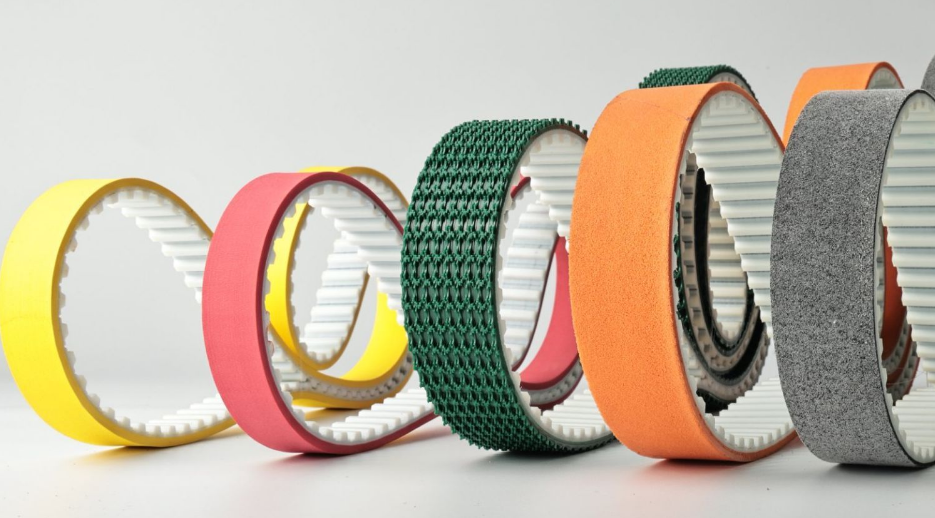
Timing belt coatings modify the belt surface that contacts a product, support rail, pulley, or guide. They can increase grip, lower friction, cushion delicate parts, improve release, resist wear, reduce noise, or protect products from marking.
A coating is not selected by material name alone. Its hardness, thickness, texture, bond, machining, temperature, chemical exposure, load, speed, pulley diameter, and base belt construction all affect performance. This guide compares common timing belt coatings and explains how to specify them for conveying and positioning applications.
Key Takeaways
- Back coatings control product contact, while tooth-side fabrics mainly reduce friction and wear.
- PU, rubber, silicone, foam, fabric, and specialty covers provide different surface behavior.
- Coating thickness and compressibility affect pulley diameter, tracking, positioning, and joint design.
- Selection must combine product friction, load, environment, base belt, fabrication, and bond strength.
What Is a Timing Belt Coating?
A timing belt coating is an additional layer applied to the belt backing, teeth, or selected surface areas. The underlying timing belt provides synchronized motion through tooth engagement, while the coating adapts contact with the conveyed product or conveyor support.
Manufacturers may call the added layer a coating, cover, facing, backing, top cover, or surface. Some covers are laminated during belt production. Others are bonded afterward with heat, adhesive, extrusion, or vulcanization. Fabric can also be integrated into the teeth during manufacturing.
Habasit groups timing belt covers into polyurethane, elastomer, PVC, polyester, foam, and specialty materials such as leather, aramid, and silicone (Habasit, HabaSYNC Timing Belt Covers). Available materials and application methods depend on the base belt family.
The coating does not carry the timing load by itself. Tensile cords in the base belt maintain pitch and transmit force. The coating adds thickness, bending resistance, mass, and surface force. Poor selection can cause bond failure, cracking, heat, product marks, or unstable tracking.
Coated belts can be truly endless, molded endless, welded endless, or open-ended. A welded timing belt has interrupted tensile cords at the splice, and a thick cover must also be joined or removed around that area. Splice and cover capacity should be specified together.
Where Can Coatings Be Applied on a Timing Belt?
Timing belt coatings can be applied to the backing, tooth side, edges, or selected zones. Each location solves a different problem. A back cover controls product contact, while tooth fabric changes sliding behavior against pulleys or support rails.
Backing Surface
The backing is the side opposite the teeth and is the most common coating location. It carries products on synchronous conveyors, feeds packaging film, grips paper, pulls cable, or cushions components. Smooth, textured, soft, hard, open-cell, and closed-cell options are available.
Tooth Surface
Polyamide fabric is often applied to the tooth surface to reduce friction, wear, and noise. It can support belts sliding on guide rails or running in demanding pulley contact. Optibelt notes that tooth-side polyamide fabric can reduce friction between a timing belt and support rail (Optibelt, Technical Manual for Polyurethane Timing Belts).
Tooth fabric is usually incorporated during production because it must follow the tooth geometry accurately. It should not change the pitch or prevent correct pulley engagement. Fabric type, treatment, and antistatic properties are product-specific.
Belt Edges and Fabric Layers
Fabric can also be applied to the backing as a low-friction or wear layer. Partial coatings and bonded pads are possible for specialized handling, but repeated stiffness changes can create local flex stress. Fabrication drawings should define every coated and uncoated zone.
What Are the Main Types of Timing Belt Coatings?
Common timing belt coatings include polyurethane, rubber, silicone, foam, polyamide fabric, PTFE-related low-friction materials, leather, aramid, and specialty high-grip surfaces. Each offers a different balance of friction, compressibility, wear, temperature, chemicals, and product release.
Polyurethane Coatings
Polyurethane covers provide abrasion resistance, cut resistance, oil resistance, and a wide range of hardnesses and textures. They are widely used on polyurethane timing belts for packaging, automation, glass, woodworking, food, and component handling.
Soft PU can improve grip and cushioning, while harder PU supports dimensional control and wear resistance. Smooth, rough, cellular, and patterned surfaces change product friction. Polyester-based and polyether-based TPU grades respond differently to moisture, heat, and chemicals.
PU coatings can be ground, milled, perforated, or fitted with profiles. TranBelt’s polyurethane conveyor belt guide explains related material and hydrolysis considerations.
Rubber and Elastomer Coatings
Rubber and elastomer covers provide grip, resilience, damping, and wear behavior for feeding, pulling, lifting, and product transport. Natural rubber, SBR, chloroprene, EPDM, NBR, and proprietary elastomers serve different environments.
Oil, ozone, heat, water, chemicals, and abrasion must be checked against the exact compound. EPDM may suit heat and ozone but not petroleum oils. NBR can improve oil resistance. A generic “rubber coating” is not a complete specification.
Silicone Coatings
Silicone covers provide high friction, release, flexibility, and heat resistance in selected applications. They are used for packaging film, food, paper, labeling, sealing, and hot product handling. Hardness and surface finish can be adjusted for grip or controlled release.
Habasit’s silicone timing belt cover data includes multiple thickness and hardness options and calculates minimum pulley diameter from both belt and cover requirements (Habasit, Silicone Timing Belt Covers). Those data apply to the listed products only.
Silicone can have lower tear and abrasion resistance than some PU covers. Sharp edges and concentrated loads require testing. See TranBelt’s silicone timing belt guide for more detail.
Foam and Sponge Coatings
Foam coatings use cellular polyurethane, rubber, silicone, or other elastomers. They compress around fragile, uneven, or variable-thickness products. Applications include glass, packaging, fruit, cartons, electronics, paper, and vacuum handling.
Open-cell foam allows airflow and can suit vacuum applications. Closed-cell foam limits liquid absorption and may provide stronger cushioning or sealing. Cell size, density, hardness, compression set, and skin surface affect performance.
Fabric and Polyamide Covers
Fabric covers reduce friction, improve wear resistance, protect teeth, and support sliding on rails. Polyamide is common on tooth surfaces and sometimes on the backing. Polyester, cotton, aramid, and coated fabrics are used in specialized contact conditions.
Low-friction backing fabric helps products accumulate or slide relative to the belt. Tooth fabric can reduce support-rail friction and noise. Fabric texture may also influence release and product marking.
PTFE and Low-Friction Coatings
PTFE-based films, fabrics, and low-friction treatments reduce adhesion and sliding resistance. They suit accumulation, guide contact, sticky products, and processes where release is more important than grip.
Low friction can also come from polyamide fabric or specially formulated polyurethane. The best option depends on load, support rail, speed, temperature, chemicals, and whether the surface contacts the product or machine.
High-Grip and Wear-Resistant Specialty Coatings
Specialty covers include leather, aramid fabric, corrugated rubber, abrasive-resistant polyurethane, high-friction elastomers, and application-specific textures. They are used when standard smooth covers cannot grip, release, protect, or survive the product.
Optibelt offers coated and mechanically processed PU timing belts for transport, food, packaging, glass, wood, linear, and medical applications (Optibelt, SPECIAL Material Handling Belts). Final suitability still requires application testing.
What Features Can Timing Belt Coatings Provide?
Timing belt coatings provide grip, release, cushioning, wear resistance, chemical resistance, noise control, and product protection. These properties interact. A soft high-grip cover can improve holding but reduce positional stiffness or increase heat.
Grip and Product Control
High-friction rubber, silicone, and soft PU help accelerate, incline, or position products. Surface texture increases mechanical contact and can let air escape beneath film or flat parts. Required friction depends on product material, contamination, load, speed, and acceleration.
Release and Low Friction
Low-friction fabric, hard PU, PTFE-related surfaces, and smooth finishes allow products to slide or release. They are useful in accumulation, sticky-product handling, and support-rail contact.
Cushioning and Product Protection
Foam, sponge, silicone, and soft elastomers absorb impact and conform around irregular products. They can reduce marks, vibration, noise, and local pressure on glass, electronics, fruit, and packaging.
Wear, Oil and Chemical Resistance
Hard PU, fabric, aramid, and selected elastomers protect the belt from abrasion, oil, chemicals, and repeated contact. Resistance must be checked at operating temperature because heat can accelerate swelling, hydrolysis, oxidation, and bond degradation.
The adhesive or lamination layer may fail before the cover material. Test the complete construction rather than comparing raw material data sheets.
Noise and Surface Protection
Soft covers and tooth-side fabrics can reduce impact and sliding noise. They also protect painted, polished, glass, or finished products from direct contact with the base belt.
Noise may originate from tooth meshing, support rails, bearings, or resonance rather than the cover. A coating can alter vibration but cannot correct poor alignment, tension, or pulley geometry.
Where Are Coated Timing Belts Used?
Coated timing belts are used in packaging, food processing, glass, woodworking, paper, printing, medical devices, electronics, cable, textiles, automation, and material handling. Synchronous teeth control belt position while the coating adapts product contact.
Packaging machines use silicone, rubber, PU, and foam covers to pull film, feed cartons, seal packages, separate products, and control spacing. Vacuum holes and machined grooves can hold flexible material during cutting, labeling, or printing.
Food applications include portioning, indexing, bakery handling, confectionery, packaging, and hot or sticky product transport. Food-contact documentation must cover the base belt, cover, bond, machining, and intended conditions.
Glass and sheet handling use soft, high-grip, nonmarking covers. Grooves, vacuum holes, or paired belts control panels through cutting, washing, inspection, and assembly. Cover wear must remain equal across parallel belts.
Automation and electronics use precision-ground covers for indexing, component positioning, and linear transport. Coating thickness tolerance, compression, static behavior, and bond uniformity affect repeatability.
Timing Belt Coating Comparison
The table gives relative guidance. Performance depends on the exact cover grade, thickness, hardness, surface, base belt, bond, load, temperature, and pulley geometry.
| Coating Type | Typical Friction | Compressibility | Wear Resistance | Common Application | Main Limitation |
|---|---|---|---|---|---|
| Polyurethane | Low to high | Low to moderate | High in many grades | Packaging, automation, glass, food | Hydrolysis and chemistry vary by grade |
| Rubber or elastomer | Moderate to high | Moderate | Compound-dependent | Feeding, pulling, incline handling | Oil, heat, and ozone limits vary |
| Silicone | High grip or release, grade-specific | Moderate | Moderate | Film, food, hot or sticky products | Tear and abrasion can limit life |
| Foam or sponge | Surface-dependent | High | Low to moderate | Fragile products, vacuum, cushioning | Compression set and larger pulley needs |
| Polyamide fabric | Low | Low | High in sliding contact | Tooth faces, rails, accumulation | Limited cushioning and grip |
| PTFE-related layer | Very low | Low | Application-specific | Sticky products and release | Bond and flex wear require review |
| Leather or aramid specialty | Application-specific | Low to moderate | Often high | Feeding, heat, abrasive products | Cost and narrow application range |
Choose from the required product behavior rather than the coating label. Friction, hardness, thickness, texture, machining, and bond must be specified together.
How Do You Select the Correct Timing Belt Coating?
Select a timing belt coating by defining the product, required friction, load, speed, positioning accuracy, pulley geometry, environment, fabrication, and expected wear. Product samples and representative trials are valuable when grip, release, marking, or compression matters.
Product Contact and Required Friction
Record product material, weight, dimensions, contact area, surface finish, temperature, and contamination. State whether the belt must grip, release, accumulate, cushion, or avoid marking.
Test startup, stopping, acceleration, incline, discharge, and worn conditions. Static and dynamic friction both matter. A cover that starts a product reliably may still create excessive sliding resistance during accumulation.
Load, Speed and Positioning Accuracy
Define belt pull, product load, acceleration, duty cycle, indexing distance, and acceptable position error. Soft coatings compress and recover, creating small changes in product height and contact timing.
Parallel belts should use matched base belts, ground cover thickness, tension, and pulley geometry. Unequal wear can tilt or rotate products. Timing accuracy still depends on tooth profile, cord elongation, pulley fit, and pretension.
Pulley Diameter and Coating Thickness
Check the minimum pulley diameter for both the base belt and added cover. Use the larger requirement. Thick, hard, or cellular coatings increase bending strain and may crack, delaminate, or heat on undersized pulleys.
Reverse bends and tensioning idlers also matter. The coating may tolerate outward bending but fail under repeated compression on a back-bend idler. TranBelt’s guide to timing belt pitch explains the underlying tooth geometry.
Temperature, Oil and Chemicals
List continuous and peak temperatures, oils, grease, water, humidity, solvents, acids, alkalis, cleaners, and ultraviolet exposure. Check cover, adhesive, base belt, fabric, and splice as one system.
For elevated heat, use TranBelt’s high temperature belt guide to separate ambient, product, peak, and belt-body temperatures. Published limits should apply to the exact coated construction.
Machining, Splicing and Bond Strength
Provide drawings for grooves, holes, pockets, profiles, coating zones, thickness tolerances, and splice location. Machining depth must preserve tensile cords and required cover bond area.
Welded belts interrupt cords at the splice and may need special coating preparation. Truly endless belts preserve continuous reinforcement but have fixed manufacturing constraints. Bond testing should represent flexing, load, chemicals, temperature, and cleaning.
Frequently Asked Questions
Can any timing belt be coated?
No. Coating compatibility depends on base material, backing preparation, belt construction, splice, temperature, and supplier process. Some covers are laminated during belt production, while others can be bonded later. Ask the belt manufacturer before modifying a finished belt.
What coating provides the most grip?
Soft silicone, rubber, and high-friction PU often provide strong grip, but the result depends on product surface, pressure, texture, contamination, temperature, and speed. Excess grip can harm release or positioning, so representative product testing is more useful than a generic friction ranking.
Does a thicker coating require larger pulleys?
Usually. Added thickness increases bending strain, especially with hard or cellular covers. Manufacturers often provide a coating thickness factor or minimum pulley recommendation. Compare that requirement with the base belt and use the larger permitted diameter.
Can timing belt coatings be machined?
Many PU, rubber, silicone, and foam covers can be ground, milled, grooved, perforated, or cut into contours. Machining must not damage cords, weaken the bond, create tear points, or violate food-contact and cleanliness requirements.
What is the difference between tooth fabric and a back coating?
Tooth fabric reduces friction and wear where teeth contact pulleys or support rails. A back coating controls product contact through grip, release, cushioning, or surface protection. Both can be used on one timing belt when the manufacturer approves the construction.
Conclusion
Timing belt coatings include PU, rubber, silicone, foam, fabric, PTFE-related, leather, aramid, and specialty surfaces. They adapt synchronized belts for grip, release, cushioning, wear, noise, and product protection.
Select the cover with the base belt, product, load, speed, positioning, pulley diameter, environment, machining, splice, and bond method in mind. A representative product trial provides a stronger basis than choosing by coating material alone.
Sources
- Habasit, HabaSYNC Timing Belt Covers, retrieved 2026-07-27.
- Habasit, Silicone Timing Belt Covers, retrieved 2026-07-27.
- Habasit, HabaSYNC Timing Belts, retrieved 2026-07-27.
- Optibelt, SPECIAL Material Handling Belts, retrieved 2026-07-27.
- Optibelt, Technical Manual for Polyurethane Timing Belts, retrieved 2026-07-27.
- Continental, Polyurethane Synchronous Belts, retrieved 2026-07-27.
- Continental, Synchromotion, retrieved 2026-07-27.
- Continental, Synchroflex Polyurethane Timing Belts, retrieved 2026-07-27.