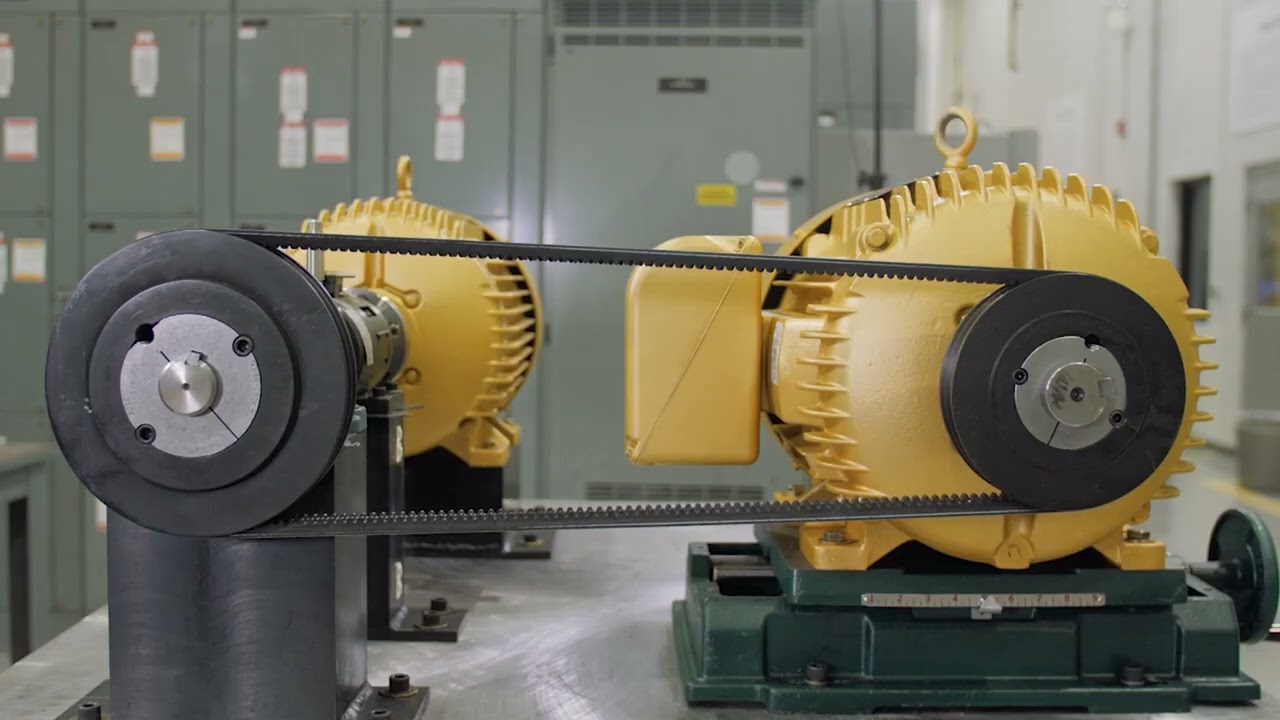
A Poly-V belt is usually the better choice for compact, high-speed drives that need a large contact area and smooth operation. A conventional V-belt remains a practical choice for general industrial equipment, especially when shock loads, simple pulley systems, easy sourcing, and low replacement costs matter more than drive width.
Both are friction belts, so neither provides the exact shaft synchronization of a timing belt. Their main difference is geometry. A Poly-V belt has many small longitudinal ribs on one wide backing. A V-belt has one larger trapezoidal section, or several individual belts run side by side.
Key Takeaways
- Choose a Poly-V belt for compact layouts, small pulleys, high speeds, and multi-pulley routing.
- Choose a V-belt for rugged general-purpose drives, straightforward maintenance, and economical replacement.
- Final selection must use calculated power, service factor, pulley diameter, wrap angle, speed, and operating conditions.
Poly-V Belt vs V-Belt: Quick Comparison
In 2026, industrial Poly-V belts are covered by five standard profiles: PH, PJ, PK, PL, and PM. The current standard defines their principal dimensions (ISO, ISO 9982:2021 Belt drives – Pulleys and V-ribbed belts for industrial applications, 2021). Classical and narrow V-belts use sections including Y, Z, A, B, C, D, E, SPZ, SPA, SPB, and SPC (ISO, ISO 4184:2025 Belt drives – Classical and narrow V-belts, 2025).
| Selection Factor | Poly-V Belt | Conventional V-Belt |
|---|---|---|
| Cross-section | Multiple small V-shaped ribs on one backing | One larger trapezoidal section per belt |
| Best fit | Compact, high-speed, serpentine, multi-pulley drives | General industrial drives with simple pulley layouts |
| Pulley diameter | Better suited to smaller pulleys | Usually needs a larger minimum pulley for the same duty |
| Drive width | High power density can reduce required width | Multiple belts may be needed for higher power |
| Flexibility | High because the belt is thin | Lower, especially with larger classical sections |
| Reverse bending | Suitable when designed for backside idlers or serpentine routing | More limited in conventional two-pulley layouts |
| Load behavior | Smooth at speed; sensitive to alignment and debris | Good general-purpose load capacity and shock tolerance |
| Replacement | One belt with the specified rib count | Single belt or matched set in multi-groove drives |
| Maintenance priority | Precise alignment, clean grooves, correct tension | Correct tension, matched belts, groove wear, alignment |
| Typical equipment | Compressors, machine tools, fitness equipment, appliances, accessory drives | Fans, pumps, conveyors, agricultural machinery, workshop equipment |
This table is a starting point, not a power rating. Manufacturer calculations remain necessary because two drives with the same motor power may need different belts when speed, pulley diameter, start frequency, or wrap angle changes.
Which Belt Transmits More Power in Limited Space?
The Poly-V belt usually wins when available drive width is limited. Its many ribs distribute load across a wide contact surface while retaining a thin, flexible cross-section. Power is calculated per rib, allowing designers to select the required rib count for a specific corrected design power (Optibelt, Technical Manual: Ribbed Belt Drives).
A conventional V-belt also gains traction from wedge action in the pulley groove. Higher power can be handled by a narrow V-belt or by adding parallel belts. However, every additional belt adds pulley grooves and face width. Multi-belt drives also need matched belts so the load is shared consistently.
The practical comparison is therefore not “one Poly-V belt versus one V-belt.” Compare the complete drive width after applying the correct service factor. A six-rib or ten-rib Poly-V belt may replace several individual V-belts in a compact drive, but only a manufacturer rating calculation can confirm the required section and rib count.
Verdict: Poly-V wins where power density and limited axial space drive the design. V-belts remain competitive when pulley width is not constrained.
Which Handles Small Pulleys and High Speed Better?
Poly-V belts generally handle small pulley diameters and high rotational speeds better because their thin cross-section bends more easily. The five PH-to-PM industrial profiles defined by ISO 9982 let designers match rib pitch and belt size to duties ranging from compact machinery to heavier industrial drives.
The benefit is especially useful when a motor drives several accessories or when the machine envelope prevents a large pulley. A Poly-V belt can also support serpentine routing, with the ribbed side driving grooved pulleys and the backing contacting suitable flat idlers. That flexibility is why related PK profiles are widely used in automotive accessory drives, although industrial and automotive applications use separate ISO standards.
V-belts can also operate at substantial belt speeds, but minimum pulley diameter becomes more restrictive as the section gets deeper. Excessive bending creates heat and internal stress. Cogged raw-edge V-belts improve flexibility, yet they still do not reproduce the very thin multi-rib geometry of a Poly-V belt.
Verdict: Poly-V wins for small pulleys, high-speed drives, and complex belt paths.
Which Provides Better Grip and Shock-Load Tolerance?
Neither belt should be selected by grip alone. Both depend on tension, groove geometry, wrap angle, friction, and pulley condition. Poly-V belts provide broad contact through multiple ribs, while conventional V-belts use deep wedge action. The better option depends on the drive’s load pattern rather than a universal friction advantage.
For smooth electric-motor loads, a correctly designed Poly-V drive can run quietly with stable power transfer. Its joined construction prevents individual ribs from turning over and eliminates the tension differences that can develop between separate belts. These traits suit compressors, machine tools, and other drives where smooth high-speed behavior matters.
Conventional V-belts remain attractive for rugged machinery with intermittent loading. They are available in classical, narrow, cogged, banded, and specialty constructions. A banded V-belt can keep several sections together when vibration or pulsating loads might make individual belts whip or turn over.
Slippage can also act as limited overload protection in either friction system. That same slippage means neither design should be used where exact angular position is required. For that requirement, compare the broader types of belts in mechanical power transmission and evaluate a synchronous belt.
Verdict: V-belts offer more rugged construction choices for severe shock and pulsation. Poly-V belts excel with smooth, distributed loading.
Which Is Easier and Cheaper to Maintain?
V-belts usually win on basic replacement simplicity and local availability. Standard sections are familiar to maintenance teams, and a single-belt drive can often be serviced without specialized procedures. The hidden complication appears when several V-belts share one drive: the complete matched set should normally be replaced together.
Replacing only one belt in a worn set can create unequal load sharing. Worn pulley grooves also let a belt bottom out instead of gripping on its sidewalls. The new belt may then run hot or carry more than its intended share.
A Poly-V drive replaces several load-carrying ribs as one component. This avoids matched-set problems, but precise pulley alignment and groove condition matter. Small ribs can be affected by damaged grooves or trapped debris. Regular inspection, tension correction, suitable guards against foreign objects, and avoiding belt wax or dressing are recommended (Optibelt, Technical Manual: Ribbed Belt Drives).
For either design, tension should follow the belt manufacturer’s method. Over-tensioning increases bearing load. Under-tensioning encourages slip, heat, noise, and premature wear. Never use belt dressing to hide a design or maintenance problem.
Verdict: A simple V-belt drive is usually cheaper and easier to service. Poly-V simplifies multi-belt replacement but demands careful alignment and clean pulleys.
Which Belt Fits Your Industrial Application?
Choose by machine duty, not by the belt already lying in the storeroom. ISO 9982:2021 covers PH, PJ, PK, PL, and PM V-ribbed profiles for general industrial applications, while ISO 4184:2025 covers classical and narrow V-belt lengths (ISO, ISO 9982:2021 Belt drives – Pulleys and V-ribbed belts for industrial applications, 2021; ISO, ISO 4184:2025 Belt drives – Classical and narrow V-belts, 2025). These standards help with dimensional compatibility, but they do not replace application engineering.
Choose a Poly-V belt when:
- The machine has limited axial space.
- The drive uses small pulley diameters.
- Belt speed is high and smooth running matters.
- One belt must route around several pulleys or idlers.
- A wide contact area is needed without several separate belts.
- Reduced vibration and compact packaging justify more precise installation.
Common applications include air compressors, machine tools, exercise equipment, commercial appliances, ventilation systems, and multi-accessory drives.
Choose a conventional V-belt when:
- The pulley layout is simple and space is available.
- The drive faces shock, vibration, dirt, or intermittent loading.
- Replacement cost and broad local availability are priorities.
- Maintenance teams already support standard V-belt sections.
- A banded or specialty V-belt construction fits the duty.
- The existing pulleys are in good condition and redesign offers little benefit.
Typical applications include pumps, fans, conveyors, agricultural equipment, crushers, workshop machinery, and general motor drives.
Consider a different belt when:
Choose a timing belt when the driven shaft must remain synchronized with the driver. Teeth eliminate normal frictional slip and support indexing or positioning. A transmission belt versus timing belt comparison can help separate friction-drive requirements from positive-drive requirements before requesting a quote.
How Should You Size the Belt Drive?
No 2026 belt selection is complete without a drive calculation. Optibelt’s ribbed-belt method, for example, corrects transmitted power with factors for service, arc of contact, and belt length before calculating the required number of ribs. Its worked PL-profile example uses a 13 kW motor, a 1.6 service factor, and a calculated design power of 20.8 kW.
Provide these values to the belt supplier:
- Motor power and driver speed
- Driven speed or required speed ratio
- Driver and driven pulley diameters
- Shaft center distance and available adjustment
- Available pulley face width
- Daily operating hours and start frequency
- Load type, including shock or pulsation
- Ambient temperature and contamination
- Idler positions and reverse-bending requirements
- Required electrical conductivity or antistatic certification
The last point matters in hazardous environments. The current standard covers electrical conductivity characteristics and test methods for antistatic endless V-ribbed belts, joined V-belts, and single V-belts (ISO, ISO 1813:2025 Belt drives – Electrical conductivity of antistatic belts, 2025). A product should not be assumed antistatic simply because it is rubber or black.
Frequently Asked Questions
Is a Poly-V belt the same as a serpentine belt?
A serpentine belt is a Poly-V or V-ribbed belt used in a multi-pulley path, most commonly for automotive accessory drives. Poly-V describes the belt geometry. Serpentine describes the routing. Industrial V-ribbed profiles are standardized by ISO 9982:2021, while automotive PK accessory-drive dimensions are addressed separately by ISO 9981:2020.
Can a Poly-V belt replace a V-belt directly?
Usually not. The belt and pulley groove profiles are different, so conversion requires compatible Poly-V pulleys and a new drive calculation. Check shaft diameters, speed ratio, center distance, alignment, guards, bearing loads, and tensioning range before redesigning the drive.
Does a Poly-V belt slip less than a V-belt?
Not automatically. Both are friction drives and can slip if tension, wrap angle, pulley condition, or load is wrong. Poly-V belts provide broad multi-rib contact, while V-belts use wedge action. Correct sizing and installation have more influence than the label alone.
Can both belt types be antistatic?
Yes, when the specific belt construction is tested and rated for that purpose. ISO 1813:2025 includes antistatic endless V-ribbed belts, joined V-belts, and single V-belts. Request the manufacturer’s conductivity declaration for fire-risk or explosive-atmosphere applications.
Which belt lasts longer?
There is no universal winner. Life depends on correct sizing, pulley diameter, alignment, tension, temperature, contamination, starts, and load variation. A well-designed V-belt can outlast a poorly aligned Poly-V belt, and the reverse is equally possible.
Final Verdict: Poly-V Belt or V-Belt?
Choose a Poly-V belt when compact packaging, small pulleys, high speed, smooth running, or multi-pulley routing are the main design constraints. Choose a V-belt when the drive is straightforward, rugged service matters, and low-cost replacement is the priority.
For a new machine, compare both options with the same corrected design power and service conditions. For a replacement, do not change belt type until pulley geometry, shaft load, speed ratio, guarding, and tensioning have been checked. TranBelt can review your drive data and recommend the appropriate profile, rib count, belt section, and pulley arrangement.
Sources
- ISO, ISO 9982:2021 Belt drives – Pulleys and V-ribbed belts for industrial applications, 2021, retrieved 2026-07-13.
- ISO, ISO 4184:2025 Belt drives – Classical and narrow V-belts, 2025, retrieved 2026-07-13.
- ISO, ISO 1813:2025 Belt drives – Electrical conductivity of antistatic belts, 2025, retrieved 2026-07-13.
- Optibelt, Technical Manual: Ribbed Belt Drives, retrieved 2026-07-13.