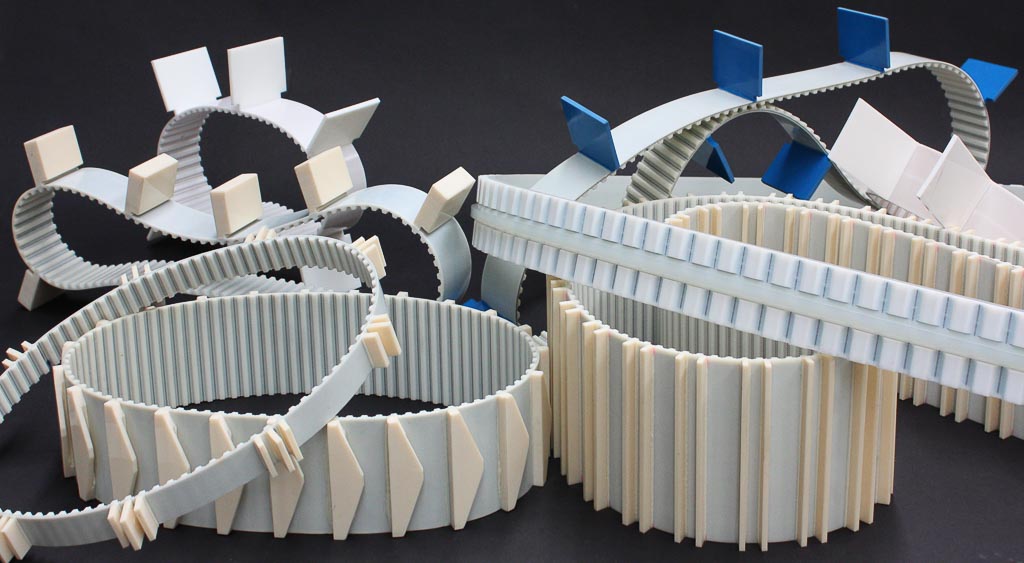
Industrial drive belts transmit rotary power between shafts. They run around pulleys and use friction, tooth engagement, or both to transfer torque from a motor or engine to a pump, fan, compressor, conveyor, spindle, or other machine component.
The main types include V-belts, timing belts, ribbed belts, flat belts, variable-speed belts, round belts, and link belts. Each type behaves differently under load and requires compatible pulleys. This guide compares their operating principles, industrial uses, materials, benefits, limitations, and key selection factors.
Key Takeaways
- V-belts are versatile friction-drive belts for general industrial power transmission.
- Timing belts provide synchronous motion without normal operating slip.
- Ribbed and flat belts suit compact, flexible, or high-speed drive arrangements.
- Power, speed, pulley geometry, load, environment, and synchronization determine belt selection.
What Is an Industrial Drive Belt?
An industrial drive belt is a flexible machine element that transfers power between rotating pulleys. The driving pulley receives torque from a motor, engine, or gearbox. Belt tension creates force in the belt, and the driven pulley delivers that force to another shaft. Speed ratio depends primarily on the effective pulley diameters.
Friction-drive belts rely on contact and tension. V-belts wedge into pulley grooves, while flat and ribbed belts develop traction across their contact surfaces. Some slip can occur during overload or poor tensioning. Controlled slip may protect equipment, but unwanted slip generates heat, wears surfaces, and changes the driven speed.
Positive-drive belts use teeth that engage matching pulley grooves. Timing or synchronous belts maintain a defined relationship between shafts and normally operate without slip. They support indexing, positioning, and accurate speed ratios. However, tooth profile, pitch, width, pulley geometry, and alignment must match exactly.
A belt drive also includes pulleys, shafts, bearings, guards, tensioning arrangements, and sometimes idlers. The belt cannot be selected in isolation. Continental’s industrial power transmission portfolio separates V-belts, synchronous belts, multi-V belts, and flat belts because each category uses a distinct drive principle and application range (Continental Industry, Power Transmission Solutions).
What Are the Main Types of Drive Belts?
The main industrial drive belt types are classical and narrow V-belts, cogged V-belts, banded V-belts, timing belts, Poly-V belts, flat belts, variable-speed belts, round belts, and link belts. The correct type depends on whether the drive prioritizes compact power, synchronization, speed, shock resistance, or field installation.
Classical and Narrow V-Belts
V-belts have a trapezoidal cross-section that wedges into a matching pulley groove. The wedge action increases friction without requiring the very high installation tension associated with some flat-belt drives. Classical sections serve traditional equipment, while narrow or wedge sections transmit more power within a smaller cross-section under appropriate conditions.
Wrapped V-belts have a fabric cover around the belt body. The cover protects the rubber and produces controlled surface behavior. V-belts are common on fans, pumps, compressors, agricultural equipment, machine tools, and conveyors. They tolerate some misalignment and cushion shock better than many rigid drive systems, but incorrect tension causes slip or bearing overload.
Cogged or Raw-Edge V-Belts
Raw-edge V-belts expose the molded sidewalls directly to the pulley grooves. Molded cogs across the belt’s inner surface improve bending flexibility and reduce heat generation. The cogs do not engage pulley teeth; the belt remains a friction-drive V-belt.
Greater flexibility allows selected cogged belts to operate on smaller pulleys than comparable wrapped constructions. The exposed sidewalls can provide strong grip, making these belts useful for compact, higher-speed, or demanding drives. Oil, temperature, pulley finish, and backside idlers still require a belt approved for those conditions.
Banded V-Belts
Banded V-belts join several V-belt ribs beneath a common top band. The band maintains rib spacing and reduces individual belt turnover, whip, or separation. These belts suit pulsating loads, vertical shafts, long spans, and drives exposed to shock or strong vibration.
The complete band operates as one unit and requires matching multi-groove pulleys. Gates describes its PowerBand construction as a solid unit that controls belt-to-belt distance and resists sideways bending in difficult drives (Gates Corporation, Quad-Power 4 PowerBand). Banded belts are wider and less tolerant of pulley-groove inconsistency than individual belts.
Timing or Synchronous Belts
Timing belts have transverse teeth that engage a toothed pulley. Their positive drive maintains speed ratio and shaft timing without normal slip. Rubber timing belts commonly use fiberglass or aramid tensile cords. Polyurethane versions often use steel or aramid cords for low stretch, wear resistance, and precise motion.
Applications include packaging machines, conveyors, textile equipment, robotics, printing, machine tools, and process synchronization. Timing belts need no lubrication and can provide high efficiency. Their limitations include tooth-profile incompatibility, sensitivity to debris, demanding alignment, and limited overload slip. A severe jam may damage teeth or overload other components.
Poly-V or Ribbed Belts
Poly-V belts, also called ribbed or multi-rib belts, combine a thin flexible backing with many longitudinal V-shaped ribs. The ribs run in matching pulley grooves. Load spreads across the belt width, and the thin construction bends around relatively small pulleys at high speed.
Ribbed belts suit serpentine layouts, compact drives, appliances, machine tools, rollers, fans, and material-handling equipment. Megadyne describes PV-ribbed belts as friction-drive products that combine characteristics of flat and V-belts (Megadyne, Material Handling Drive Belts). Their wide pulley alignment and tension must be controlled to prevent edge wear or rib tracking problems.
Flat Belts
Flat belts have a thin rectangular cross-section and run on flat or crowned pulleys. They can operate efficiently at high speed and bend around small diameters when construction permits. Traditional leather or fabric belts remain in some machinery, while modern flat belts use synthetic traction layers and strong tensile members.
These belts serve textile machines, printing equipment, grinders, live rollers, lifts, and precision machinery. They can provide smooth, quiet motion with low vibration. Flat belts need adequate wrap and carefully controlled tracking. They may require greater tension than wedging V-belts and can move laterally when pulleys or shafts are misaligned.
Variable-Speed Belts
Variable-speed belts are wide V-shaped belts designed for pulley systems whose effective diameter changes. Movable pulley sheaves force the belt to ride higher or lower in the groove, changing the transmission ratio continuously. The belt must withstand strong side pressure, repeated flexing, and changing contact geometry.
They are used in agricultural machinery, machine tools, industrial variators, scooters, and equipment requiring mechanical speed adjustment. Width, side angle, length, and pulley range must match the variable-speed drive. A conventional V-belt generally cannot replace a purpose-designed variable-speed belt.
Round and Link Belts
Round belts use a circular cross-section and transmit light power by friction. Thermoplastic polyurethane round belting can often be cut and heat-welded to length, making it useful for roller conveyors, packaging equipment, line shafts, and small machines. Groove shape, pretension, diameter, hardness, and joint quality affect capacity.
Link belts consist of removable links assembled to the required length. They can be installed around captive shafts without dismantling the drive and adjusted after initial seating. Link V-belts are practical for maintenance or unusual lengths, but their speed, power, vibration, pulley, and environmental limits must be checked before replacing an endless belt.
Industrial Drive Belt Type Comparison
| Belt Type | Drive Principle | Best Use | Main Advantage | Main Limitation |
|---|---|---|---|---|
| Classical or narrow V-belt | Friction and wedge action | General industrial drives | Versatile and shock-absorbing | Slip and tension affect speed |
| Cogged V-belt | Friction and wedge action | Compact or small-pulley drives | High flexibility and reduced heat | Exposed sidewalls need suitable conditions |
| Banded V-belt | Friction with joined ribs | Shock, vibration, and long spans | Resists belt whip and turnover | Requires consistent multi-groove pulleys |
| Timing belt | Positive tooth engagement | Synchronized and positioning drives | No normal slip | Exact tooth and pulley compatibility |
| Poly-V belt | Friction through multiple ribs | High-speed compact drives | Flexible with broad load distribution | Sensitive to alignment across belt width |
| Flat belt | Surface friction | High-speed smooth transmission | Efficient, quiet, and flexible | Tracking and wrap require control |
| Variable-speed belt | Adjustable V-pulley friction | Continuously variable drives | Mechanical ratio adjustment | Specialized pulley and belt geometry |
| Round or link belt | Friction | Light conveying or field replacement | Custom lengths and easy installation | Lower or product-specific power capacity |
Which Materials and Reinforcements Are Used?
Drive belt construction combines an elastomer or polymer body with tensile members and surface fabrics. The body forms the belt geometry, supports teeth or ribs, cushions engagement, and protects the reinforcement. Tensile cords carry the working tension and control elongation. Covers and tooth facings influence wear, friction, and noise.
Rubber compounds include chloroprene, EPDM, and other engineered elastomers. Formulation determines heat, oil, ozone, flexibility, and fatigue performance. A belt described simply as “rubber” may not suit high temperature or oil exposure. The manufacturer’s declared range must govern selection.
Polyurethane is common in precision timing, round, V, and flat belts. Thermoplastic polyurethane can be extruded, machined, coated, and welded. It offers useful abrasion resistance and clean operation, but hydrolysis, temperature, chemical exposure, and food contact depend on the grade. Polyurethane does not automatically mean food-safe or oil-proof.
Polyester cords are widely used in V-belts because they combine strength, fatigue resistance, and dimensional stability. Fiberglass cords are common in rubber timing belts and provide low elongation with flexibility. Aramid offers high strength at low weight and can improve stiffness or shock capacity, although clamp, pulley, and fatigue requirements differ.
| Material or Reinforcement | Main Function | Typical Belt Types | Important Limitation |
|---|---|---|---|
| Rubber compound | Flexible belt body | V, timing, ribbed, variable-speed | Performance varies by formulation |
| Polyurethane | Wear-resistant body or surface | Timing, round, V, and flat | Heat and hydrolysis limits vary |
| Polyester cord | Carries belt tension | V and ribbed belts | Stretch and heat ratings are product-specific |
| Fiberglass cord | Controls pitch and elongation | Rubber timing belts | Can be damaged by improper crimping |
| Aramid cord | High strength at low weight | Timing and high-performance V-belts | Different tension and fatigue behavior |
| Steel cord | High stiffness and low elongation | Polyurethane timing and flat belts | Corrosion and pulley-diameter constraints |
Where Are Industrial Drive Belts Used?
Pumps, fans, and blowers commonly use single or multiple V-belts because they offer flexible speed ratios, shock damping, and practical component replacement. Narrow V-belts provide compact power transmission. Banded constructions help where pulsation, long spans, vertical shafts, or vibration could destabilize individual belts.
Packaging and automation equipment relies heavily on timing belts. They synchronize feeders, cutters, sealers, labeling equipment, robotic axes, and indexed conveyors. Polyurethane timing belts can accept profiles, backings, holes, and machining for product transport. Drive accuracy still depends on pulley runout, backlash, tension, frame rigidity, and controls.
Conveyors and material-handling systems use drive belts in several roles. V-belts transmit motor power to shafts, round belts drive live rollers, Poly-V belts connect motorized and carrying rollers, and timing belts position products. Belt selection depends on whether slip, accumulation, or exact synchronization is required.
Agricultural machinery uses wrapped, cogged, banded, variable-speed, and ribbed belts under dust, shock, weather, and changing load. Continental’s AGRIDUR range, for example, includes wrapped, banded, variable-speed, and Poly-V constructions for different agricultural drives (Continental Industry, AGRIDUR Drive Belts).
How Do You Select the Correct Drive Belt?
Start with power, torque, and speed. Record motor power, driver speed, driven speed, operating hours, and desired speed ratio. Peak torque may occur during startup or a jam rather than steady operation. Apply the belt manufacturer’s service factors for shock, duty cycle, prime mover, and driven equipment.
Define pulley geometry and space. Provide shaft diameters, center distance, available width, existing pulley profile, groove count, pitch, and minimum pulley diameter. Small pulleys increase belt bending stress. Timing pulleys must match tooth pitch and profile, while V-pulley groove angle and condition affect wedging and load sharing.
Decide whether the drive may slip. V, ribbed, flat, and round belts transmit power by friction and can slip under overload. Timing belts maintain phase and speed ratio, making them appropriate for synchronization. A positive drive can transfer a jam more directly into shafts, bearings, teeth, or driven equipment.
Account for load behavior. Frequent starts, reversing, shock, pulsation, braking, vertical shafts, and long center distances can change the preferred construction. Banded V-belts control lateral instability, while high-stiffness synchronous belts improve positioning. Variable-speed pulleys need a belt designed for repeated movement through their operating range.
Specify the environment. Temperature, oil mist, chemicals, moisture, dust, ozone, UV exposure, static requirements, and washdown affect compounds and reinforcement. Gates notes that static conductivity applies only to identified belt products and standards, rather than every belt of a general type (Gates Corporation, Industrial Power Transmission Preventive Maintenance Manual).
Consider installation and replacement. Endless belts may require shaft or guard removal. Link or weldable thermoplastic belts simplify installation around captive shafts but have application-specific ratings. In a multiple-belt drive, use a matched set approved for the pulley system rather than mixing brands, constructions, or service histories.
Frequently Asked Questions
What is the most common industrial drive belt?
The V-belt is among the most common industrial drive belts because it offers practical power capacity, compact pulleys, shock damping, and broad availability. Timing, ribbed, and flat belts may be better when the application requires synchronization, small pulley diameters, high speed, or smoother motion.
What is the difference between a V-belt and a timing belt?
A V-belt wedges into smooth pulley grooves and transfers torque by friction. It can slip under overload. A timing belt uses teeth that engage matching pulley grooves, maintaining a defined speed and position relationship. The timing belt requires exact pitch and tooth-profile compatibility.
Can one drive belt type replace another?
Not directly in most cases. Different belt types require different pulley profiles, tension, widths, diameters, and load calculations. A conversion may be possible after engineering review, but installing a different cross-section on the existing pulleys can reduce capacity, damage the belt, or create unsafe shaft loads.
Which drive belt is best for high torque?
High-performance narrow V-belts, banded V-belts, and synchronous belts can all transmit high torque when correctly sized. The best choice depends on speed, pulley diameter, shock, allowable slip, space, and environment. Use manufacturer ratings rather than selecting only by belt width or material.
Conclusion
Industrial drive belts include V, cogged, banded, timing, ribbed, flat, variable-speed, round, and link constructions. Each uses a different combination of friction, wedging, flexibility, or tooth engagement to move power between shafts.
Select from the actual drive requirements: power, speed ratio, pulley geometry, center distance, shock, synchronization, environment, and installation access. Then verify the complete drive with manufacturer data. The right belt is not simply the strongest option; it is the construction that matches the machine and its operating conditions.
Sources
- Continental Industry, Power Transmission Solutions, retrieved 2026-07-21.
- Continental Industry, AGRIDUR Drive Belts, retrieved 2026-07-21.
- Gates Corporation, Quad-Power 4 PowerBand, retrieved 2026-07-21.
- Gates Corporation, Industrial Power Transmission Preventive Maintenance Manual, retrieved 2026-07-21.
- Megadyne, Material Handling Drive Belts, retrieved 2026-07-21.
- Megadyne, PV-Belts Technical Handbook, retrieved 2026-07-21.
- Optibelt, Industrial Drive Belt Product Range, retrieved 2026-07-21.