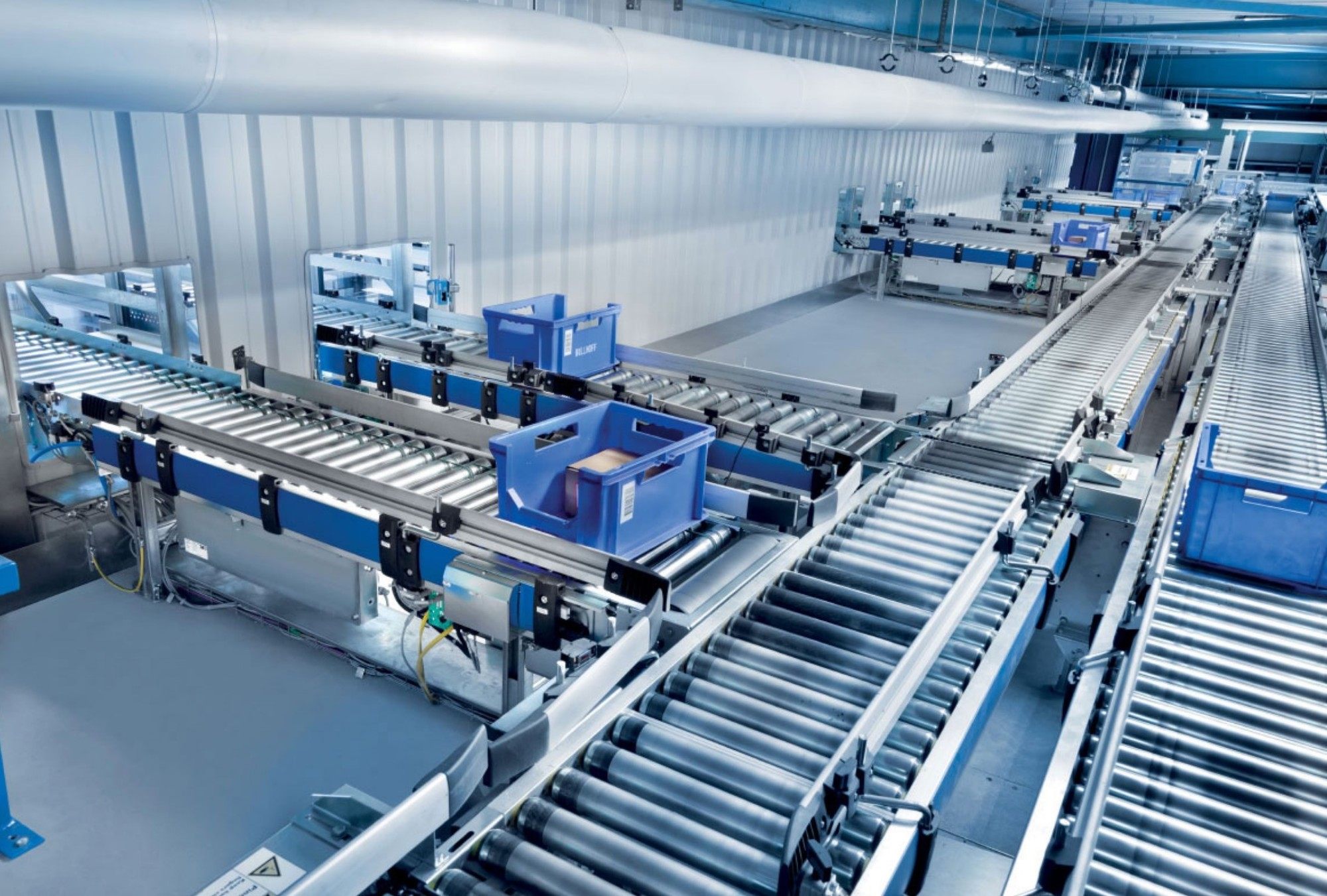
A conveyor system is a mechanical arrangement that moves products, components, packages, or bulk material between defined locations. It may use a belt, rollers, chains, slats, screws, buckets, air, or suspended carriers as the conveying medium. Powered and gravity-driven systems are both common.
Conveyors connect production steps, reduce repeated manual handling, and maintain a controlled flow through factories, warehouses, processing plants, and distribution centers. However, each conveyor type suits a different product and route. This guide explains how conveyor systems work, compares the main types, and outlines their uses, benefits, limitations, and selection factors.
Key Takeaways
- A conveyor system moves unit loads or bulk material along a controlled path.
- Belt, roller, chain, slat, modular, screw, bucket, pneumatic, and overhead systems serve different needs.
- Product properties, route, throughput, environment, and accumulation method determine the best type.
- A complete system includes the conveying medium, structure, drive, controls, transfers, and safety devices.
What Is a Conveyor System?
A conveyor system is material-handling equipment designed to transport a load along a repeatable path. The load may be a single carton, pallet, bottle, machine component, food product, parcel, powder, grain, or mineral. The path can be horizontal, inclined, declined, vertical, curved, overhead, or divided among several routes.
The term describes the complete working system rather than only its moving surface. A belt conveyor, for example, includes the belt, pulleys, rollers or bed, drive, tensioning arrangement, frame, supports, guarding, and controls. Larger systems also contain merges, transfers, stops, sensors, elevators, sorters, and interfaces with other machinery.
MHI groups powered conveyor equipment into categories that include belt, chain, platform, slat, and accumulation conveyors. Its conveyor and sortation guidance also distinguishes conveying from routing technologies that actively direct loads toward different destinations (MHI, Introduction to Conveyor and Sortation Systems).
How Does a Conveyor System Work?
A conveyor system works by supporting a load on or within a moving medium and applying controlled force along a defined route. An electric motor commonly turns a drive pulley, sprocket, roller, or screw. Gravity conveyors are different: they use a slope or manual force rather than a powered drive.
The conveying medium makes direct or indirect contact with the load. A flat belt supports packages across a continuous surface. Rollers create separated contact points. Chains may contact a pallet directly or carry rigid slats. A screw rotates inside a trough, while a pneumatic system moves particles through piping with airflow.
The structure holds the working components in alignment. Frames, beds, rails, idlers, wear strips, supports, and guides control the route and maintain product stability. A poorly supported conveyor may sag, vibrate, track incorrectly, or create an unstable transfer even when the drive has enough power.
Powered systems require a way to transmit force and manage tension. Belt conveyors use drive and return pulleys, with a take-up maintaining suitable belt tension. Chain conveyors use sprockets and may include adjustable take-ups. Modular belts use positive sprocket engagement, reducing dependence on friction at the drive pulley.
Sensors and controls coordinate product flow. Photoelectric sensors detect presence, encoders measure movement, and variable-frequency drives adjust motor speed. Programmable controllers can sequence stops, merges, gates, transfers, and downstream machines. Zone accumulation systems start and stop selected sections so products can queue without excessive contact pressure.
Transfers connect conveyors or process equipment. Their design must account for product length, base shape, orientation, speed, and height. Small or unstable products can catch in gaps, while heavy loads may require powered transfer modules. A complete conveyor system succeeds only when its loading, conveying, accumulation, and discharge functions work together.
What Are the Main Types of Conveyor Systems?
The main conveyor types are belt, roller, chain and slat, modular belt, screw, bucket, pneumatic or vacuum, and overhead systems. The best choice depends on whether the load is a unit product or bulk material, how it must travel, and what processing conditions surround the route.
Belt Conveyors
Belt conveyors move products or bulk material on a continuous flexible belt. The belt travels over rollers or a sliding bed and wraps around drive and return pulleys. Flat belts suit cartons, parcels, components, packaged food, and general production. Troughed belts carry loose bulk material over longer distances.
Belts provide broad product support and can handle items with uneven bases that would be unstable on rollers. Surface materials, covers, cleats, sidewalls, and tracking guides can adapt the conveyor to inclines, food contact, high grip, or product release. Sharp edges, hot material, oil, and chemical exposure require a compatible belt construction.
Roller Conveyors
Roller conveyors support products on a series of parallel rollers. Gravity versions rely on slope or manual pushing. Powered systems use belts, chains, line shafts, or motors inside individual rollers. They are common for cartons, totes, pallets, drums, and other products with firm, reasonably flat bottoms.
Rollers create low rolling resistance and allow practical accumulation, inspection, and transfer arrangements. Gaps between rollers can accept pop-up belts, chains, stops, or scales. The product must span enough rollers to remain stable, so very small, flexible, or irregular items often need another conveying surface.
Chain and Slat Conveyors
Chain conveyors use one or more driven chains to carry pallets, racks, drums, or heavy unit loads. Slat conveyors attach rigid metal, wood, or plastic plates to chains, creating a continuous or closely spaced supporting surface. They suit assembly work, hot components, bottles, fixtures, and loads that need positive drive.
Steel slats withstand concentrated loads and difficult industrial conditions. Plastic flat-top chains support containers through curves and complex packaging routes. Chain and slat systems can be durable, but joints, sprockets, wear strips, lubrication, and product pinch points require attention. The structure is generally heavier than a comparable light-duty belt conveyor.
Modular Belt Conveyors
Modular belt conveyors use interlocking plastic modules connected by hinge rods. Sprockets engage the underside of the belt, creating positive drive. The modular surface can include open areas, flush grids, raised ribs, friction inserts, sidewalls, flights, or special transfer edges.
Replaceable modules and corrosion-resistant plastics make these conveyors useful in food, beverage, packaging, cooling, drainage, and washdown applications. Curving and straight-running designs are available. Open hinges can trap residue in some processes, while product loading, temperature, chemicals, and sanitation methods must match the selected resin and belt geometry.
Screw Conveyors
Screw conveyors rotate a helical flight inside a trough or tube to push bulk material forward. They handle powders, granules, grains, sludge, chips, and other flowable materials over relatively controlled distances. Inclined and vertical arrangements are possible, although capacity and power requirements change with angle.
The enclosed form can contain dust and protect material, but the rotating screw also shears and mixes the product. Fragile particles may degrade, sticky material may build up, and abrasive material can wear flights and troughs. Proper filling level, screw diameter, pitch, speed, bearings, and clearances are essential.
Bucket Conveyors
Bucket conveyors or elevators carry bulk material in containers attached to a belt or chain. Vertical bucket elevators lift grain, powders, pellets, and other bulk products between floors or processing levels. Pivoting bucket conveyors can also move delicate products horizontally and vertically with controlled discharge.
Buckets make steep elevation possible in a compact footprint. However, feeding and discharge must suit the material. Dust, carryback, impact, contamination, and trapped product can create problems. Bucket attachment, belt or chain rating, speed, casing, explosion protection, and access depend on the product and industry.
Pneumatic and Vacuum Conveyors
Pneumatic conveyors move powders, granules, or small particles through piping using an air stream. Pressure systems push material, while vacuum systems draw it toward a receiver. Separate vacuum belt conveyors use suction through a perforated moving belt to hold sheets or light products against its surface.
Piping can route around obstacles and contain dusty materials, but airflow must be designed around particle size, density, abrasiveness, moisture, and required rate. Excessive velocity can damage products and pipes. Filters, separators, blowers, seals, and dust controls add energy demand and maintenance requirements.
Overhead Conveyors
Overhead conveyors suspend products, carriers, or hooks from an elevated track. Chain-driven systems move continuously or in controlled stages, while power-and-free conveyors let individual carriers stop and accumulate. They are used for painting, finishing, garment handling, assembly, storage, and movement through ovens or process booths.
Using overhead space keeps floors open and exposes several sides of a product. Tradeoffs include support steel, elevated maintenance, carrier swing, clearance requirements, and complex routing. Products must be secured against falling.
| Conveyor Type | Best Suited For | Main Advantage | Common Limitation |
|---|---|---|---|
| Belt | Packages and broad product support | Versatile continuous surface | Belt damage and tracking requirements |
| Roller | Cartons, totes, and pallets | Efficient accumulation and transfers | Requires a suitable product base |
| Chain or slat | Heavy loads, fixtures, and containers | Positive drive and durable support | Weight, noise, and joint wear |
| Modular belt | Food, washdown, and packaged goods | Replaceable modules and sprocket drive | Hinges may require careful cleaning |
| Screw | Powders and granules | Enclosed, compact bulk handling | Can shear or damage material |
| Bucket | Vertical bulk transport | Large elevation in limited floor space | Feeding, carryback, and cleaning |
| Pneumatic | Powders through complex routes | Enclosed piping with flexible routing | Energy use and particle degradation |
| Overhead | Finishing and assembly | Uses space above the floor | Complex support and elevated access |
Where Are Conveyor Systems Used?
Conveyor systems are used wherever material must move repeatedly between operations. Manufacturing plants connect machining, assembly, inspection, cooling, and packing stations with belts, rollers, chains, or pallets. Controlled flow reduces forklift traffic around production equipment and lets automatic machines exchange products at repeatable positions.
Warehouses and distribution centers use roller and belt conveyors for receiving, order fulfillment, carton transport, sortation, shipping, and returns. Barcode readers, scales, dimensioning equipment, print-and-apply systems, and diverters can operate while products remain within the conveyor network. Accumulation zones buffer temporary differences between upstream and downstream rates.
Food and beverage plants use sanitary belts, modular belts, flat-top chains, screws, bucket elevators, and pneumatic systems. Applications range from raw ingredients to unpackaged food, bottles, cans, cartons, and cases. Material compliance alone isn’t enough; conveyor geometry must also support cleaning access, drainage, contamination control, and the plant’s sanitation procedure.
Packaging and bottling lines depend on stable movement between filling, capping, labeling, inspection, wrapping, and case-packing equipment. Plastic chain conveyors provide curves and accumulation for containers, while timing or indexing conveyors position products for machine operations. Smooth transfers are critical because tall bottles and small packages can become unstable.
Mining, agriculture, recycling, and bulk processing use troughed belt conveyors, screws, drag chains, and bucket elevators. These systems move ore, grain, aggregates, waste, chips, powders, and other loose materials. Dust, impact, abrasion, spillage, fire risk, and environmental exposure strongly influence the enclosure, belt, liner, drive, and cleaning arrangement.
What Are the Benefits and Limitations of Conveyor Systems?
Conveyor systems provide repeatable movement at a controlled rate. They can reduce manual carrying, coordinate production steps, improve throughput, and create predictable product spacing. Automation also makes it possible to inspect, weigh, scan, sort, cool, dry, or process products while they travel.
Mechanical transport can improve ergonomics when it removes frequent lifting or long carries. OSHA advises using conveyors or carts for horizontal movement where possible and notes that conveyor working height affects posture (Occupational Safety and Health Administration, Ergonomics Program Management Guidelines for Meatpacking Plants). The actual benefit depends on suitable loading and unloading heights.
Conveyors use space efficiently through curves, inclines, spirals, and overhead routes. Their fixed infrastructure is less flexible than mobile equipment, however. Frames, utilities, guarding, controls, and custom transfers add initial cost, while one jam or sensor failure can affect several connected processes.
Conveyors introduce moving parts, nip points, falling-object risks, and stored energy. OSHA requires appropriate guarding, accessible emergency stops, warnings before powered startup, and lockout/tagout during applicable service work in covered operations (Occupational Safety and Health Administration, 1917.48 Conveyors). Local regulations and the machine’s risk assessment govern the final measures.
How Do You Choose the Right Conveyor System?
Begin with the product or material. Record dimensions, minimum and maximum weight, base shape, center of gravity, temperature, moisture, abrasiveness, fragility, and whether products may leak or shed debris. For bulk materials, add density, particle size, flow behavior, dust characteristics, and allowable degradation.
Define the required flow. State average and peak throughput, conveyor speed, spacing, orientation, accumulation time, and whether products may contact one another. Indexing, merging, sorting, inspection, or robotic pickup requires more precise control than continuous transport between two open areas.
Match the environment to the construction. Washdown may require stainless steel, drainage, compatible plastics, sealed components, and cleanable geometry. Abrasive bulk material needs wear protection. High or low temperatures affect belts, lubricants, bearings, motors, and sensors. Hazardous dust or classified areas require specialist electrical and explosion-risk review.
Finally, compare complete proposals covering load, duty cycle, drive, controls, guarding, installation, documentation, spare parts, and warranty. Ask suppliers to state exclusions and performance assumptions. Match documented operating conditions to a rated conveyor rather than choosing by appearance alone.
Frequently Asked Questions
What is the most common conveyor system?
Belt and roller conveyors are among the most widely used for packaged products and general material handling. Belt conveyors support a broad range of product shapes, while roller conveyors suit cartons, totes, and pallets with stable bottoms. The most common type varies by industry and material.
What is the difference between a conveyor belt and a conveyor system?
A conveyor belt is the flexible moving surface within one type of conveyor. A conveyor system includes the belt or other conveying medium plus the frame, drive, supports, pulleys or sprockets, controls, transfers, and safety devices. Many conveyor systems don’t use belts at all.
Can one conveyor system handle different products?
Yes, provided every product falls within the system’s rated size, weight, stability, speed, and environmental limits. Adjustable guides, variable speed, sensor recipes, and controlled zones can increase flexibility. Very different products may still need separate lanes, carriers, tooling, or conveying surfaces.
How much weight can a conveyor system carry?
Capacity ranges from a few grams on a miniature conveyor to many tonnes on heavy industrial systems. There is no universal rating. Engineers must consider load per unit length, individual product weight, concentrated loads, impact, conveyor width, support spacing, incline, speed, drive capacity, and duty cycle.
Conclusion
A conveyor system moves products or bulk material along a controlled route using belts, rollers, chains, slats, screws, buckets, airflow, or overhead carriers. Each type offers a different balance of support, routing, capacity, cleanliness, and control.
Choose the system from the material, throughput, route, environment, transfers, and required accumulation. Then evaluate the complete equipment scope, not only the conveying surface. A well-matched conveyor can improve flow and reduce repeated handling, while a poor match simply moves bottlenecks to another part of the operation.
Sources
- MHI, Introduction to Conveyor and Sortation Systems, retrieved 2026-07-21.
- MHI, Conveyor and Sortation Systems Handbook, retrieved 2026-07-21.
- Occupational Safety and Health Administration, 1917.48 Conveyors, retrieved 2026-07-21.
- Occupational Safety and Health Administration, Ergonomics Program Management Guidelines for Meatpacking Plants, retrieved 2026-07-21.
- Occupational Safety and Health Administration, Materials Handling and Storage, retrieved 2026-07-21.