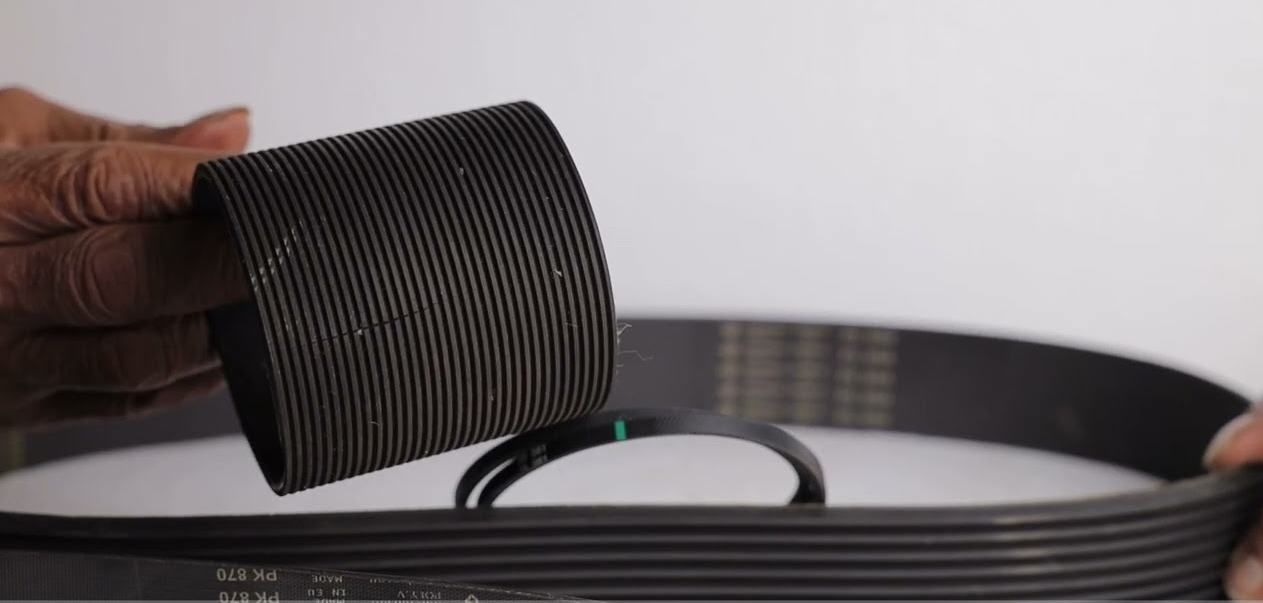
You pop the hood of any modern car and there it’s — a single black belt snaking around the alternator, AC compressor, power steering pump, and water pump. That belt is a Poly-V belt, and it’s one of the most clever pieces of engineering in your engine bay.
In this guide, you will learn exactly what a Poly-V belt is, how it compares to traditional V-belts and serpentine belts, the common section profiles from J to M, its key advantages over older belt designs, and how to choose the right one for your application.
1. What Is a Poly-V Belt and How Does It Work?
A Poly-V belt is a power transmission belt with multiple V-shaped ribs running lengthwise on the inner surface. It’s also called a multi-ribbed belt or, in automotive contexts, a serpentine belt. The ribs engage with matching grooves in the pulley for positive grip without slipping.
The belt wraps around pulleys and the rib flanks contact the pulley groove walls to transmit torque. Unlike a single V-belt that relies on wedge action, Poly-V belts distribute the load across multiple ribs. This design allows higher power transmission in a narrower width. With over 98% efficiency, Poly-V belts are one of the most efficient power transmission options available today.
2. Poly-V Belt vs V-Belt vs Serpentine Belt: What Is the Difference?
These three belt types are often confused. All serve power transmission, but they differ in design, application, and performance. Understanding the differences helps you choose the right belt for the job.
| Aspect | Poly-V Belt | V-Belt | Serpentine Belt |
|---|---|---|---|
| Rib design | Multiple small V-ribs on flat back | Single large V-cross-section | Same as Poly-V (automotive name) |
| Power transmission | High, distributed across ribs | Moderate, wedge friction | High, same as Poly-V |
| Space requirement | Compact, narrow width | Wider per belt | Compact, single belt system |
| Typical applications | Automotive, industrial, appliances | Older machinery, simple drives | Modern car accessory drives |
| Efficiency | Over 98% | 85-95% | Over 98% |
The key takeaway: a Poly-V belt combines the grip of multiple V-ribs with the compactness of a flat belt. For modern compact engine compartments and tight industrial machinery, Poly-V is the go-to choice. V-belts remain the workhorse for older designs, and serpentine is simply the automotive name for a K-section Poly-V belt.
3. Common Poly-V Belt Section Profiles
Poly-V belts are categorized by standardized section profiles. Five main profiles cover from light-duty to heavy industrial applications.
| Profile | Rib Pitch | Rib Height | Min Pulley Diameter | Typical Applications |
|---|---|---|---|---|
| J | 2.34 mm | ~2.0 mm | 9 mm | Fitness equipment, small appliances |
| K | 3.56 mm | ~2.6 mm | 20 mm | Automotive serpentine drives |
| L | 4.70 mm | ~3.5 mm | 50 mm | HVAC, industrial fans |
| M | 9.40 mm | ~5.9 mm | 100 mm | Heavy industrial machinery |
| H | Intermediate | Between J and K | Specialized | Special applications |
J Section
What it is
The J section is the smallest Poly-V profile with a rib pitch of 2.34 mm and rib height of approximately 2.0 mm. Designed for light-duty applications where space is extremely limited.
It is the go-to profile for consumer-grade and compact equipment. The small rib pitch allows the belt to bend around tight pulley diameters as small as 9 mm, which larger profiles cannot handle.
Key features
High flexibility allows operation on pulleys as small as 9 mm diameter. Rib count typically ranges from 3 to 20. Low noise operation compared to larger profiles.
The narrow width means multiple J-section belts can fit into compact drive layouts. Despite its small size, the belt can transmit sufficient power for light machinery when properly tensioned.
Best for
Best for fitness equipment, small appliances, office machines, garden tools, and light power tools where compact design matters.
It is not suitable for high-torque industrial applications. If your drive requires more power, stepping up to a K or L section is the better choice.
K Section
What it is
The K section has a rib pitch of 3.56 mm with a rib height of about 2.6 mm. This is the most common automotive Poly-V profile — often called the serpentine belt profile in the automotive industry.
It is the standard for modern engine accessory drives found in nearly every passenger vehicle produced since the 1980s. The rib design balances flexibility with the ability to transmit moderate to high torque loads.
Key features
The rib count ranges from 3 to 28, with typical automotive applications using 4 to 7 ribs. It offers excellent flexibility for serpentine routing around multiple pulleys and idlers.
The K section’s higher power capacity compared to J allows it to drive multiple accessories from a single belt. It can handle the constant load fluctuations of an automotive engine without excessive wear.
Best for
Best for automotive accessory drives (alternator, AC compressor, power steering pump, water pump) and light to medium industrial machinery.
It also works well for lawn and garden equipment, small industrial gearboxes, and belt-driven compressor units. For heavy industrial loads, step up to L or M section.
L Section
What it is
The L section has a rib pitch of 4.70 mm with a rib height of approximately 3.5 mm. Designed for medium-duty applications requiring higher power transmission than J or K sections.
The larger rib profile provides more contact surface area per rib, which translates to higher torque capacity. L section belts are commonly found in commercial and industrial equipment where reliability matters.
Key features
Rib counts typically range from 4 to 20. Can handle higher tension loads and wider power ranges. Suitable for operation on pulley diameters starting around 50 mm.
The belt’s thicker cross-section provides better heat dissipation under continuous load. It also resists stretching better than smaller profiles under sustained high tension.
Best for
Best for HVAC equipment, industrial fans and blowers, agricultural machinery, and medium-duty industrial drives.
These applications typically run for extended periods, and the L section’s durability makes it a reliable choice. For heavy industrial environments requiring maximum power, the M section is more appropriate.
M Section
What it is
The M section has a rib pitch of 9.40 mm with a rib height of about 5.9 mm. This is the largest standard Poly-V profile, designed for heavy-duty high-power applications.
It is the powerhouse of Poly-V belt profiles, capable of transmitting substantial power through its large rib cross-section and high rib counts. M section belts are built for the most demanding industrial drives.
Key features
Rib counts range from 4 to 50, with some industrial belts using high rib counts for extreme loads. Requires larger pulley diameters starting at 100 mm.
The large rib design creates significant surface contact for maximum friction grip. M section belts can replace multiple traditional V-belts in heavy industrial applications, reducing drive width and maintenance requirements.
Best for
Best for heavy industrial machinery, mining equipment, large HVAC systems, and high-power engine applications where maximum power transmission is needed.
It is also the preferred profile for large agricultural combines, industrial compressors, and heavy-duty conveyor systems. For anything below 50 hp, an L section may be more cost-effective.
4. Advantages of Poly-V Belts Over Traditional V-Belts
The main advantage is power density — a single Poly-V belt can replace multiple V-belts in the same drive, saving space and reducing maintenance. Power is distributed across multiple ribs, so if one rib is damaged, the belt can still function temporarily. According to drive system manufacturers, Poly-V belts achieve over 98% efficiency compared to 85-95% for traditional V-belts, according to drive system manufacturer data.
Additional advantages include flexibility for serpentine routing around multiple pulleys and idlers, quieter operation, reduced vibration, and longer service life with proper maintenance. The thinner cross-section also means less heat buildup during operation compared to thick V-belts. That combination is why Poly-V belts have become the standard. Efficiency, compactness, reliability — modern design demands all three. When one belt does the job of several with less space and higher efficiency, the choice is clear.
5. Common Applications of Poly-V Belts
Automotive is the largest application. Modern cars use a single Poly-V serpentine belt to drive the alternator, AC compressor, power steering pump, and water pump from the crankshaft. The belt handles both driving and driven pulleys with a single ribbed surface, and sometimes uses the flat backside for idler pulleys. According to the International Organization of Motor Vehicle Manufacturers (OICA), over 73 million vehicles were produced globally in 2024 — nearly all of them use a Poly-V belt for their accessory drive system. That is millions of belts across every major automotive market.
Industrial applications are equally important. HVAC systems use Poly-V belts for fans and compressors, fitness equipment uses J section belts for treadmills and exercise bikes, and agricultural equipment uses K and L sections for harvesters and balers. Household appliances like washing machines and dryers also use Poly-V drives for their compact, quiet operation.
6. How to Choose the Right Poly-V Belt
To choose the right Poly-V belt, evaluate four factors: section profile, rib count, belt length, and material. Getting these right ensures proper fit, maximum power transmission, and long service life. A Gates Corporation study found that improper belt selection is a leading cause of premature drive failure in industrial applications.
Identify the Section Profile
The section profile (J, K, L, M, or H) must match the pulley grooves. Using a K-section belt on J-section pulleys causes poor engagement and rapid wear. Check the pulley manufacturer specifications or measure the groove pitch with a gauge. Hutchinson H profile is an intermediate size between J and K for specialized applications.
Count the Ribs
Count the number of grooves on the pulley to determine the required rib count. Common K-section automotive belts use 4 to 7 ribs. Industrial L and M section belts can use 10 to 50 ribs. A belt with too few ribs will overload and slip — too many and it may not seat properly in the pulley.
Measure the Belt Length
Belt length is measured along the outside circumference or effective pitch line, depending on the manufacturer. The length must match the drive center distance with proper tension allowance. Poly-V belts are available in standard lengths, or custom lengths from manufacturers. Always check the installation manual for tension specifications.
Consider the Belt Material
Standard Poly-V belts use neoprene rubber with polyester or Kevlar reinforcement for general applications. EPDM rubber offers better heat and ozone resistance for high-temperature automotive environments. For industrial applications with exposure to oil or chemicals, polyurethane belts provide superior chemical resistance.
7. How Tranbelt Helps You Source Industrial Belts from China
Finding the right Poly-V belt supplier isn’t always straightforward. You need someone who understands section profiles, rib counts, and material requirements, and can deliver belts that match your specifications. That’s where we step in.
- We supply Poly-V belts in J, K, L, and M sections with rib counts to match your application
- We work with manufacturers experienced in neoprene, EPDM, and polyurethane belt production
- We help match belt dimensions, profiles, and materials to your specific drive requirements
- We handle export logistics so you can focus on your production line
- We offer bulk pricing for automotive suppliers, industrial distributors, and OEMs
If you’re looking for reliable industrial belts from China, we can help. Tell us what your drive needs, and we will find the right Poly-V belt solution.
8. Frequently Asked Questions
1) What is the difference between a Poly-V belt and a timing belt?
A Poly-V belt has multiple V-shaped ribs that transmit power through friction with pulley grooves. A timing belt has square teeth that lock into pulley sprockets for positive engagement. Poly-V belts can slip under overload as a safety feature; timing belts can’t slip at all because they must maintain exact engine timing.
2) Is a Poly-V belt the same as a serpentine belt?
Yes — a serpentine belt is simply the automotive name for a Poly-V belt. The word “serpentine” describes the winding path the belt takes around multiple pulleys. The belt itself is typically a K-section Poly-V belt with 4 to 7 ribs. Every modern car uses a serpentine Poly-V belt for its accessory drive.
3) How long does a Poly-V belt last?
A Poly-V belt typically lasts 60,000 to 100,000 miles (5 to 7 years) in automotive applications, or 5,000 to 15,000 operating hours in industrial use. Lifespan depends heavily on operating conditions — high temperatures, chemical exposure, misalignment, and improper tension all shorten belt life. Regular inspection helps catch wear before it causes failure.
4) What is the HS code for Poly-V belts?
Poly-V belts are classified under HS code 4010.35 — endless transmission belts of trapezoidal cross-section made of vulcanized rubber. The specific subheading may vary depending on belt width and whether the belt is reinforced with textile or metal.
5) Can a Poly-V belt replace multiple V-belts?
Yes — a single Poly-V belt can replace up to 15 individual V-belts in many applications, saving space and reducing maintenance. The multiple ribs provide the same contact surface area as several V-belts combined. However, the pulleys must be compatible — the grooves must match the Poly-V section profile. Retrofitting may require pulley replacement.
9. Conclusion
Poly-V belts are one of those parts you don’t think about until they fail. But they have quietly transformed how power is transmitted in cars and factories. Their compact design, high efficiency, and versatility make them the preferred choice for everything from your car’s engine to heavy industrial machinery.
Start by identifying your section profile and rib count. Choose the right belt material for your operating environment. And when it’s time to buy, work with a supplier who knows the difference between a J section and an M section — it makes all the difference in keeping your equipment running reliably.